
90-Day Conversion Plan for Tasting Events for Luxury Brands
The single most effective tasting event for a brand treats tasting as an experience first, not a sampling exercise: a curated guest list, trained hosts, and a sequenced sensory program that matches the brand’s story. Three priorities come first: control the guest list before anything else, train your hosts as ambassadors rather than servers, and sequence the tasting so each pour or bite builds on the last. Experienced event producers have found this order rarely fails.
TL;DR:
Curate a guest list that aligns precisely with the event’s objective, whether for consumer trial, VIP bonding, or retail buyer engagement.
Use a tasting sequence that builds flavors intentionally, either from light to intense or through a brand-themed narrative, with palate resets.
Staff should be trained ambassadors who understand the brand story and have clear scripts, with staffing ratios kept within one host per 15-20 guests.
Operations must include detailed vendor SLAs, permits early planning, and a chain of command to ensure smooth execution and contingency handling.
Focus on sensory details like sound, scent, and texture, which significantly enhance recall and media reach, especially when integrated cohesively with the brand story.
Table of Contents
Eight Essential Tactics For Planning A Tasting Event For Brands
A tasting event for brands succeeds or fails long before the first guest arrives. The following sequence reflects how top-tier activations get built, in the order decisions actually need to happen.
Define the objective and the guest persona. Are you chasing consumer trial, buyer conversion, or VIP relationship building? Each answer changes everything downstream, from venue size to sample volume.
Choose a format and venue that match that objective. A micro-event of 40 to 80 guests suits relationship building; a pop-up suits consumer trial; an in-store activation suits retail visibility.
Build the tasting sequence with intention. Move from lighter to more intense flavors, or structure the progression around a narrative, with palate resets between each stage.
Staff and train your ambassadors. Every host should know the brand story, the tasting notes, and how to redirect a guest’s attention without sounding rehearsed.
Map the guest flow and run-of-show. Entry, staging, tasting stations, and exit all need a timed script, especially when RSVP counts are tight and controlled.
Capture engagement data on-site. Digital intake at check-in, sampling mechanics that log preferences, and a light incentive for completing a short survey.
Clear the regulatory groundwork early. Permits, alcohol licensing, liability insurance, and transport logistics all take longer than teams expect.
Sequence your marketing before and after. Pre-event outreach builds anticipation; post-event follow-up is where most brands leave value on the table.
Venue and format decisions deserve particular care. A private preview or micro-event built around intimacy consistently outperforms large public activations for recall and purchase intent among discerning guests, according to industry guidance on luxury brand activation. That is not an argument against scale. It is an argument for matching scale to the guest you actually want in the room.
Pro Tip: Cap your guest list before you book the venue, not after. A room built for 200 that holds 60 curated guests reads as generous. A room built for 60 that gets crammed with 150 reads as chaos, no matter how good the pours are.
Menu design deserves its own planning session, and staffing ratios deserve a document, not a verbal briefing. Both get their own treatment further down. What matters here is sequence: objective, format, tasting design, staffing, flow, data capture, permits, marketing. Skip a step and the gaps show up as friction on the day of the event, usually right as your most important guest walks in.
Operations Checklist: Staffing, Vendor SLAs, and On-Site Protocols
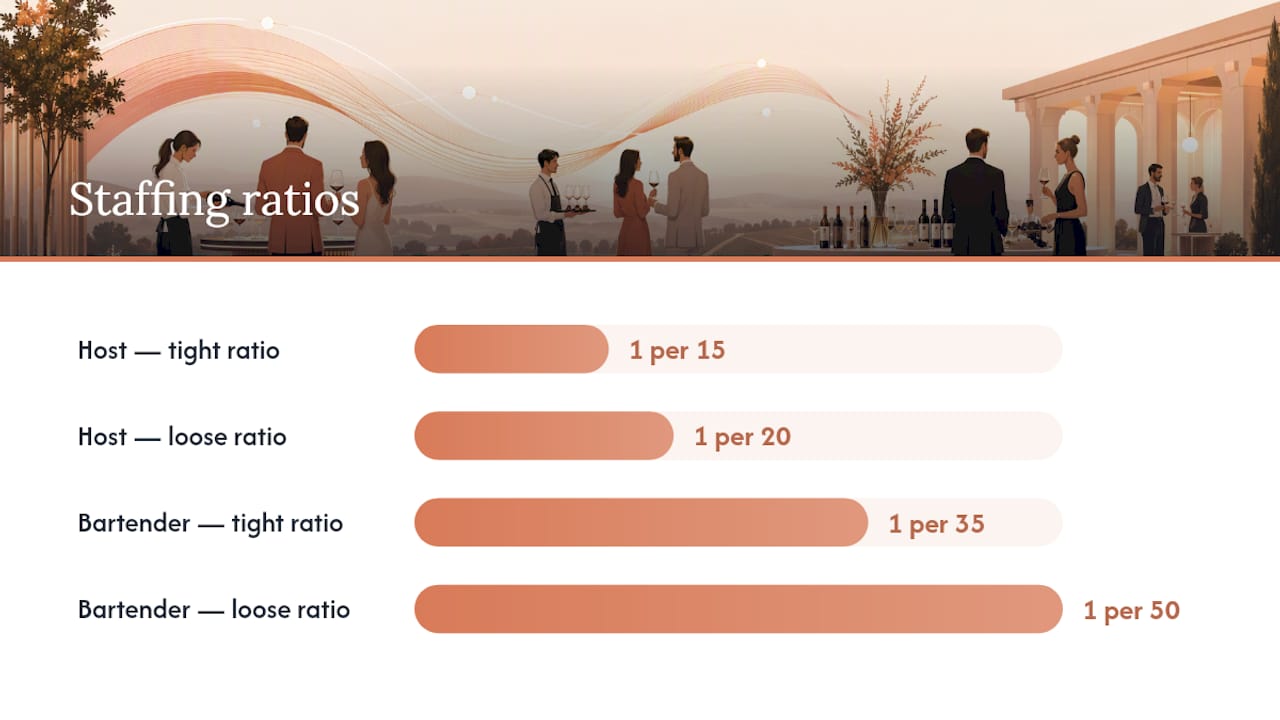
Staffing ratios make or break the guest experience. For a seated or standing tasting, one trained host per 15 to 20 guests keeps service attentive without crowding conversation, and one bartender per 35 to 50 guests keeps pours consistent under pressure.
A one-page ambassador brief should include:
Three core brand facts the host can recite without notes
A sample script for introducing the tasting sequence
Two upsell or relationship cues (repeat visits, private tastings, loyalty programs)
Vendor SLAs need specifics: arrival windows in writing, refrigeration and equipment confirmed 48 hours out, and a named waste management plan. Every event needs a documented chain of command for contingencies. Experiential activations for luxury brands often run with sizable investment behind them, and that spend only pays off when the operations underneath it hold.
Designing The Tasting Menu And Sensory Environment
Sequencing shapes everything a guest remembers. Two approaches work best: a low-to-high intensity progression, or a narrative arc that mirrors the brand’s own story chapter by chapter.
Keep portions small enough for four to six tastings without palate fatigue
Build in a neutral reset (water, plain bread, citrus) between each pour or bite
Map scent, sound, and texture to brand identity rather than treating them as décor
Confirm dietary accommodations and accessibility needs before finalizing the tasting menu
Immersive activations that connect sight, sound, scent, and taste coherently tend to generate outsized recall and media reach compared with straightforward sampling. The sensory layer is not garnish. It is where the brand story actually lands.
Running A Trade-Floor-Lite Tasting To Win Retail Distribution
A buyer-focused tasting event for brands looks different from a consumer activation, and it demands more discipline, not less.
Curate the invitation list around category buyers, not general attendees, and write the invitation as a pitch, not an announcement.
Restructure the run-of-show around spec sheets, a short founder Q&A, and time for a direct conversation about logistics and pricing.
Capture buyer data on the spot and send tailored proposals within 24 to 72 hours, while the tasting is still fresh.
Track the right KPIs: verified buyer attendance, lead-to-order conversion, and how fast orders move once a proposal lands.
Curated, buyer-focused tastings convert at a noticeably higher rate than chaotic trade-show booths, largely because the guest list stays tight and the follow-up stays disciplined.
Measuring ROI: The 90-Day Conversion Framework
Two categories of KPIs matter here: operational (RSVP show rate, sample-to-guest ratio, dwell time) and commercial (leads generated, orders placed, retail placements secured).
A workable cadence looks like this:
24 hours after: thank-you outreach and a recap sent to every qualified lead
7 to 14 days after: a tailored follow-up tied to whatever the guest expressed interest in
30 to 90 days after: a check-in tied to order velocity or repeat engagement
Report value in terms stakeholders recognize: sample-to-order ratios, confirmed retail placements, and earned media reach. Experiential spend earns its keep when it produces measurable follow-through, not just a good night.
Bonnie Rae’s Approach To Luxury Activations
The gap between a memorable tasting and a forgettable one rarely comes down to budget. It comes down to whether every sensory detail, from the glassware to the music cue, was chosen on purpose.
Full-service event producers often serve ultra-high-net-worth individuals, professional athletes, corporate executives, and cultural icons, spanning venue scouting, catering, florals, bar and sommelier programs, and vetted staffing.
Top-tier activations typically need a 6 to 12 month planning window, not weeks
Micro-event scale, often under 100 guests, tends to outperform larger formats for recall
Every sensory choice gets mapped back to the brand’s identity before it earns a place in the room
Budgeting And Cost Management For A Brand Tasting Event
Budget conversations should start with the objective, not the venue. A consumer-trial pop-up and a VIP relationship dinner draw from entirely different cost structures, even at similar guest counts.
Four categories consistently absorb the largest share of spend: venue and rentals, staffing and training, food and beverage (including waste built into portion planning), and the sensory design elements that carry the brand story, whether that is custom scent diffusion, a live artisan, or bespoke tableware.
Build in a contingency line of 10 to 15% for last-minute vendor changes, weather-related venue shifts, or guest count adjustments. Luxury clients rarely tolerate visible cost-cutting, so trim scale before you trim quality. A 40-guest event with impeccable staffing and sourcing will outperform a 100-guest event where the ambassadors are undertrained and the pours run short.
Track cost per guest against your objective, not against a flat industry benchmark. A buyer-conversion event justifies a higher spend per head than a broad consumer sampling, because the revenue attached to a single retail placement can dwarf the entire event budget. Get vendor quotes in writing early, since transportation and logistics for VIP guests often get priced last and budgeted worst, even though arrival experience sets the tone before the first pour happens.
Review your budget against actual attendance and engagement data after the event, not just against the invoice total. That comparison is what turns one good tasting into a repeatable playbook.
What Makes A Tasting Memorable For Luxury Guests
The tastings I remember most were never the ones with the biggest budgets. They were the ones where every detail, down to the glass a guest held, felt considered. An invitation-only preview, a curated tasting kit sent ahead of a virtual event, a single scent that lingered after the last course. That is where brand storytelling actually happens. If you want to see how that thinking translates into full event design, Bonnie Rae’s guest experience framework walks through the details.
— Bonnie Rae
Where To Go Deeper On Tasting Event Strategy
For readers who want to go beyond the checklist, these sources offer sharper detail on format, sensory design, and buyer conversion:
Experiential marketing ROI for luxury brands
2026 luxury brand activation ideas
Bring Your Brand Tasting To Life With Bonnie Rae
The difference between hiring a caterer and commissioning a full sensory experience is the comprehensive building of the entire activation: venue scouting, staffing, bar and sommelier programs, florals, and sensory details that make a tasting feel unmistakably yours.
If your last activation felt like a sampling table instead of a brand moment, that’s usually a staffing and sequencing problem, not a product problem. Teams built for exactly the checklist above include trained ambassadors, tight run-of-show, and sensory design mapped to the brand from the first pour. Whether you’re planning a VIP relationship dinner or a buyer-focused tasting for retail distribution, the production details are the part clients rarely have bandwidth to manage in-house. Visit Bonnie Rae to start a conversation about your next activation and get a proposal built around your guest list, your objective, and your timeline.
Sources
Recommended
Comments