
Luxury Event Menus: Turn Allergen Safety Into a Hospitality Signal
Collect structured dietary information from guests at least three weeks out, require every vendor to hand over written allergen protocols and ingredient lists, and build a small, clearly labeled set of flavor-first dishes cleared for the most common allergens. That single sequence, grounded in FDA guidance, FARECheck training standards, and the way Bonnie Rae runs kitchens for private and corporate clients, is what separates a genuinely safe event from one that merely looks accommodating.
TL;DR:
Collect guest dietary information at least three weeks before the event to allow for ingredient testing, menu adjustments, and proper vendor coordination.
Require written confirmation from caterers that they have reviewed allergen information and adhere to strict labeling and kitchen protocols.
Implement dedicated prep spaces and strict sequencing of dish preparation to prevent cross-contact and verify ingredient labels upon ingredient receipt.
Use a hybrid menu approach for smaller events with few flagged guests or opt for a fully allergen-free menu for larger, inclusivity-focused occasions.
Include detailed allergen handling procedures, ingredient disclosures, and explicit accountability clauses in catering contracts to ensure safety and response readiness.
Table of Contents
What Should Be on Your Allergen-Friendly Event Menu Checklist?
An allergen-friendly event menu isn’t a single decision. It’s a sequence of small, deliberate steps that start weeks before the first guest arrives and end with someone physically checking plates as they leave the kitchen.
Six to three weeks out:
Build dietary questions into your registration or RSVP form, using structured checkboxes for the nine major allergens plus an open text field for less common triggers like sesame or shellfish sensitivities.
Send that data to your caterer immediately, and require written confirmation that they’ve reviewed it against their standard menu.
Lock ingredient disclosure and labeling commitments into the catering contract, not a side email.
Request a tasting for any substituted dishes. A dairy-free sauce or gluten-free bread that hasn’t been tested on a real palate is a gamble at a five-star event.
Decide early whether you want a full top-nine-free menu across the board or a hybrid approach with special plated meals for guests who flagged restrictions.
Two weeks out:
Finalize service style around that decision. Buffets complicate cross-contact control; plated service with a dedicated allergen station gives you more command over what touches what.
Build in buffer meals, roughly 5 to 10% above your guest count, for last-minute dietary disclosures that inevitably surface at check-in.
Day of:
Confirm epinephrine availability on-site and a written emergency response plan with venue security or medical staff.
Assign one person, typically a banquet captain or expediter, whose sole job is tracking every allergen-restricted plate from kitchen to guest.
Pro Tip: Give your on-site allergen liaison a physical copy of the guest list with dietary flags, not just a digital file. Kitchens lose signal fast during service, and a laminated card survives spilled sauce better than a phone screen.
What Foods Must Be Disclosed Under FDA Allergen Guidance?
Nine foods carry legal weight in American food labeling: milk, eggs, fish, crustacean shellfish, tree nuts, wheat, peanuts, soybeans, and sesame. These are the FDA’s major food allergens, and the agency’s Edition 5 guidance, finalized in January 2025, sharpened how milk, egg, and tree-nut sources get interpreted on packaged goods.
That distinction matters for event planning because most caterers work with a mix of house-made dishes and packaged components, sauces, stocks, garnishes, that carry their own labels.
A “Contains” statement on a packaged ingredient must list every major allergen present, and per FALCPA and the FASTER Act, any voluntary allergen claim a vendor makes must be truthful and verifiable, not marketing shorthand.
Highly refined oils derived from major allergens (like refined peanut oil) are generally exempt from labeling requirements, which means “peanut-free” claims need a second look at what oil the kitchen actually uses.
Incidental additives, carryover ingredients in shared equipment, fall into a gray zone that written kitchen protocols, not packaging alone, need to address.
The takeaway for a planner: packaging law is your floor, not your ceiling. A compliant label tells you what’s legally required to appear. It doesn’t tell you whether the fryer used for your gluten-free canapés also cooked breaded shrimp an hour earlier.
How Do You Prevent Cross-Contact in an Event Kitchen?
Cross-contact, not cross-contamination, is the term that matters here, and it’s the difference between a trace amount and a full allergen exposure. FARECheck’s program guidance is direct about this: trace amounts trigger severe reactions in sensitive guests, and the events that succeed are the ones that build safety into kitchen design from the start, not the ones that scramble to fix it during service.
What that looks like in practice:
Dedicated prep space and separate cookware for allergen-free dishes whenever the kitchen layout allows it.
Where dedicated space isn’t possible, strict sequencing: allergen-free dishes prepped first, on sanitized surfaces, before any allergen-containing ingredient enters the workflow.
A receiving check on every packaged ingredient that arrives, verifying the label against what the recipe assumes, since suppliers change formulations without always alerting kitchens.
Documented standard operating procedures for allergen handling, reviewed by every cook on the line, not just the executive chef.
Staff training through a recognized program like FARECheck or an equivalent food-safety certification, with proof of completion kept on file.
Day-of plating that’s visually distinct, separate garnish tools, a different plate rim color, or a flagged ticket, so nothing gets mixed up under service pressure.
An expeditor whose only job during peak service is confirming special plates match their tickets before they leave the pass.
Pro Tip: Ask your caterer to walk you through their actual cross-contact protocol before you sign, not just their allergen policy. A policy is a paragraph. A protocol tells you exactly which cutting board, which fryer, and which staff member is accountable.
Can Allergen-Friendly Food Still Feel High-End?
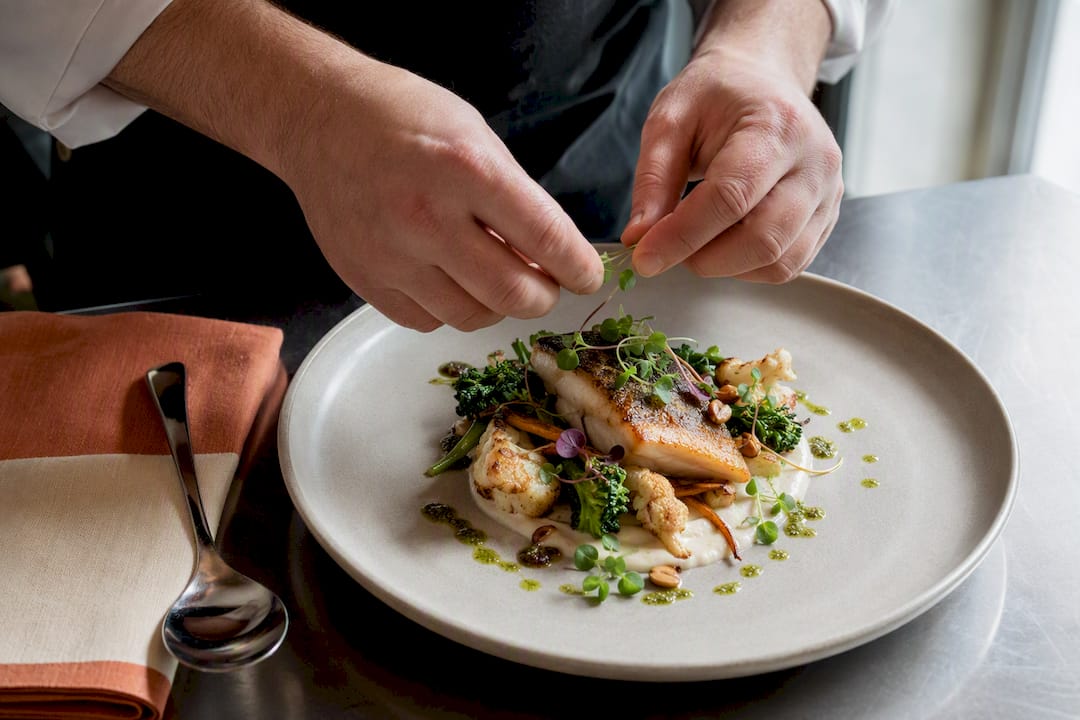
Yes, and the substitution technique matters more than the exclusion itself. A nut-free canapé loses nothing when you swap toasted pepitas or crisped chickpeas for the crunch a candied pecan would have given. Dairy-free sauces built on cashew cream, aquafaba, or a well-reduced vegetable stock hold body and richness that a thin oat-milk substitute can’t match. Gluten-free plating works best with starches that were built for texture from the start, think risotto made with cauliflower rice or a properly toasted polenta, rather than a gluten-free bread standing in for something it was never designed to replace.
Three menu structures cover most high-end events:
Reception canapés (nut-free): a rotating station of seared scallop on cucumber, beet tartare with herbed goat cheese, and a chilled pea soup shooter, all built without a single tree nut or peanut derivative in sight.
Plated three-course dinner (dairy-free option): a citrus-cured fish starter, a protein course finished with an olive-oil emulsion instead of butter, and a fruit-forward dessert that skips cream entirely.
Dessert course (egg-free or nut-free): a dark chocolate ganache tart using a nut-free crust, or a fruit-based panna cotta stabilized with agar instead of gelatin and cream.
The bigger design decision is whether to build one top-nine-free menu for the entire event or run a hybrid model with special plates for flagged guests. A fully allergen-free menu, as industry reporting on food allergy inclusivity notes, takes more lead time and tighter vendor coordination, and it removes the awkwardness of a guest eating something visibly different from the table. A hybrid model is faster to execute and often better suited to complex, multi-allergen guest lists, but it demands airtight tracking so the right plate reaches the right person. For events with fewer than a handful of flagged guests, hybrid usually wins on speed. For large-scale galas or brand activations where inclusivity is part of the story you’re telling, a single unified menu tends to land better with guests.
What Should Go in Your Catering Contract and BEO?
Contracts protect you only if they’re specific. Vague language like “we accommodate dietary needs” gives you nothing to enforce if something goes wrong.
Require full ingredient disclosure for every dish and packaged component, in writing, attached as a contract exhibit rather than a verbal assurance.
Include a clause requiring documented allergen SOPs and proof of current staff training.
Add a remedy clause specifying what happens if a substitution or labeling error occurs, replacement protocol, notification timeline, and accountability.
On the banquet event order itself, list the full ingredient set for each special plate, name the assigned expeditor, and note the plating sequence so kitchen staff can’t lose track under pressure.
A reliable timeline: collect final dietary information at the three-week mark, confirm the finished menu and any substitutions 7 to 10 days out, print final labels 72 hours before the event, and run a day-of verification checklist where the head chef or banquet captain initials each special plate ticket before it leaves the kitchen.
Why Allergen Safety Is a Hospitality Signal, Not a Checklist Item
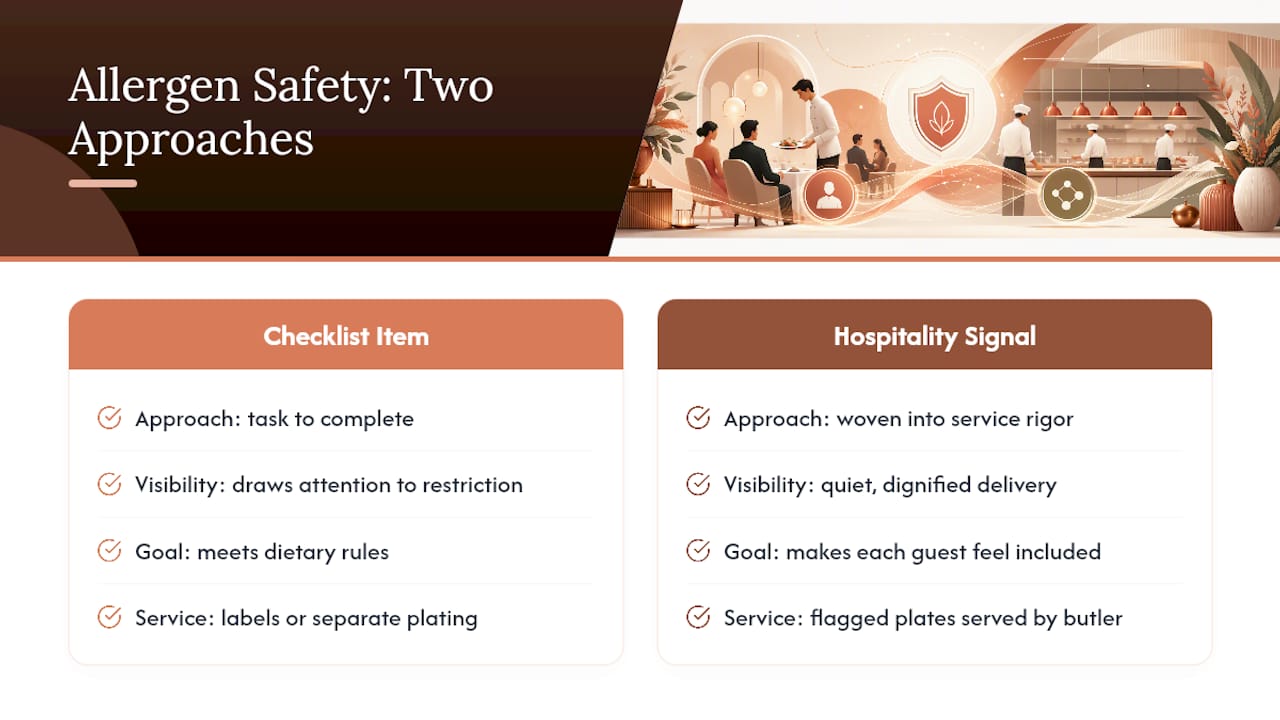
The events that stay with people aren’t the ones with the most elaborate menu. They’re the ones where every guest, regardless of what they can or can’t eat, felt like the evening was built with them in mind. Allergen strategy should be woven into the same rigor applied to butler service and athlete nutrition planning, where discretion and precision are the whole point.
Our anti-inflammatory event menu work has shown that removing common allergens doesn’t require flattening flavor, and pairing that with butler service for flagged plates gives a quiet, dignified way to confirm the right dish reaches the right guest without ever drawing attention to why. Allergen safety, done well, becomes part of the story the evening tells.
— Bonnie Rae
Let Bonnie Rae Handle the Allergen Details for You
Coordinating dietary registration, vendor SOPs, ingredient audits, and day-of plate tracking across a full guest list is a job most hosts don’t have the bandwidth to run themselves, and getting it wrong at a high-profile event carries real reputational risk. Bonnie Rae’s full event production service builds allergen management into catering coordination, staffing, and butler service from the first planning call, so you’re never piecing together vendor promises on your own.
Whether planning an intimate private dinner or a large-scale brand activation, the event production team can design the menu, vet kitchen protocols, and staff the service so every guest, restricted diet or not, gets the same caliber of experience. If you’re ready to talk through your guest list and dietary requirements, reach out through Bonnierae for a bespoke proposal.
Where to Verify Allergen Guidance and Training
For primary sourcing, review the FDA’s food allergen guidance, enroll staff in FARECheck training, and consult AAAAI’s event planning resources for allergy awareness best practices. Menu presentation inspiration is also available through Wild Foodz’s event menu roundup.
Sources
FAQ
What Is an Allergen-Friendly Event Menu?
It’s a menu designed and prepared to exclude or clearly label the major food allergens, milk, eggs, fish, shellfish, tree nuts, wheat, peanuts, soybeans, and sesame, while maintaining kitchen protocols that prevent cross-contact during preparation and service.
How Far in Advance Should I Collect Guest Dietary Information?
Start collecting structured dietary data at registration and finalize it no later than three weeks before the event, giving your caterer enough lead time to source ingredients and test substitutions. Confirm any last-minute changes 7 to 10 days out when the final menu locks.
Should I Choose a Top-9-Free Menu or Special Plates for Allergic Guests?
A full top-nine-free menu works best for larger events where inclusivity is part of the guest experience, though it requires more lead time and vendor coordination, according to Event Marketer’s reporting on food allergy inclusivity. Hybrid special plates are faster to execute and often more practical for smaller guest lists with varied restrictions.
Does Bonnie Rae Handle Allergen-Friendly Catering for Private Events?
Yes, Bonnie Rae builds allergen management into its full event production and catering services, pairing chef-forward menu design with vetted staffing and butler service. Pricing is bespoke and available on request through a direct consultation.
What Training Should Catering Staff Have for Allergen Safety?
Staff should complete a recognized allergen-safety program such as FARECheck, which covers cross-contact prevention, kitchen auditing, and emergency response. Documented proof of training should be part of any catering contract for high-end events.
Recommended
Comments