
Insist on PNC Wording for Luxury Private Residence Event Insurance
Every host of a significant private-residence event should carry a standalone short-term event liability policy, and add host liquor liability and cancellation coverage whenever alcohol, rentals, or nonrefundable vendor deposits are involved. Homeowners insurance rarely covers large or hosted events at the limits a serious gathering demands, so buy a dedicated policy and request a Certificate of Insurance. Call your insurer or a specialist broker now and ask specifically for primary and non-contributory wording if a property owner, HOA, or permit office requires it.
TL;DR:
Event liability policies should be purchased early, ideally when hiring vendors or obtaining permits, to ensure paperwork is in order before the event.
Policies must include primary and non-contributory wording, as well as the property owner as an additional insured with a waiver of subrogation, to fully protect hosts.
Homeowners insurance generally does not cover large or high-risk private events, especially with alcohol, rentals, or numerous guests, making standalone event insurance essential.
Exclusions such as pyrotechnics, motorized vehicles, or intentional acts are common; hosts must verify coverage for specific risky activities beforehand.
Documentation through photos before and after the event helps support insurance claims, especially for damages or liability disputes that could arise weeks later.
Table of Contents
What Does Event Insurance Private Residence Coverage Actually Include?
Event insurance for a private residence typically bundles four distinct protections, and understanding what each one actually pays for changes how you shop. General liability covers bodily injury and property damage claims, the kind that follow a guest tripping on uneven flagstone or a rented dance floor buckling under weight. Host liquor liability responds when an intoxicated guest causes harm, either to themselves or someone else, after drinking at your event. Medical payments, sometimes called no-fault medical coverage, pays for a guest’s immediate treatment regardless of who was at fault, which matters because homeowners’ Med Pay limits are often too low for a high-value gathering. Property damage coverage extends to the venue itself, whether that’s your own home or a rented estate.
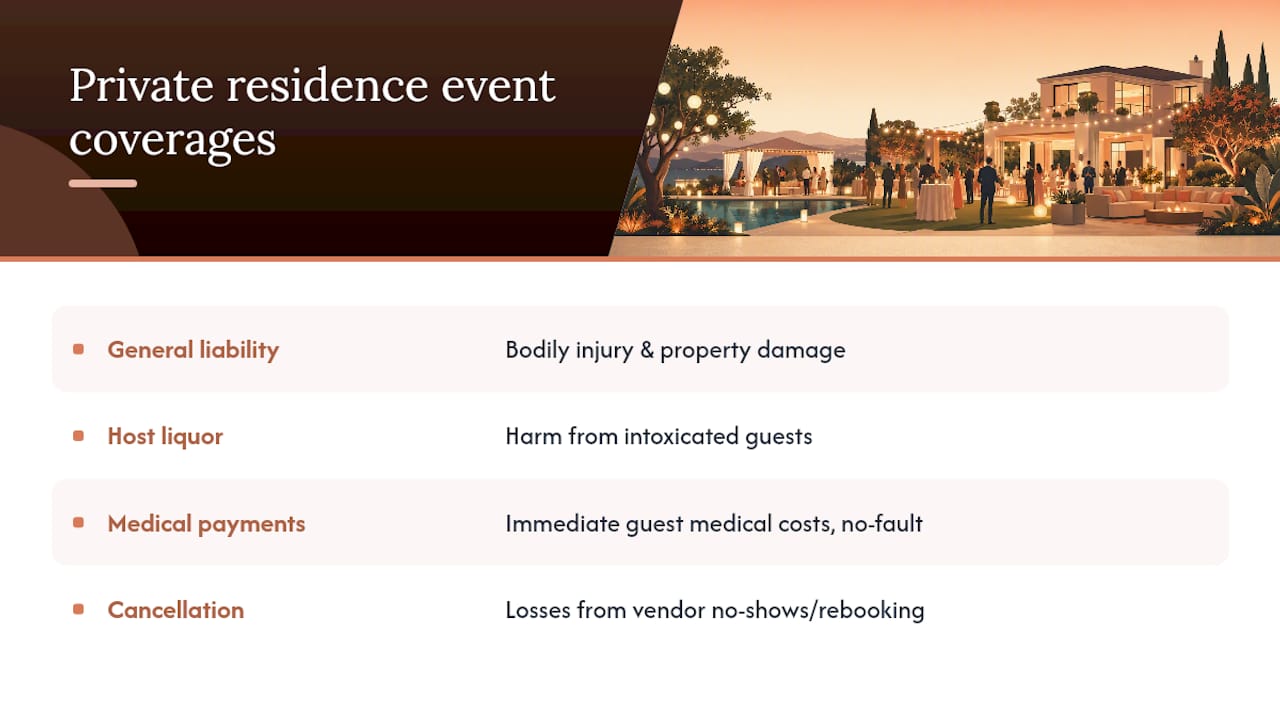
Real incidents make the distinctions concrete. A guest injured by a collapsing tent falls under general liability. A bartender who over-serves someone who later causes a car accident triggers host liquor liability, assuming the bartender isn’t independently insured. A vendor no-show that forces a last-minute rebooking is a cancellation claim, not a liability one.
Standalone event liability policies commonly bundle liquor liability and cancellation add-ons into a single quote, which is worth requesting even if you think you won’t need every piece. High-risk activities often require additional clarifications or endorsements, such as open flame elements needing specific coverage endorsements. Pyrotechnics, fireworks, or drone displays are commonly excluded unless specifically added. Valet parking and off-site guest transportation may need separate auto liability coverage. Swimming pools and water features typically require specific endorsements beyond standard coverage.
Do You Need Event Insurance for a Private Residence?
Three clear signals tell you whether a standalone policy is worth the phone call, or whether your existing homeowners coverage might be enough.
A Certificate of Insurance is required. If a property owner, HOA, permit office, or vendor contract demands a COI, you need coverage. This isn’t negotiable. Many venues and permit offices deny the booking outright without one.
The event carries elevated risk factors. Serving alcohol, renting a tent or dance floor, hiring outside vendors, inviting a guest count into the hundreds, or hosting recognizable public figures all push you firmly into event-policy territory.
It’s a small, low-risk gathering. A family dinner with no rentals, no alcohol service beyond what you’d normally pour, and a modest guest list may fall within homeowners coverage. Confirm the limit with your carrier, and consider a low-cost medical payments rider or an umbrella policy as a cushion.
For anything approaching a formal gathering with outside guests, the math favors buying the policy. A few hundred dollars in premium is a rounding error against the potential cost of a single liability claim.
How to Buy Event Insurance for a Private Residence
Start the insurance conversation the moment you contract your first vendor or file for a permit, not the week before the event. You can typically buy event coverage up to two years in advance, and most venues and permit offices want the COI in hand roughly 30 days before the event date. Many carriers now issue instant policies within 24 to 72 hours for straightforward gatherings, which is useful, but it’s not a substitute for early planning when the event involves multiple vendors or a permit application.
Call your homeowners insurer first to understand what, if anything, your existing policy covers, then move to a specialized event insurer or independent broker who can shop multiple carriers. For a simple cocktail party with no rentals, an online instant-policy platform may be sufficient.
Have this information ready before you call:
Event date, address, and the legal property owner’s name
Estimated guest count
Whether alcohol will be served, and by whom
Full vendor list and any rented equipment (tents, staging, generators)
Any HOA or permit-office insurance requirements already on file
When the COI arrives, check it line by line: confirm the named additional insureds match exactly what the property owner or permit office requested, verify primary and non-contributory wording appears, and look for a waiver of subrogation if the venue asked for one.
Pro Tip: Request the COI at least a week before your event’s own 30-day deadline. Carriers occasionally misspell an additional insured’s name or omit an endorsement, and catching it early avoids a scramble against a permit office’s clock.
Policy Language That Actually Protects You
The coverage amount matters less than the wording attached to it. Four specific terms separate a policy that performs under stress from one that leaves a gap exactly when you need it most.
Primary and non-contributory (PNC): insist on this wording so the event policy pays first, ahead of the homeowner’s own insurance, rather than splitting the claim.
Additional insured and waiver of subrogation: name the property owner, HOA, or rental platform as an additional insured, and add a waiver of subrogation so the insurer can’t turn around and sue the property owner after paying a claim.
Host liquor liability vs. vendor liquor coverage: confirm which party, you or the catering/bar service, carries the liquor liability, and request their COI as proof rather than assuming it’s covered twice.
Cancellation and medical payments riders: add cancellation coverage for nonrefundable vendor deposits, and a medical payment clause so injured guests get immediate treatment without a liability determination first.
Adding the property owner as an additional insured with primary and non-contributory language protects both sides of the arrangement, which matters enormously when the “property owner” is a rented estate rather than your own home.
How Event Coverage Works With Homeowners and Umbrella Policies
Homeowners policies were built for everyday household risk, not a 150-guest gathering with a bar and a rented tent. Coverage limits are often too low for the exposure a large event creates, and many homeowners policies simply exclude hosted events above a certain size or won’t allow the property owner to be added as an additional insured at all.
A short-term event policy exists to fill exactly that gap, functioning as a temporary layer that sits alongside, not instead of, your homeowners coverage. An umbrella policy can add another layer above both, which matters for events with celebrity attendance or elevated guest counts. Confirm with a licensed agent which policy responds first, and get that answer in writing before the event, not after a claim is filed.
Checklist and Timeline for Securing Coverage
Working backward from the event date keeps insurance from becoming a last-minute scramble.
Two-plus months out (complex or multi-day events): start insurance conversations the same week you book key vendors like catering, staging, or entertainment.
Two to four weeks out: purchase the liability and cancellation policy, and formally request the COI naming all required additional insureds with PNC wording.
One to two weeks out: confirm the homeowner, HOA, or permit office has received and accepted the COI, and collect insurance certificates from every outside vendor.
Day of the event: keep a copy of the COI on-site and document any incident immediately, with photos and witness names if applicable.
After the event: retain every record for at least a year in case a claim surfaces after the fact.
That timeline lines up with how carriers actually operate: instant policies can issue within 24 to 72 hours for simple events, but complex ones with multiple vendors and permit requirements need the full runway.
Bonnie Rae’s View: Insurance as Production, Not Paperwork
Luxury production teams don’t treat insurance as an afterthought. It’s a standard line item in the budget, itemized alongside florals and staffing, and managed with the same rigor as vendor and valet coordination. Every vendor’s certificate gets checked against the contract before the event, not discovered missing the week of. That level of coordination is what separates a smooth Saturday night from a coverage dispute nobody saw coming.
Homeowners Insurance vs. Special Event Insurance: Where the Gaps Are
The core difference comes down to scope. Homeowners insurance is built to cover your household’s everyday liability, a slip on the front steps, a dog bite, a minor mishap. It was never designed to absorb the risk of 200 people, an open bar, and a rented tent staked into your lawn.
Homeowners policies typically cap liability well below what a formal event requires, and many carriers explicitly exclude events above a certain guest count or any gathering involving paid vendors. There’s also a structural problem: most homeowners policies simply won’t let you add a caterer, rental company, or the HOA as an additional insured, because the policy wasn’t written with that flexibility in mind.
Special event insurance closes that gap by design. It’s a temporary, purpose-built program that flexes to the specific event, naming exactly who needs to be covered and for how long. Event insurance exists precisely to fill the space homeowners and general liability leave open when alcohol, rentals, vendors, or a large guest count enter the picture.
The practical takeaway: never assume homeowners coverage extends to a hosted event just because it happens at your address. Call your carrier and ask the specific question. If the answer is vague or the limit sounds low for the guest list you’re planning, that’s your signal to buy a standalone policy rather than gamble on an assumption.
Risks Unique to Private Residences
A rented ballroom doesn’t have a swimming pool, mature landscaping, or a driveway that becomes a parking lot for the evening. Private residences carry a distinct set of exposures that hotel and venue insurance rarely has to account for.
Landscaping damage is the most common. Heeled shoes on a lawn, a tent’s stakes driven through irrigation lines, or a catering truck backing over a flower bed all cause real repair costs that homeowners insurance may not fully address when the damage stems from a hosted event.
Pool liability deserves particular attention. Any gathering where guests have pool access, even if swimming wasn’t the plan, introduces a drowning or slip-and-fall risk that most standard policies exclude without a specific endorsement. If the pool is lit, uncovered, or accessible after dark, insist on this coverage explicitly.
Guest parking creates its own exposure. Cars lining a private road, a valet service directing traffic on residential streets, or overflow parking on a neighbor’s property can all generate claims that have nothing to do with the event itself but everything to do with hosting it. Confirm whether your event policy or the valet service’s own insurance covers vehicle damage and pedestrian incidents in the parking area.
Fencing, gates, and outdoor structures round out the list. A gate left open for vendor access, a pergola bearing string lights, or a stone wall guests lean against during cocktail hour are all places where routine use turns into a claim when 150 extra people are on the property at once.
Urban Townhouse vs. Rural Estate: What Changes
The type of private residence shapes both the risks you’re insuring against and the paperwork required to host legally.
An urban townhouse event usually triggers municipal permit requirements faster than a rural property does. Noise ordinances, street parking restrictions, and neighbor proximity mean cities like New York often require a temporary event permit before you can legally host a gathering above a certain size, and that permit process typically demands its own COI naming the city or building association as an additional insured. Space constraints also mean vendors, valet staff, and tenting often spill onto sidewalks or shared property, which raises the stakes on liability coverage extending beyond your own lot line.
A rural estate carries different exposures. Larger grounds mean more landscaping at risk, private wells or septic systems that can be damaged by heavy equipment, and often longer emergency response times if a medical situation arises. Estates also more commonly host multi-day events, which changes the insurance conversation from a single-night policy to coverage spanning setup, the event itself, and breakdown.
Whichever category your property falls into, check local permit requirements early. A temporary event permit often needs proof of insurance attached to the application itself, not delivered afterward, which is one more reason the insurance conversation has to start before the guest list does.
Documenting Property Condition Before and After
Photographic evidence is the single strongest tool you have if a damage dispute arises after the event. Walk the entire property with your phone before any vendor sets foot on it, and photograph the lawn, flooring, walls, fixtures, and any area where tents, staging, or heavy foot traffic will occur.

Date-stamp every photo, and if the event spans multiple days, photograph again each morning. Note the condition of anything expensive or fragile specifically, a marble entryway, an antique rug, custom millwork, since general property shots can miss the detail an insurer needs to process a claim.
After the event, repeat the same walkthrough before cleanup crews finish, comparing against the earlier photos. Any new damage should be photographed immediately, with a written note of what happened and when you noticed it. If a vendor caused the damage, get their acknowledgment in writing while everyone is still on-site rather than relying on a phone call days later.
Keep every photo and note with your event file for at least a year. Claims, especially medical ones, sometimes surface weeks after the event, and a documented before-and-after record is often the difference between a smooth reimbursement and a drawn-out dispute over what actually happened.
Choosing the Right Coverage Limits
Coverage limits should scale with both guest count and activity risk, not simply match whatever the broker quotes first. A common baseline for private events is $1 million per occurrence in general liability, but that figure is a floor, not a ceiling, for high-net-worth gatherings.
Push the limit higher when any of these apply: a guest list exceeding 150 to 200 people, an open bar running for several hours, a swimming pool or water feature in active use, pyrotechnics or open flame elements, or attendance by public figures whose presence could itself attract heightened scrutiny in the event of an incident. Each of these raises the statistical odds of a claim and the potential size of one.
Layering an umbrella policy above the event-specific limit is worth the conversation for any gathering approaching those thresholds, particularly when celebrity or athlete attendance adds a reputational dimension to what would otherwise be a straightforward liability claim. Ask your broker to model out a worst-case scenario, a serious injury combined with a liquor liability claim, and confirm the combined limits would actually cover it before you finalize the policy.
Negotiating Better Terms With Your Insurer or Broker
Treat the quote as a starting point, not a final offer. Brokers who specialize in event coverage have more flexibility than a generalist homeowners agent, and they’re often willing to adjust terms once they understand the full scope of a high-end gathering.
Ask directly whether the primary and non-contributory endorsement is included or an add-on. Some carriers bundle it, others charge extra, and the difference is worth negotiating rather than accepting silently. The same goes for the waiver of subrogation. If it’s not standard, ask what it costs to add and push back if the number seems disproportionate to the policy’s overall premium.
Bundle where it makes sense. A broker handling both your liquor liability and your cancellation coverage in one policy may offer better pricing than two separate carriers, and it simplifies the COI process since everything comes from a single document.
Finally, ask about multi-event or annual policies if you host more than once a year. Frequent hosts, particularly those with a standing calendar of gatherings, can often negotiate a better rate across multiple events than by purchasing a new policy each time from scratch.
Common Exclusions to Watch For
Every event policy has a list of exclusions, and the ones that catch hosts off guard tend to be the same handful every time. Pyrotechnics, fireworks, and drone displays are almost universally excluded unless specifically endorsed, regardless of how brief or professionally operated they are. Assault and battery claims are frequently carved out entirely, which matters more than it sounds given that many liability disputes at events with alcohol involve exactly this kind of incident.
Motor vehicle incidents, including valet-related accidents, are typically excluded from general event liability and require separate auto coverage. Intentional acts are never covered, which seems obvious until a dispute arises over whether an incident was accidental or deliberate. And extreme weather, while sometimes included under cancellation add-ons, is often excluded from the liability portion of the policy entirely, meaning a storm that damages a tent might not be covered the same way a guest injury would be.
Read the exclusions page before the coverage summary. It tells you more about what you’re actually buying than the marketing language on the first page ever will.
The Real Gap in Most Event Insurance Advice
Most guidance on this topic treats event insurance as a box to check, buy a policy, get a COI, move on. That’s not wrong, but it undersells what actually protects a host at the high end of this market: the specific wording inside the policy, not just its existence.
Primary and non-contributory language is the single most overlooked detail in event insurance conversations, and it’s the one that determines whether a claim touches the homeowner’s personal policy at all. A generic liability policy without PNC wording can still leave a property owner’s own insurance exposed, premium increases and all, even when the host did everything else right. The same goes for waiver of subrogation. Skip it, and an insurer that pays a claim can turn around and pursue the property owner directly.
What should change first is the order of operations. Don’t start by asking “how much coverage do I need?” Start by asking “what wording protects everyone named on this event?” That’s the question luxury production teams ask before they ask about premium, and it’s the one that prevents a six-figure gathering from turning into a legal mess over a $1,500 policy decision. Coverage amount is important. Wording is what actually pays the claim correctly.
— Bonnie Rae
Another Option: Let Bonnie Rae Handle the Insurance Logistics for You
For hosts seeking coordinated event planning services, some teams offer to manage vendor certificates and COI paperwork alongside event design, building insurance verification into vendor contracts before the event begins.

Such coordination often covers services a private-residence host typically requires—event production, catering, staffing, and bar programs—with insurance and contract language incorporated into planning rather than added last minute. This centralized approach can streamline communication and contract management for complex events.
If you’re planning a private-residence event and want the insurance conversation handled alongside the guest experience itself, request a bespoke proposal from Bonnie Rae to start the process.
Sources
FAQ
Does Homeowners Insurance Cover a Party at My House?
Homeowners insurance may cover a small, informal gathering, but it often excludes larger events and won’t add a property owner as an additional insured, so confirm your limit before hosting anything beyond a casual dinner.
How Much Does Event Insurance for a Private Residence Cost?
Pricing varies by guest count, alcohol service, and rentals, but standalone event liability policies often cost a few hundred dollars depending on the event’s scope and features.
How Far in Advance Should I Buy Event Insurance?
You can typically buy coverage up to two years ahead, and most venues want the COI delivered around 30 days before the event, though instant policies can issue within 24 to 72 hours for simple gatherings.
What Is Primary and Non-Contributory Coverage?
Primary and non-contributory wording means the event policy pays a claim first, before the homeowner’s own insurance is touched, which protects the property owner from premium increases or exhausted limits.
Does Bonnie Rae Handle Event Insurance Coordination?
Bonnie Rae’s production teams coordinate vendor insurance verification, COI collection, and contract language as part of full-service event planning, so hosts don’t have to manage that paperwork separately from the rest of the event design.
Recommended
Comments