
70–90 vs 50–60 MPH: Clear Top or Sailcloth Tents for Luxury Planners
For a black-tie dinner on a manicured lawn, sailcloth wins for its flattering amber glow and quiet, breathable interior. Choose a clear-top tent when the site demands a hard-surface install, you need an unbroken sightline to the stars, or wind exposure rules out staking. Site conditions, season, and how much you’re willing to spend on lighting and HVAC will often override whichever look you fall for first.
TL;DR:
Site conditions, such as staking restrictions and surface type, heavily influence whether sailcloth or clear-top tents are more suitable, with hard surfaces favoring clearspan.
Clear-span tents are more wind-tolerant and better suited for evening use, but they require high-capacity HVAC and visible rigging for lighting to achieve their aesthetic potential.
Sailcloth tents excel in daytime settings with passive ventilation and immersive interior lighting, but they demand deep perimeter stakes and interior center poles that may intrude on the layout.
Budget considerations show that clear-top tents tend to have higher overall costs due to HVAC and rigging, while sailcloth prices are driven by premium fabric, decor, and early booking demand.
Hybrid tent setups are a practical solution for combining aesthetic and site constraints, with careful design ensuring a seamless experience between different structures.
Table of Contents
Clear Top vs Sailcloth Tent: A Side-by-Side Look
The two tent families solve different problems, and the differences show up long before guests arrive. Sailcloth tents use a pole-and-tension system with translucent canvas that glows from within. Clear-top structures use a rigid, clearspan aluminum frame with transparent PVC panels that disappear entirely after dark unless you light them with intent.
Here’s how they stack up across the decisions that actually drive a production budget:
Aesthetic and vibe: Sailcloth delivers a soft, romantic glow with visible fabric texture; clear-top delivers drama through transparency, best seen with a night sky or dramatic landscape behind it.
Site compatibility and anchoring: Sailcloth requires perimeter staking into turf; clearspan tents can be ballasted for installs on asphalt, terraces, or historic sites where staking is prohibited.
Wind and weather tolerance: Clearspan frames commonly carry wind ratings of 70 to 90-plus mph, compared to roughly 50 to 60 mph for pole tents.
Layout flexibility: Clear-top’s open footprint gives you a clean, obstruction-free floor plan; sailcloth’s center poles require early coordination for bars, stages, and dance floors.
Climate control needs: Clear-top traps heat and often needs high-capacity HVAC for daytime events; sailcloth ventilates passively but struggles in heavy humidity or storms.
Lighting and production overhead: Clear-top needs pin-spot lighting and visible trussing to avoid a flat, dark ceiling at night; sailcloth’s fabric does much of that work for you.
Typical cost drivers: Sailcloth shells often rent at a premium and sell out early for summer weekends, while clear-top shells look cheaper upfront until HVAC, rigging, and lighting get added.
A night wedding on a stone terrace with no grass to stake into almost always points to clear-top with ballast. A daytime garden reception under mature trees points toward sailcloth, unless the forecast calls for wind gusts near that 50 to 60 mph ceiling. When a single tent can’t satisfy both the aesthetic brief and the site constraints, a hybrid pairing, discussed later, tends to be the more honest answer than forcing one structure to do everything.
What Makes Sailcloth Tents a Planner Favorite?
Sailcloth tents rely on wooden or aluminum center poles under tension, with a translucent polyester or vinyl canvas stretched taut across the frame. That fabric is the whole point: sunlight filters through it during the day, and once the sun drops, interior uplighting turns the entire canopy into a warm, glowing lantern. Photographers love it. Guests notice it without knowing why the room feels so good.
The trade-off is structural. Sailcloth tents need perimeter staking driven into real turf, which means grass, soil depth, and irrigation lines all matter before you sign a contract. Center poles also intrude on the floor plan. A five-tier cake table or a DJ booth positioned without accounting for a pole in the sightline is a mistake you only catch once, usually the week of the event.
Here’s what a sailcloth install typically demands:
Perimeter stakes driven 18 to 36 inches deep, depending on soil composition and tent size.
A locate call to confirm no irrigation, septic, or utility lines run through the stake zone.
Interior center poles positioned early in the floor plan, not layered in after the seating chart is finalized.
Sidewall options in clear vinyl for evenings that turn cool or breezy.
A realistic wind ceiling of roughly 50 to 60 mph before the structure requires evacuation protocols.
Installation typically runs a full day for a mid-size tent, sometimes two for larger footprints with flooring and full draping. Crew size scales with square footage, but expect a four-to-six person team minimum for anything serving more than 150 guests.
The center poles are the one detail that separates a polished sailcloth install from an amateur one. Left bare, they read as a compromise. Wrapped in greenery, draped silk, or a cluster of low-hanging florals, they become part of the design instead of an obstacle to design around.
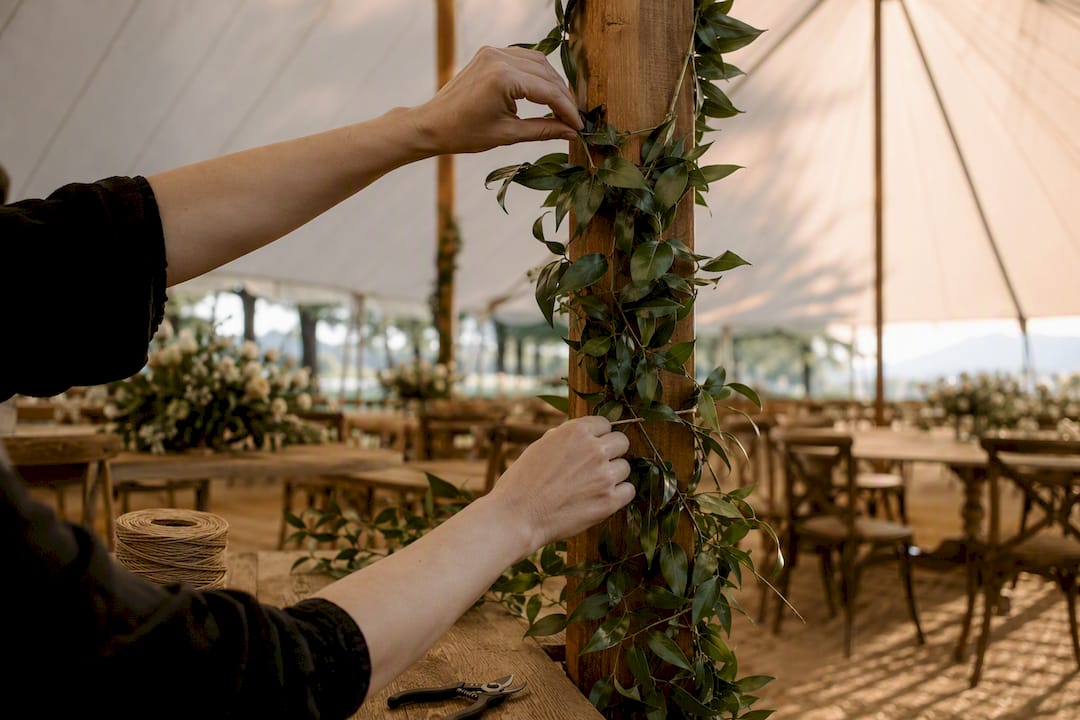
Pro Tip: Ask your florist to treat each center pole as its own micro-installation rather than an afterthought. A tight cluster of trailing greenery from base to crown does more to elevate a sailcloth interior than any amount of additional uplighting.
Why Clear-Top Tents Cost More to Finish
Clear-top, or clearspan, tents use a rigid aluminum frame with a keder track system that holds transparent PVC panels in place without a single interior support pole. That engineering is what makes the open, uninterrupted footprint possible, and it’s also what makes the structure heavier, sturdier, and more expensive to finish properly. Because there’s no need to stake into soil, these frames can be ballasted with weighted blocks, which opens up terraces, courtyards, and parking lots that sailcloth simply cannot touch.
The visual payoff is real. An unobstructed sky view over a seated dinner or a dance floor under stars is the single most requested clear-top effect among luxury clients. The catch: that same transparency turns into a liability after dark. Without deliberate lighting design, a clear-top tent at night reads as a flat, dark ceiling, what production crews often call the black hole effect. Fixing it requires visible trussing and targeted pin-spot lighting, both of which become part of the interior aesthetic whether you planned for them or not.
Daytime clear-top events carry their own cost. Direct sun through transparent panels creates a greenhouse effect that can push interior temperatures well above what’s outside, which usually means high-capacity HVAC isn’t optional, it’s structural to the plan. That equipment needs power, which needs generators or a confirmed shore-power hookup, which needs its own line item in the budget.
Key production considerations for clear-top installs:
Ballast plans must be engineer-verified for the specific surface and tent size, not estimated on-site.
HVAC sizing should account for direct sun exposure, guest count, and event duration, not just square footage.
Rigging and cabling will be visible unless masked, so decide early whether to hide it or lean into an intentional industrial look.
Wind tolerance runs meaningfully higher than sailcloth, which makes clear-top the safer call for coastal or high-elevation sites.
Clearspan frames can support heavier hanging loads and insulated glass walls, making them the stronger option for winter events or shoulder-season celebrations where guest comfort depends on a sealed, heated environment.
Pro Tip: Budget your lighting designer’s time before you budget the fixtures. A clear-top tent’s finished look depends entirely on where light is aimed, and that’s a design decision, not a rental line item.
Clear-top earns its premium on hard surfaces, in high-wind zones, and for evening-heavy programs where the ceiling becomes part of the show.
How Do You Evaluate a Site Before Choosing a Tent?
Every tent decision should start with a walk of the actual property, not a floor plan on paper. Confirming what the ground can and can’t support prevents the kind of last-minute pivot that eats into both budget and goodwill with a client.
Check the surface. Grass and soil allow sailcloth staking; asphalt, stone, and wood decking require clearspan with ballast.
Locate utilities before staking. Irrigation lines, septic fields, and buried cabling all rule out staking in specific zones, and a locate call should happen well before the contract is signed.
Confirm ballast specifications with the rental company. Signed load tables and ballast weight confirmations protect against liability on hard-surface installs, and no reputable vendor should hesitate to provide them.
Ask about no-stake restrictions. Historic estates, protected root zones near mature trees, and some private clubs prohibit ground penetration entirely, which often settles the tent decision before aesthetics ever enter the conversation.
Review permit requirements with the venue. Some municipalities require structural permits for tents over a certain square footage, particularly for clearspan installs with HVAC and generator power.
Plan installation timing around lawn recovery. Tents down for multiple days ahead of an event can leave visible impressions in turf; ask the rental company about protective flooring or matting if the lawn needs to look pristine on arrival day.
Skipping any one of these steps tends to surface as a problem on install day, exactly when there’s the least flexibility to fix it.
Managing Heat, Humidity, and Storms Under Canvas or Glass
Guest comfort lives or dies on how well a tent handles the weather it’s actually built for, not the weather everyone hoped for. Clear-top tents in direct sun can trap heat fast enough that HVAC becomes a structural necessity rather than an amenity, especially for daytime cocktail hours or early receptions. Scheduling the bulk of a clear-top program after sunset, or adding reflective liners over the panels, both help reduce the load on cooling equipment.
Sailcloth’s woven fabric breathes in a way glass never will, allowing passive airflow that keeps interiors comfortable in moderate heat without mechanical help. That same breathability becomes a liability in sustained rain or high humidity, where moisture can seep through seams that a sealed clear-top structure simply doesn’t have to worry about.
A few planning benchmarks worth locking in early:
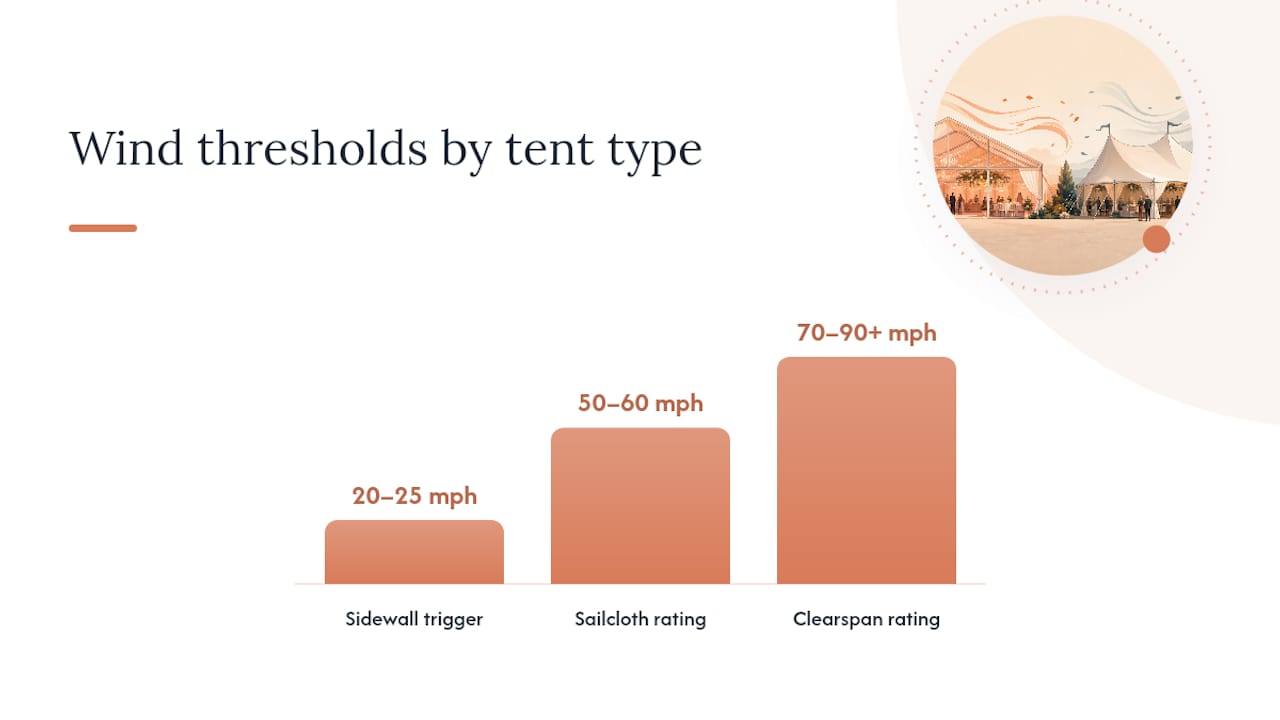
Set a wind-monitoring threshold well below the tent’s rated maximum; most experienced crews start sidewall deployment and guest notifications at 20 to 25 mph sustained winds, regardless of tent type.
Because sailcloth structures are typically rated for 50 to 60 mph while clearspan frames often reach 70 to 90-plus mph, coastal and mountain venues with unpredictable gusts lean the decision toward clearspan by default.
Rough HVAC planning for a clear-top tent should assume roughly one ton of cooling capacity per 300 to 400 square feet in full sun, adjusted upward for glass walls or extended dwell time.
Confirm generator capacity separately from lighting power; HVAC draws far more current than most planners expect, and undersized generators are one of the most common day-of failures.
Pro Tip: Build your weather contingency plan around trigger points, not vague “we’ll monitor it” language. Assign one person the authority to call sidewall deployment or evacuation, and give them that authority in writing before the event.
Designing Light and Decor for Each Tent Type
Tent structure dictates lighting strategy almost entirely, and getting that sequence backward is one of the most common production mistakes. Clear-top tents need visible trussing and pin-spot lighting to avoid reading as a flat black ceiling once the sun sets, which means the lighting designer needs to be involved at the same stage as the florist, not after.
Sailcloth’s translucent canvas does a lot of the heavy lifting on its own. Interior uplighting against the fabric produces a soft, ambient glow that reduces how much fixture rental and rigging you need overall, though the trade-off is a hard limit on hanging weight and placement since anything suspended has to route around center poles.
A few coordination details that keep both approaches on schedule:
Confirm hanging weight limits with the tent vendor before the florist finalizes any installation involving chandeliers, greenery walls, or suspended florals.
For loads beyond the tent’s rated capacity, an independent truss system, installed and load-tested by a licensed rigger, is not optional.
Schedule rigging and load tests at least 24 hours before the event, never the same day as floral or furniture load-in.
Hire a dedicated lighting designer for any clear-top event with an evening program; the tent’s transparency makes lighting design, not decor, the primary tool for creating intimacy.
Pro Tip: Treat your rigger, lighting designer, and florist as one coordinated team with a shared install timeline, not three vendors working in sequence. Overlap in scheduling is where most tented-event surprises originate.
Where the Real Costs Hide in a Tented Event Budget
The tent shell is rarely where a luxury tented event’s budget actually goes. Line items that consistently shape the final number include the shell rental itself, lighting and rigging, HVAC and generator power, subfloor and flooring, draping and decor, labor for install and strike, permits, and standby power for weather contingencies.
Clear-top’s costs tend to cluster around HVAC and lighting. Because the structure offers no natural shade or ambient glow, both systems have to be built from scratch, and initial shell quotes that look cheaper than sailcloth often don’t survive contact with a full production estimate. Sailcloth, meanwhile, tends to push cost into decor, since camouflaging center poles and finishing the interior to a luxury standard takes real floral and drapery budget.
A few questions worth asking every vendor before comparing quotes side by side:
Does this estimate include HVAC and generator power, or are those separate line items?
What’s the ballast or staking plan for this specific site, and is it included in the shell price?
Are pin-spot lighting, trussing, and rigging included, or will I need a separate lighting vendor?
What’s the load-in and strike timeline, and does that affect labor costs?
Is flooring or subflooring required for this surface, and is it priced separately?
Ballpark figures vary widely by region and vendor, but planners should expect clear-top installs with full HVAC and lighting to run meaningfully higher than the shell quote alone once every system is accounted for. A realistic per-guest production budget for a corporate gala offers a useful benchmark for how quickly line items compound once catering, staffing, and decor are layered onto a tent structure.
A Step-by-Step Framework for Choosing Your Tent
Rather than starting with aesthetics, work through site and program constraints first, then let the visual preference settle in last.
Confirm guest count and program flow. A seated dinner for 80 has different needs than a 300-person gala with a full dance floor and stage.
Assess the site. Grass supports sailcloth staking; hard surfaces or no-stake restrictions point to clearspan with ballast.
Factor in season and time of day. Daytime summer events lean toward sailcloth’s passive ventilation; winter or evening-heavy programs lean toward clear-top with proper HVAC.
Set the production budget honestly. If lighting and HVAC aren’t funded, clear-top’s advantages disappear fast.
Finalize the recommendation, and if the brief genuinely calls for both a soft dinner atmosphere and a dramatic dance floor, consider a hybrid.
Hybrid setups pairing sailcloth for dinner service with a connected clear-top structure for dancing let planners deliver both effects without compromising either one. The key is designing the transitional space between the two tents with the same care as the interiors themselves, so the shift feels intentional rather than like walking from one rental contract into another.
Pro Tip: If a site consult raises more than one red flag, no-stake restrictions plus a forecast near the sailcloth wind ceiling, for example, treat that as a signal to move the entire recommendation toward clearspan rather than trying to negotiate around two separate problems.
Expect final tent selection and vendor contracts locked roughly four to six months out for peak season dates, with site surveys, ballast or staking confirmations, and rigging plans finalized in the final 30 days before the event.
What We’ve Learned Choosing Tents for Discerning Clients
Most planners default to whichever tent looks best in a styled photo shoot, and that instinct is exactly backward. The site should decide the structure; the structure should decide the lighting plan; only then does aesthetic preference get a real vote. A thoughtful approach starts with guest comfort, because a stunning tent that runs 15 degrees too hot or rattles in a wind gust the client wasn’t warned about undoes every other design decision made that day.
One recurring scenario illustrates the trade-off well: a client falls in love with a clear-top tent for the sky view, but the venue turns out to sit on a protected historic lawn where staking is prohibited and the only power source is 200 feet away. The fix wasn’t abandoning the vision. It was ballasting the frame, running buried cable runs approved by the venue in advance, and building the HVAC and lighting budget into the proposal from day one instead of discovering it during walkthrough week.
— Bonnie Rae
How Bonnie Rae Handles Tented Events From Site Survey to Strike
A tented event with a clear-top structure over a client’s estate lawn is not a rental decision. It’s an engineering, lighting, and climate-control problem disguised as one, and it’s exactly where a full-service producer earns its place at the table. The event producer runs the site survey, sources the tent, and plans HVAC, power, rigging, and lighting as one coordinated system, so a client never learns about a ballast requirement or an undersized generator the week of the event.
That coordination is the real advantage over piecing a tented event together vendor by vendor. Bonnie Rae’s Full Event Production service covers venue scouting, tent sourcing, and staffing under one point of contact, backed by a team drawn from top-tier restaurant and hospitality backgrounds who understand what a Michelin-level guest experience actually requires under canvas or glass. For events layering in private chef service or full catering, that same team plans kitchen tent placement and power draw alongside the guest tent, rather than treating them as separate contracts. Ready to scope your site? Request an on-site consult through Bonnie Rae and get a proposal built around your property’s actual constraints, not a generic package.
Sources
FAQ
Are Clear-Top Tents More Expensive Than Sailcloth?
Not necessarily in shell price, but clear-top installs usually cost more overall once HVAC, pin-spot lighting, and trussing get added to the estimate. Sailcloth shells can actually rent at a premium during peak summer dates due to limited inventory.
Do Clear-Top Tents Get Hot?
Yes. Direct sunlight through transparent panels creates a greenhouse effect that can push interior temperatures well above outside air, making high-capacity HVAC a near-requirement for daytime clear-top events.
Why Are Sailcloth Tents So Expensive?
Demand outpaces supply for premium sailcloth inventory during peak wedding season, and the fabric, poles, and setup labor cost more than standard tenting. Add in decor needed to camouflage center poles, and the finished budget can rival a clear-top install.
What Is the Best Fabric for Luxury Event Tents?
Translucent, tightly woven polyester or vinyl sailcloth is the standard for its light-diffusing glow and durability, while clear-top structures use transparent PVC panels on an aluminum frame for maximum wind tolerance and an unobstructed sightline.
Can You Combine Clear-Top and Sailcloth in One Event?
Yes, and it’s increasingly common among luxury planners. A hybrid setup pairing sailcloth for dinner with a connected clear-top tent for dancing delivers flattering ambient light for the meal and a dramatic open-sky dance floor without forcing one tent to do both jobs.
Recommended
Comments