
3 ADA Failures That Expose U.S. Luxury Event Planners
Under Title III of the ADA, the host and the venue share legal responsibility for ensuring meaningful access at any event open to the public or attended by clients and guests. This means providing auxiliary aids and accessible ticketing at no charge, confirming the venue’s accessibility claims yourself, and naming a single accessibility coordinator before the invitations go out. Skip any of those three, and you are exposed.
TL;DR:
Verifying venue accessibility claims through an in-person walk-through is essential, as relying solely on the venue’s assurances exposes you to risks.
Booking sign language interpreters, CART captioners, and accessible seating must be done early, ideally immediately after confirming the venue and date, to ensure availability.
Charging attendees for auxiliary aids violates ADA requirements; these services, including interpreters and captioning, must be provided at no cost to the guest.
Internal responsibilities such as naming an accessibility coordinator and documenting accommodations are critical to managing real-time needs and protecting against liability.
Building accessibility planning into the overall production timeline ensures it is prioritized alongside other event components, rather than treated as an afterthought.
Table of Contents
What Does ADA Compliance for Events Actually Require?
Meeting ADA compliance for events starts with a working checklist, not a legal textbook. Most compliance failures trace back to five gaps: an unchecked venue claim, a missing interpreter, mismatched ticket pricing, an inaccessible registration form, or no one in charge when a guest needs help on-site. Work through these in order, and you close the gaps that trigger complaints and litigation.
Walk the venue yourself. Confirm the accessible route, restroom function, and parking or drop-off zone in person. Never take a venue’s word for it.
Book ASL interpreters and CART captioners early for every speaker session, panel, and marquee moment, not just the keynote.
Price accessible seating identically to standard seating. Sell it through the same channels, at the same time, with the same seating information as non-accessible seats.
Add an accommodation request field to registration and offer at least two communication formats for confirmations.
Name an accessibility coordinator and run an AV and assistive-tech test on-site before doors open.
Each step protects a different failure point: the venue walk-through catches physical gaps, the interpreter booking ensures communication access, the ticketing rule ensures proper seating access and pricing, and the coordinator manages real-time accessibility needs.
Pro Tip: Build your accessibility checklist into the same production timeline as catering and florals; treat it as a line item with its own deadline, not an afterthought bolted on two weeks before the event.
Who Is Legally Responsible Under Title III?
Title III of the ADA governs any place of public accommodation, and its regulations, codified at 28 CFR Part 36, define enforceable accessibility standards for the private sector. For event planners, three points matter more than the statute’s fine print.
Hosts share liability with the venue. Renting a “compliant” space does not transfer risk. Verify the venue’s claims independently before you sign.
Auxiliary aids and services, including interpreters, CART, and captioning, must be provided at no cost to the attendee. Charging a guest for their own accommodation invites Department of Justice enforcement or private litigation.
“Undue burden” and “fundamental alteration” exist as defenses, but courts read them narrowly and fact by fact. Budget constraints alone rarely qualify, and neither does simple inconvenience.
Treat these as floor requirements, not aspirational goals. A single overlooked clause here can undo months of otherwise flawless production work.
Interpreters, CART, and Captioning: Getting Communication Access Right
Effective communication access is not one tool. It is choosing the right combination for each moment of the program.
Onsite ASL interpreters work best for live, high-stakes moments: keynotes, award presentations, award acceptance speeches.
Video Remote Interpreting (VRI) covers smaller breakout rooms when a qualified onsite interpreter is not available, though it demands a stable connection and a quiet room.
CART (Communication Access Realtime Translation) delivers word-for-word live text, essential for attendees who read rather than sign.
Closed captions on any recorded or streamed content extend access after the room empties.
NAD’s guidance for conferences and workshops stresses booking qualified providers early and confirming credentials, not just availability, since interpreter quality varies widely by specialty and setting.
Pro Tip: Test caption display and interpreter sightlines during your final walk-through, not the morning of. Lighting rigs and stage risers block sightlines in ways floor plans never show.
Are Your Venue Routes, Restrooms, and Seating Actually Accessible?
A floor plan that looks accessible on paper often fails on the ground. Test these physically, every time.
Accessible routes need stable, slip-resistant surfaces and ramps at a slope no steeper than 1:12, with clear pathways free of cable runs, furniture, or décor pinch points.
Seating must be dispersed throughout the venue, not clustered in one back corner, with companion seats available beside every accessible spot.
Accessible seats sell through the same channels and at the same price as every other seat. That rule applies whether you sell through a ticketing platform or a private RSVP list.
When a venue lacks permanent features, temporary ramps, portable lifts, and accessible restroom trailers fill the gap, but they need the same slope, width, and signage standards as fixed infrastructure.
Accessible parking, drop-off points, and transit directions belong in the attendee packet, not buried in a separate accessibility page few people find.
Is Your Registration Platform Actually Accessible?
Digital access failures happen before a single guest arrives, and they are among the easiest to prevent with proper testing.
Build or select registration forms that meet WCAG 2.1 AA, the practical standard courts and the DOJ point to when weighing whether access was meaningful.
Every form field needs keyboard navigation and screen-reader labels, plus a visible accommodation request field.
Provide alt text on images, tagged and readable PDFs, and offer materials in large print or Braille on request.
Run your registration and ticketing workflow through a screen reader before launch. This single test catches most of the errors that create legal exposure.
Who Owns Accessibility on Your Event Day?
Legal obligations only work if someone owns them daily. Build these four responsibilities into your production schedule.
Name an accessibility coordinator and publish their contact information on every piece of event material, from the invitation to the day-of program.
Walk the venue with staff, and where possible, with an attendee who uses a mobility device or service animal, before finalizing floor plans.
Train front-line staff on disability etiquette, escorting guests, and exactly who to call when a request comes in mid-event.
Document every accommodation request, confirmation, and AV test log. This paper trail is your best defense if a complaint ever surfaces.
When Should You Book Accommodations, and What Do They Cost?
Interpreters, CART captioners, and specialty transport all book out fast, especially during peak conference and gala season. Reserve them the same week you lock your venue, not after.
Budget accessibility as its own line item alongside catering and floral costs, never as a discretionary add-on cut when budgets tighten.
Require contract language from every vendor covering accessibility obligations, backup staffing if a provider cancels, and clear cancellation terms.
Keep records of every quote, confirmation, and correspondence. Integrating accessibility into the budget from the start avoids the scramble and premium pricing that comes with last-minute bookings.
How Bonnie Rae Builds Accessibility Into Luxury Production
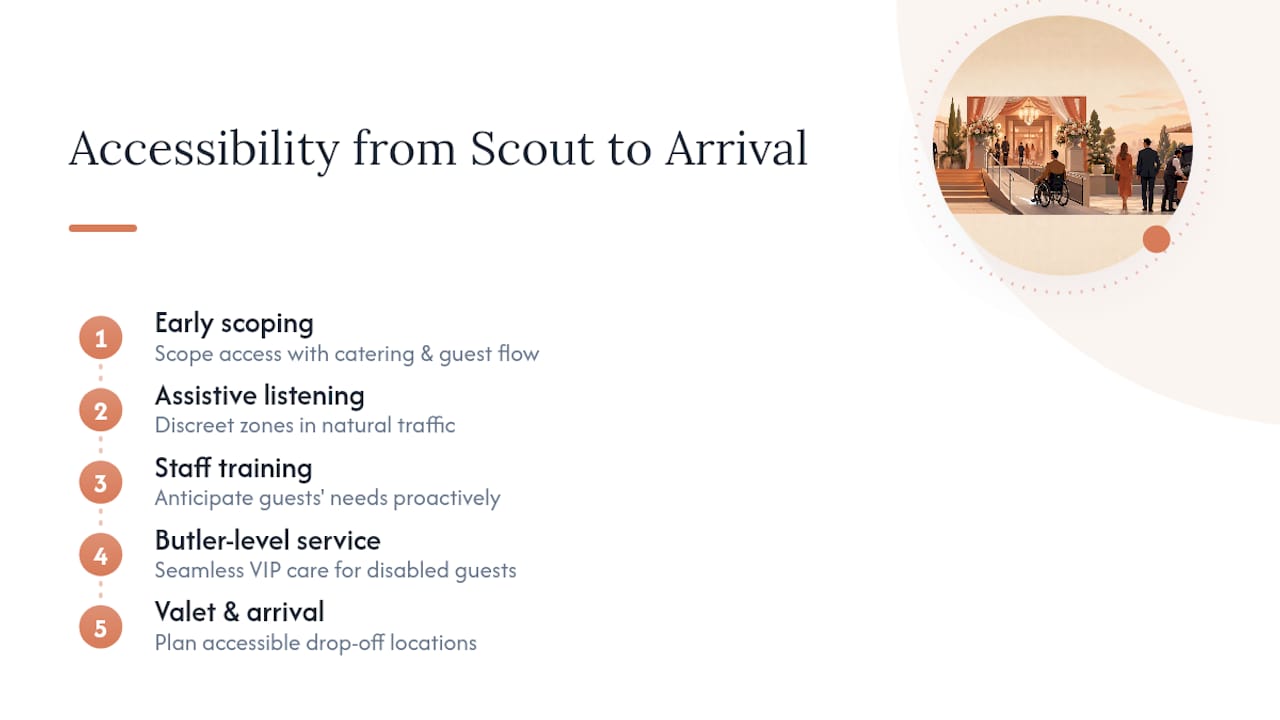
Accessibility in the ultra-luxury space demands more discretion, not less rigor. Bonnie Rae scopes access requirements during the earliest venue-scouting conversations, alongside catering flow and guest-list logistics, so accommodations feel woven into the experience rather than appended to it.
That looks like discreet assistive listening zones tucked into a reception’s natural traffic flow, hospitality staff trained to anticipate a guest’s needs before they ask, and butler-level service that extends seamlessly to VIP guests with disabilities. Even valet and arrival planning accounts for accessible drop-off, because the guest experience begins the moment a car door opens.
Why Most ADA Checklists Miss What Luxury Clients Actually Need
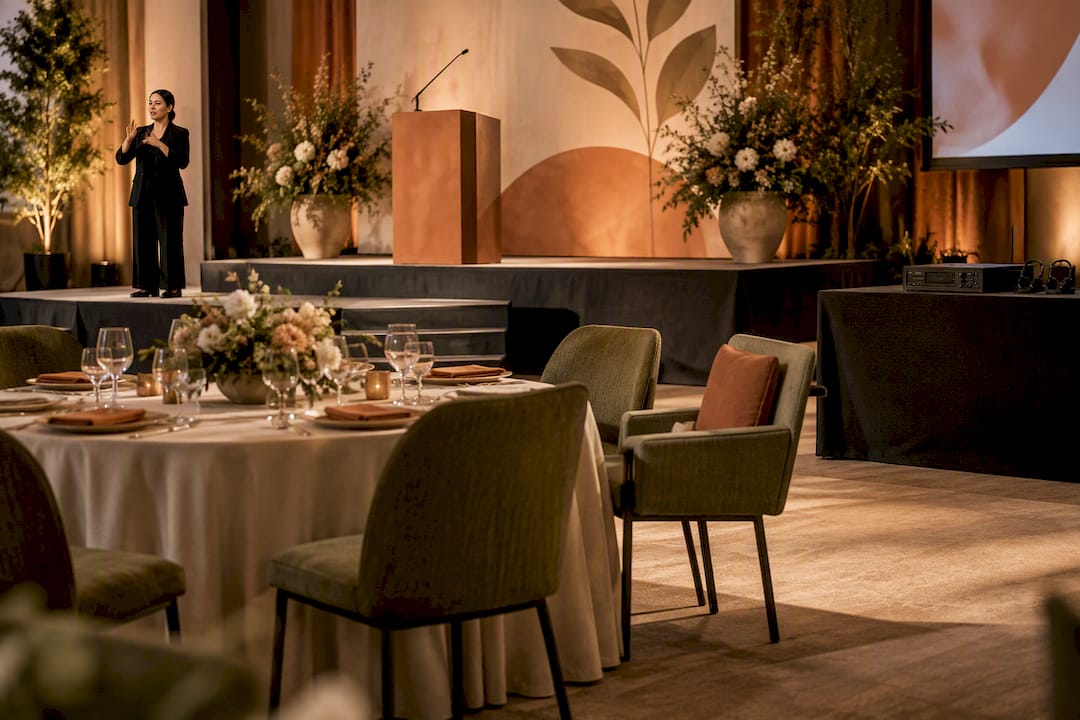
Most ADA guidance treats accessibility as a compliance exercise: check the box, avoid the lawsuit, move on. That framing misses what actually matters for the caliber of event Bonnie Rae produces. A discreet interpreter positioned with sightlines to the stage, a companion seat placed without fanfare beside a client’s usual table, an assistive listening system built into the sound design rather than bolted on as a visible accessory: these are hospitality decisions, not legal ones.
The conventional advice tells planners to satisfy the minimum. The better standard is to make access invisible in its friction and unmistakable in its care. That distinction shows up nowhere in a generic ADA checklist, yet it is exactly what separates a compliant event from a genuinely gracious one.
If you take one thing from this guide, prioritize the venue walk-through and the accessibility coordinator above everything else. Every other requirement, from interpreter booking to digital forms, becomes manageable once those two anchors are in place. Skip them, and even a well-intentioned event runs on guesswork.
— Bonnie Rae
Ready to Build an Accessible, Unforgettable Event?
Some event production companies offer full-service accessibility coordination, staffing, and hospitality design as part of a unified timeline and accountability point, rather than retrofitting accessibility after venue and caterer bookings.
That single-point coordination extends across Full Event Production, Private Events & Catering, Professional Sports Concierge, Brand Installations, Staffing, and the Bar & Sommelier Program, all scoped with accessibility built in from the first venue walk-through, not added as an afterthought. Bonnie Rae’s team, drawn from top-tier restaurant and hospitality backgrounds, applies the same discretion to a service dog’s presence at a private dinner as it does to a Fortune 500 gala’s stage lighting. If you are planning an event for a high-profile client, an executive team, or a professional athlete’s inner circle, consider requesting proposals from full-service event production companies that specialize in accessible, ultra-curated hospitality.
Where to Go for Authoritative ADA Guidance
For legal grounding beyond this guide, consult the Title III manual and ticket-sales guidance directly from ADA.gov, along with the Title III regulations, NAD’s conference guidance, and the Federal Bar Association’s accessibility manual for technical detail and sample checklists. The ADATA temporary events guide offers additional signage and wayfinding specifics worth reviewing before a large-scale production.
Sources
FAQ
What Is the First Step in ADA Compliance for Events?
Walk the venue in person to verify accessible routes, restrooms, and parking rather than relying on the venue’s own claims. Pair that with naming an accessibility coordinator so accommodation requests have a clear point of contact from the start.
Who Pays for Sign Language Interpreters at Events?
The host and venue cover the full cost of interpreters, CART, and other auxiliary aids under Title III. Attendees cannot be charged for their own accommodation.
Can a Venue’s ADA Certification Protect the Host From Liability?
No. Hosts share legal responsibility with the venue even when the venue claims full compliance, so independent verification of routes, restrooms, and AV setup remains the host’s obligation.
Does Bonnie Rae Handle Accessibility Coordination for Luxury Events?
Yes. Bonnie Rae integrates accessibility into venue scouting, staffing, and hospitality design from the earliest planning stages, rather than treating it as a separate compliance task. Full details on services are available through Bonnie Rae’s site.
How Early Should Accessible Seating and Interpreters Be Booked?
Book interpreters and CART providers as soon as the venue and date are confirmed, since qualified providers book out quickly during peak event season. Accessible seating should be listed and sellable the moment general ticketing opens, under the same conditions as standard seats.
Recommended
Comments