
Zero Seams: Event Production vs Planning for Luxury Hosts
Event planners build the blueprint; event producers build the experience on the ground. If your event runs on timelines, budgets, and vendor coordination, you need a planner. If it demands staging, lighting, sound, or a live technical moment, you need a producer. For anything with real stakes, a black-tie gala, a brand activation, a celebrity milestone, you need both working from the same brief.
TL;DR:
Technical complexity, such as synchronized video or custom lighting, determines the need for a producer regardless of guest count.
Engaging production late in the planning process often leads to costly redesigns due to venue or technical constraints.
For high-stakes events with technical or creative elements, having a single integrated team minimizes handoff gaps and ensures seamless execution.
Large events with simple logistics are planning-focused, but smaller events with complex technical needs require production leadership from the start.
Most professionals should develop fluency in both roles, but only high-stakes, technically demanding events benefit from a combined, accountable team.
Table of Contents
Event Production vs Planning: What Separates the Two Roles
The confusion between these two roles is understandable, because their work overlaps at the edges and both disappear into the background when done well. But the distinction is not academic. Event planning manages the logistics, budgets, vendor contracts, and timelines that get an event to the starting line. Event production takes over from there, engineering the technical and creative execution that guests actually experience: the lighting cue, the sound mix, the moment the stage goes dark before a reveal.
Think of it this way. A planner answers “will everything be ready?” A producer answers “will everything work?” Both questions matter enormously for a private dinner at an Aspen estate or a corporate gala at a Manhattan rooftop, but they demand different skill sets, different vendors, and often different personalities. Planners tend to be detail-obsessed project managers. Producers tend to be technical problem solvers who thrive under live-event pressure.
Here’s the part most hosts miss: the terms “event coordination” and “event management” get used almost interchangeably with planning in the industry, while “production” is sometimes assumed to mean anything technical, including audiovisual rental. The more precise framing, and the one worth adopting, is that planning owns the guest and vendor journey before doors open, while production owns the physical and technical build that makes the moment land.
What Is Event Planning? Defining the Role
Event planning is the discipline of managing every pre-event decision that determines whether the day runs on schedule and on budget. A planner’s world is timelines, contracts, and communication, not cables and lighting rigs.
Typical planner deliverables include:
Venue selection, site visits, and contract negotiation
Vendor sourcing and management (catering, florals, rentals, transportation)
Budget tracking and reconciliation across every line item
Guest list management, invitations, and RSVP logistics
A written run of show covering arrival times, ceremony flow, and vendor load-in windows
Day-of coordination to keep the schedule moving
A planner-only engagement works well for smaller, lower-complexity events: an intimate dinner party, a milestone birthday at a private residence, a corporate off-site where the venue’s in-house AV team can handle a microphone and a slideshow. If nothing on your event requires custom staging, elaborate lighting design, or a technical rehearsal, a skilled planner can carry the entire event from concept to closing toast.
Where planners hit their ceiling is technical complexity. A planner can book a lighting vendor. A planner cannot design a lighting plot, troubleshoot a signal dropout during a live performance, or make a split-second call when a rigging point fails an inspection. That is not a knock on the profession. It is simply outside its scope.
What Is Event Production? Defining the Producer’s Job
Event production is the technical and creative discipline that turns a concept into a physical, functioning experience. If planning is the blueprint, production is the construction crew, the electricians, and the stage manager rolled into one coordinated operation.
Production covers the technical and creative execution that a guest actually sees and hears: stage design, lighting programming, audio engineering, video and projection mapping, scenic fabrication, rigging, and live show calling. A producer’s deliverables look different from a planner’s:
Lighting plots and technical drawings for the venue’s electrical and rigging capacity
Full AV system design, including redundancy planning for live audio and video
Crew call sheets, load-in schedules, and strike timelines
Scenic fabrication specs and vendor coordination for custom builds
A minute-by-minute run of show for the live event, cued in real time
On-site technical direction during load-in, rehearsal, and the live show itself
Producer-only engagements make sense when an event is fundamentally a technical or creative production wrapped in minimal logistics, a product launch with a cinematic reveal, a live performance, a large-scale brand activation where the “guests” are really an audience. The complexity lives entirely in the build and the show, not in vendor contracts or seating charts.
What planning documents cannot capture is what happens when something breaks mid-event. A detailed plan is not a substitute for a producer standing at front of house when a wireless mic drops out thirty seconds before a keynote. That real-time technical authority, the ability to diagnose and fix a live problem without the audience noticing, is the entire value proposition of production.
Planning vs. Production: A Side-by-Side Comparison
Dimension | Event Planning | Event Production |
Primary focus / scope | Logistics, budget, vendor contracts, guest experience | Technical and creative execution, staging, AV, live show |
Typical deliverables | Venue contracts, budget tracker, run of show, seating charts | Lighting plots, AV specs, crew call sheets, technical run of show |
Timeline engagement | Steady involvement 3 to 6 months out, peaks in final weeks | Ramps up during pre-production, peaks at load-in and show time |
Core skills / disciplines | Project management, negotiation, vendor relations, hospitality | Lighting design, audio engineering, rigging, live show calling |
Budget impact | Coordination fees, usually a smaller share of total spend | Equipment rental, technical labor, fabrication, usually the largest cost driver |
Best-for event types | Private dinners, intimate celebrations, low-tech corporate meetings | Product launches, live performances, large brand activations |
A few of these dimensions deserve a closer look. Timeline engagement is often misunderstood: hosts assume producers show up the week of the event, when in reality the most valuable production work, structural engineering, permit review, rigging plans, happens months earlier, in parallel with the planning process. Skills and credentials also diverge sharply. Planners often pursue certifications like the Certified Meeting Professional (CMP) designation, which validates competency in logistics, risk management, and stakeholder coordination. Producers, by contrast, tend to carry industry AV and safety certifications tied to rigging, electrical load, and life safety codes, credentials that matter enormously when a lighting truss hangs over a dance floor.
The “best for” column is where most hosts make their first mistake. It is tempting to categorize your event by size alone, assuming a large guest count automatically means you need a producer. Size matters less than technical complexity. A 300-person seated dinner with a single microphone and ambient lighting is a planning job. A 40-person private reveal with synchronized video, custom lighting cues, and a live orchestral moment is a production job, regardless of the smaller headcount.
How Planning and Production Affect Your Budget and Timeline
Production line items, equipment rental, technical crew, custom fabrication, typically represent the largest share of a total event budget once an event moves beyond a basic microphone-and-speaker setup. Planning fees, by comparison, are usually structured as a percentage of total spend or a flat coordination fee, and they cover management rather than materials.
This budget shape has a direct consequence for how you should sequence your hires. If your event has any meaningful technical component, bringing production into the conversation late is the single most expensive mistake a host can make. A stage design finalized without production input often collides with a venue’s actual rigging capacity or fire code, forcing expensive redesigns weeks before the event.
Pro Tip: Ask any vendor quoting a “full production package” to itemize crew hours, equipment rental days, and fabrication costs separately. Bundled quotes hide where your money is actually going, and that makes it nearly impossible to negotiate intelligently.
On timing, the guidance is fairly consistent across the industry. Planners should be engaged three to six months before an event for anything beyond a simple gathering, giving enough runway for venue negotiation and vendor booking. Producers ideally join on a similar timeline when the event involves complex builds, since structural and rigging plans need lead time for engineering review. For simpler production needs, a producer can sometimes be brought on later, focused purely on execution rather than design. The exception that luxury hosts should never test: anything involving custom fabrication, pyrotechnics, or multi-camera broadcast needs production input from day one, not week six.
How to Decide: Planner, Producer, or Both?
Work through these questions in order, and the answer usually becomes obvious by the third one.
How many guests, and how are they moving through the space? A seated dinner for 50 has different needs than a standing reception for 400 with multiple activation zones.
Does the event include a reveal, a performance, or any synchronized technical moment? A product unveiling, a surprise proposal staging, or a live musical performance all require production-level precision.
What is riding on flawless execution? A private family celebration carries different stakes than a Fortune 500 brand launch or a celebrity milestone event covered by press.
What is your actual timeline? Fewer than eight weeks out with any technical complexity is a red flag for scrambling, not smooth execution.
Certain elements are non-negotiable triggers for production. If your event involves multi-camera video capture, LED walls, pyrotechnics, broadcast streaming, or coordination across multiple venues, you need a producer regardless of guest count or budget size. These are not enhancements a planner can bolt on with a rental order.
The bigger strategic question is whether to hire planning and production as one integrated team or as two separately contracted vendors. Most high-stakes events benefit from both roles working from a shared brief, and the research is consistent on why: separate contracts create handoff gaps, moments where the planner assumes production has covered a detail and production assumes planning has, and nobody actually owns it. A single-contract integrated team eliminates that gap entirely because one organization is accountable for the whole night.
If you do go the combined-team route, brief the technical and creative vision first, not the logistics. Tell an integrated team what the event needs to feel like and what the pivotal moment is before you hand over the guest list. Production requirements shape venue selection and timeline far more than the reverse.
Real Scenarios: Which Role Leads Which Event
A private dinner for twelve at a Napa Valley estate. The planner leads almost entirely here: menu coordination with a private chef, wine pairing logistics, table styling, and staff timing. Production input might extend to ambient lighting, nothing more.
A corporate product launch with a cinematic reveal. Production takes the lead, designing the lighting sequence, the reveal mechanism, and the AV cues that build suspense before the unveiling. The planner supports with guest logistics, credentialing, and catering, but the night’s success hinges on production execution.
A multi-track corporate conference across three venues. Both roles carry equal weight here, with a clear ownership split: planning owns registration, room blocks, and speaker logistics, while production owns stage AV, breakout room technical setups, and general session lighting. Without a defined split, this is exactly the event type where handoff gaps cause the most visible failures.
A luxury red-carpet activation for a cultural icon’s brand launch. This calls for a fully integrated team. Production leads the physical execution, step-and-repeat lighting, photography staging, security-adjacent crowd flow, while planning leads hospitality: guest experience, VIP handling, and the details that make press coverage and guest satisfaction align. Neither role can succeed here without the other.
Why Bonnie Rae Builds Integrated Teams for Luxury Hosts
Luxury events carry a specific risk profile that most standard event advice does not address: the guest experience and the technical execution have to be flawless simultaneously, with zero visible seams between them. Many luxury event companies structure engagements around integrated delivery rather than handing hosts a planner and telling them to find their own production vendor.
In-house production capacity matters here because it removes the handoff gap that shows up as a late cue, a lighting mismatch, or a catering timeline that ignores a technical rehearsal window. Vetted staffing matters just as much. For ultra-high-net-worth clients, celebrities, and professional athletes, hospitality details like sommelier programs and private chef coordination carry as much weight as the staging itself, because guests notice both in equal measure.
Hosts preparing to brief a luxury integrated team should have three things ready: a clear picture of the event’s pivotal moment, an honest guest count with any VIP segmentation, and a sense of the technical elements under consideration, even a rough one. That single conversation replaces what would otherwise be weeks of back-and-forth between separately contracted vendors.
Where Planners and Producers Hit Different Walls
Planners and producers face fundamentally different pressure points, and understanding both helps explain why the roles rarely overlap cleanly. A planner’s biggest recurring challenge is vendor reliability: a florist that double-books, a rental company that ships the wrong linens, a caterer that underestimates dietary restrictions. These are logistics failures, solvable with better contracts and buffer time.
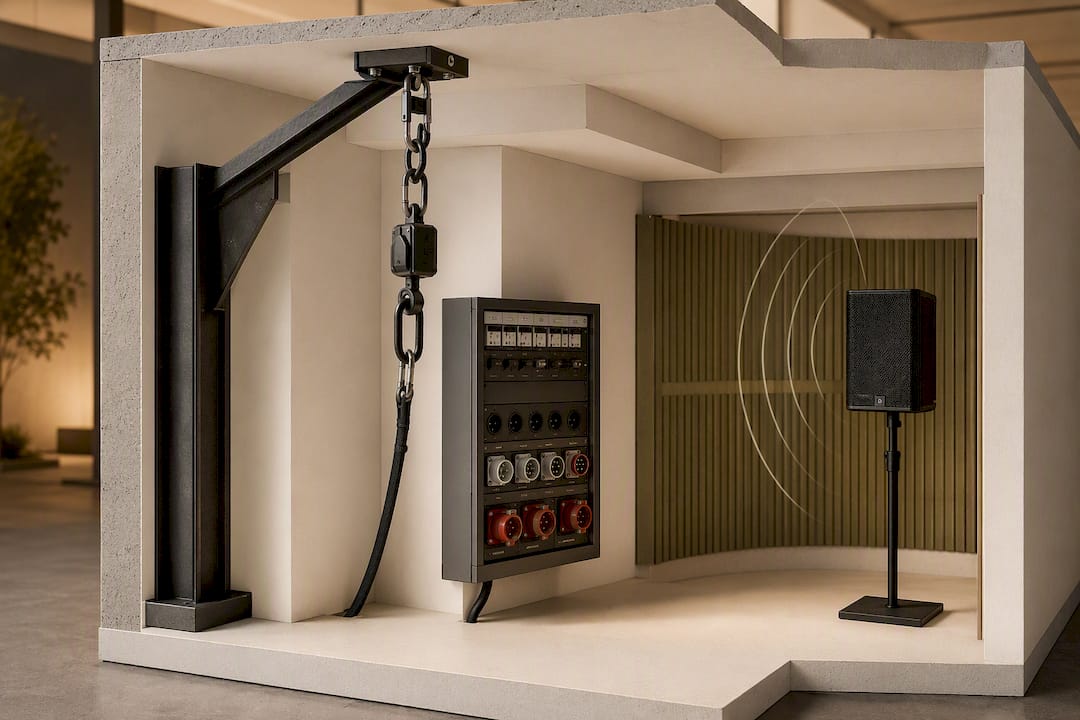
Producers face a different category of problem entirely: physical and technical risk that cannot be solved with a phone call. A rigging point that fails inspection the morning of the event. A power draw that exceeds a venue’s electrical capacity. A live audio system that behaves differently once a room fills with bodies that absorb sound. Excellent planning documents do not prevent these failures; only a producer’s real-time technical judgment does.
The shared challenge both roles face, and where most events actually break down, is communication across the boundary between them. A planner who does not flag a venue’s low ceiling height to production. A producer who does not tell planning that load-in requires four hours, not two. These are not failures of either discipline individually. They are failures of integration, and they are exactly what a single accountable team is built to prevent.
Tools and Software That Keep Planners and Producers on the Same Page
Planners typically live inside project management and event management platforms that track budgets, vendor contracts, and guest RSVPs in one dashboard, alongside shared documents for run-of-show timelines and seating charts. The goal for a planner’s toolkit is visibility across every moving logistical piece at once.
Producers work with a different technical stack: lighting console software for programming cues, audio digital signal processing tools for live sound mixing, and CAD software for stage and rigging plots that get submitted to venues for structural approval. A sample run-of-show or technical spec document, showing exact cue timing, power requirements, and crew positions, is standard practice for any credible production team and something hosts should always ask to see before signing a contract.
The friction point, and where technology increasingly helps close the gap, is in shared scheduling and live-day communication. Reliable live-display and cue-management systems, the kind used to keep audiences and staff aligned during time-sensitive live events, matter just as much for a red-carpet reveal as they do for a live tournament. When both teams work from a shared, real-time schedule rather than separate documents, the number of day-of surprises drops sharply.
How Event Size and Type Change Who Leads
Guest count alone rarely determines which role should lead an event. Complexity does. A large cocktail reception with passed hors d’oeuvres and ambient music is fundamentally a planning exercise because nothing about it demands technical design. A 30-person private dinner with a synchronized multimedia tribute is a production-heavy event despite its tiny guest list.
That said, scale does shift the balance in predictable ways. As guest count grows, planning complexity grows with it: more vendors, more logistics, more moving pieces to track simultaneously. As technical ambition grows, whether that means a multi-camera livestream, custom scenic builds, or synchronized lighting across multiple rooms, production complexity grows independently of headcount. Event type matters more than either factor alone. A wedding, even a large one, tends to lean planning-heavy with modest production needs. A corporate brand activation, even a modest one, often leans production-heavy because the entire point is a designed sensory experience rather than a gathering.
Career Paths: Where Planning and Production Overlap
Most professionals enter this industry through one door and eventually develop fluency in both. A planner who spends years coordinating with production vendors starts to understand lighting plots and AV riders well enough to speak the language fluently, even without designing the systems themselves. A producer who manages enough live events develops budget and vendor negotiation instincts that overlap heavily with planning work.
The career ceiling in both disciplines tends to be the same destination: a role that oversees integrated delivery across both functions, often titled executive producer, creative director, or head of experience at agencies built around full-service delivery. That convergence is not a coincidence. The industry has been moving toward integrated teams for years, precisely because the strongest indicator of execution quality is how well planning and production communicate, not how skilled either discipline is in isolation.
For hosts, this career overlap has a practical implication worth remembering. When you interview a potential full-service partner, ask who on the team has walked both sides of this line. A producer who has never managed a vendor contract, or a planner who has never stood through a technical rehearsal, is less likely to anticipate the handoff problems that sink otherwise well-planned events.
The Real Lesson: Stop Treating This as an Either/Or Decision
Most advice on this topic frames planning and production as a fork in the road, pick one, hire the other separately if you need it later. That framing works fine for a backyard birthday party. It falls apart the moment real stakes enter the picture: press coverage, a brand reputation, a celebrity guest list, a technical moment that has to land perfectly on the first try.
The conventional wisdom undersells how much damage a handoff gap does. Not catastrophic failure, usually, but a hundred small seams: a lighting cue that’s a beat late, a vendor timeline nobody double checked against load-in, a guest experience that feels slightly disjointed even when nothing visibly broke. Hosts rarely notice these individually. They notice the cumulative effect, and they call it “the event felt a little off.”
What should actually drive your hiring decision is not “how big is this event” but “how much is riding on flawless execution, and how many seams exist between the people responsible for it.” For a private dinner, one seam is fine. For a brand launch with press in the room, zero seams is the only acceptable number, and that means one accountable team, not two vendors hoping their timelines line up.
— Bonnie Rae
Bring Your Vision to Bonnie Rae
A single accountable team for both planning and production eliminates the handoff gap, so hosts avoid being stuck between a planner and a production vendor who blame each other when something slips. That structure matters most for exactly the events discussed here: private dinners with a private chef, brand installations for luxury and fashion clients, and high-stakes moments where zero visible seams is the only acceptable standard.
Bonnie Rae’s Full Event Production service covers everything from venue scouting and technical design through staffing, bar and sommelier programs, and hospitality-focused guest experience, all under one contract. Professional athletes and their teams also work with Bonnie Rae’s Professional Sports Concierge offering for team dining and nutrition coordination, while brands planning installations get the same integrated approach applied to activation design.
Before reaching out, have three things ready: your guest count and any VIP segmentation, a rough sense of the technical or creative moment you’re building toward, and your target date. That’s enough for the Bonnie Rae team to scope your event accurately and start the conversation. Visit Bonnierae to request a proposal for your next event.
FAQ
What Are the 5 P’s of Event Planning?
Different sources define this framework slightly differently, but a common version covers purpose, people, place, product, and promotion, the core questions a planner works through before booking any vendor. Not every planning team uses this exact terminology, but the underlying logic, defining the “why” before the “how,” runs through virtually every professional planning process.
What Does an Event Producer Actually Do Day to Day?
An event producer designs and manages the technical and creative execution of an event, including lighting, audio, video, staging, and live show calling. Day to day, that means building technical drawings and cue sheets well before the event, then directing crew during load-in, rehearsal, and the live show itself.
Is Event Planning a Stressful Job?
Event planning is widely considered a high-pressure profession, largely because it involves managing dozens of moving vendor relationships and deadlines that cannot slip. The stress tends to concentrate in the final weeks before an event, when logistical problems and vendor issues surface fastest, though experienced planners build buffer time specifically to absorb that pressure.
Do I Need Both a Planner and a Producer for a Luxury Event?
For most high-stakes or technically complex luxury events, yes, both roles working from a shared brief produces stronger execution than hiring either in isolation. Bonnie Rae structures its engagements around this integrated model specifically to avoid the handoff gaps that occur when planning and production are contracted separately.
What Does Bonnie Rae Charge for Full Event Production?
Bonnie Rae does not publish flat pricing, since every engagement is scoped around guest count, technical complexity, and hospitality requirements. Current details and proposal requests are available directly through Bonnierae.
Recommended
Comments