
Add 30–35% to the Quote: U.S. Wedding Restaurant Buyout Cost
A full restaurant buyout for a wedding or private event often ranges substantially in cost all-in, once service charges and tax get added to the quoted minimum. The two numbers that swing your total the most are guest count and city tier. A 60-guest buyout in a major metro can cost as much as a 120-guest buyout in a secondary market, purely because of where the restaurant sits.
TL;DR:
A full restaurant buyout typically costs $16,000 to $24,300 for a 60-guest wedding in a major metro, including service charges and tax.
Buyout minimums are highly variable, generally increasing by 30 to 35 percent after adding service charges, tax, and estimated additional fees.
The quoted minimum often does not include room rental fees, AV, vendor meals, overtime, or other add-on costs that can significantly increase the total budget.
Scheduling off-peak days, reducing guest count, or securing inclusions like waived fees can help lower overall costs without sacrificing the event experience.
Negotiating tactics focus on shifting dates, requesting specific inclusions, and proving transparency, as venue math is based on displacement floors and premiums for exclusivity.
Table of Contents
What Is a Restaurant Buyout Cost, Really?
The phrase “restaurant buyout cost” gets thrown around loosely, so it’s worth being precise. In industry terms, this is a full-venue rental or exclusive-use booking: the restaurant closes to the public and every table, seat, and staff member belongs to your event for the night. That’s different from a private dining room reservation, which only carves out one section while the rest of the restaurant keeps serving walk-ins.
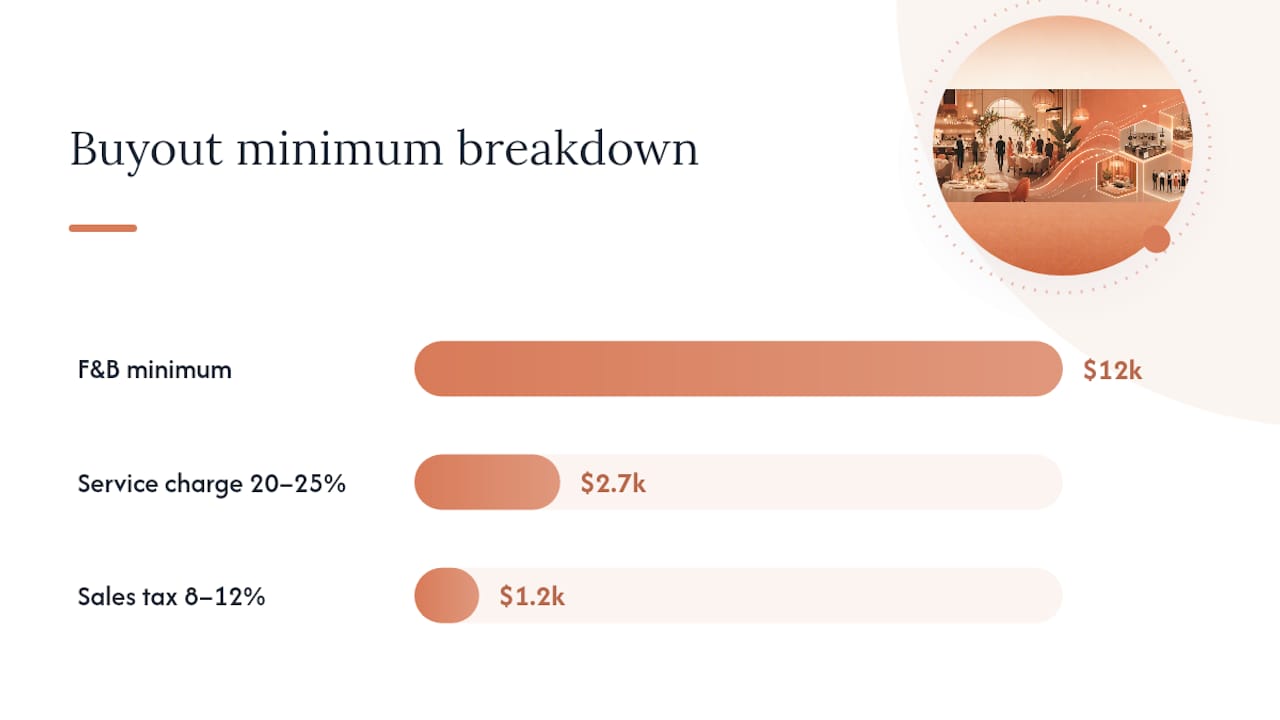
Most quotes you’ll see from restaurants aren’t final prices. They’re food and beverage minimums, meaning the dollar figure the venue expects you to spend on food and drink before service charge and tax get layered on. A $12,000 minimum rarely means a $12,000 night. Once you add the typical 20 to 25% service charge and 8 to 12% sales tax, that quote often becomes $16,000 to $17,000 in reality, according to Gather Shot’s restaurant buyout wedding guide.
For a 50 to 80 guest wedding, full buyout minimums typically range in the low to mid five figures, with per-person food and beverage costs varying broadly depending on the menu and bar program. Smaller intimate buyouts in secondary markets can come in under $8,000. Ultra-luxury bookings in major cities with premium spirits and extended hours can exceed typical high-end minimums before rentals or florals enter the picture.
Typical restaurant buyout prices vary markedly by guest count and market tier, with tier-one market venues often being more expensive than secondary city venues at similar sizes.
Typical buyout minimums and all-in totals vary widely by guest count and market tier, generally increasing from lower ranges for smaller groups in secondary markets to higher ranges for larger groups in major metros. Exact figures differ by venue and specific circumstances.
To convert any venue’s stated minimum into a realistic all-in figure, add roughly 30 to 35% on top, a rule that Privateevents confirms is close to standard across most U.S. markets once room fees, service, and tax are counted together.
Two quick examples make this concrete:
60-guest wedding, mid-tier city: $18,000 F&B minimum + $4,500 service (25%) + $1,800 tax (10%) = roughly $24,300 before rentals or florals.
40-guest rehearsal dinner, major metro: $10,000 F&B minimum + $2,500 service + $1,000 tax = roughly $13,500 before AV or printed menus.
Neither example includes flowers, entertainment, or a dedicated event producer. Those are separate line items entirely, and worth planning for before you fall in love with a venue’s advertised minimum.
What’s Actually Included in a Restaurant Buyout Quote?
A buyout quote almost never tells the whole story on its own page. Understanding what each line represents lets you question a number instead of just accepting it.
F&B minimum: The dollar amount you must spend on food and drink, not a flat rental fee. Spend less than the minimum and you still pay the difference.
Room rental fee: A separate flat charge, often $500 to $5,000 or more, layered on top of the F&B minimum at many venues. Not every restaurant charges this, but plenty do, especially for weekend nights.
Service charge/gratuity: Typically 20 to 25% of the food and beverage total, distributed to staff. Some contracts split this into a mandatory service charge plus an optional gratuity line, which effectively doubles what looks like one fee.
Sales tax: Usually 8 to 12% depending on your state and city, applied after service charge in most jurisdictions.
Add-ons: AV equipment, coat check, security, corkage fees for outside wine, and printed menus. Budget an additional 5 to 15% of your F&B total for these extras combined.
That’s $6,750 in fees on top of the number printed at the top of your quote, before you’ve ordered a single flower arrangement.
Corkage policies deserve a specific mention. Some restaurants ban outside alcohol entirely during a buyout, since the bar program is part of what you’re paying the F&B minimum for. Others allow a limited number of outside bottles at a per-bottle fee, usually $20 to $40. Ask about this early, especially if a client wants a specific wine collection served.
How Do Restaurants Price a Buyout?
Restaurants don’t pull buyout numbers out of thin air, and understanding their math gives you real leverage at the negotiating table. Most operators follow a version of the same three-step formula.
Set a displacement floor. The venue pulls its last several matching time slots, say six recent Saturday dinner services, and averages the gross revenue those nights generated. That average becomes the baseline: the amount the restaurant would have earned anyway without your buyout.
Apply a buyout multiplier. Operators typically multiply that baseline by 1.25 to 1.35, since a private event carries more planning overhead, staffing coordination, and menu customization than a normal service night, according to Sway’s guide on buyout pricing.
Add an access premium. On top of the multiplied baseline, many restaurants tack on another 15 to 25% simply for granting exclusive access and turning away their regular clientele for the night.
Here’s a worked example. Say a restaurant’s average Saturday night revenue is $12,000. Multiply by 1.3, and you get $15,600.
Weekend nights carry the steepest premiums for a reason: they’re the restaurant’s highest-earning shifts on a normal week, so displacing them costs the most. Restaurant Velocity’s operator guide recommends operators price Saturday-night buyouts at projected daypart revenue plus a 25 to 50% premium specifically to avoid cannibalizing full-year margin.
Seasonality compounds all of this. Peak months, December and late September in particular, can push minimums 15 to 30% higher than the same restaurant charges in January or February, when demand for private dining drops off.
Pro Tip: Ask the venue directly whether their quote already reflects a buyout multiplier and access premium, or whether it’s a flat number they’ve never actually broken down. Restaurants that can explain their own math tend to be more flexible in negotiation than ones reciting a number from a template.
Sample Restaurant Buyout Budgets By City Tier
Numbers land differently depending on where you’re booking, so here’s how three common scenarios play out from quote to final invoice.
All-in total: approximately $41,650.
All-in total: approximately $22,282.
All-in total: approximately $11,556.
Here’s the same three scenarios in table form for quick reference:
Shifting any of these off Saturday night changes the equation meaningfully.
Saturday evening: full premium pricing, the highest minimum you’ll see.
Friday evening: typically 10 to 15% below Saturday.
Weekday evening: typically 25 to 40% below Saturday.
Sunday brunch/lunch: often the lowest minimum of the week, since daytime revenue baselines are smallest.
Negotiating a Restaurant Buyout: What Actually Works
Negotiating a buyout isn’t about asking a venue to simply lower its number. Most operators won’t budge much on the headline minimum, since it’s tied to real displacement math. What moves the needle is asking for specific concessions instead.
Shift the date or time. Off-peak seasons (January through March), weekday bookings, and earlier start times (5:00 PM instead of 8:00 PM) all reduce the displacement baseline a venue is working from.
Ask for two-tier pricing. Many venues have a published base buyout and a premium buyout with extra inclusions. Sway’s research found operators who offer this structure capture more revenue overall while still giving planners a lower entry point to negotiate from.
Request specific inclusions rather than a discount. Asking a venue to waive the separate room fee, cap staff overtime hours, or allow a limited corkage exception tends to succeed more often than asking them to cut the F&B minimum itself, according to Privateevents.
Offer something back. A larger non-refundable deposit, a guaranteed final guest count locked in early, or booking 9 to 12 months out all give a venue certainty they’ll reward with flexibility elsewhere.
A realistic negotiation timeline looks like this: initial inquiry and site visit, followed by a first proposal with base pricing, then a counter-request focused on two or three specific inclusions, followed by a revised proposal, then contract signing with a deposit due within one to two weeks.
Pro Tip: For high-net-worth clients, trading a lower headline price for better inclusions, an extra bartender, a private arrival cocktail hour, an upgraded tasting menu, usually delivers a better guest experience than squeezing the venue on its base number.
Staffing and Operational Costs That Change the Total
The number on your contract only tells part of the story. Understaffing a buyout is one of the fastest ways to turn a beautiful venue into a frustrating guest experience, and it’s rarely reflected in the original quote until you ask specific questions.
Professional event operators generally follow these staffing benchmarks:
One bartender per 50 guests for a standard cocktail-format bar.
One bartender per 30 guests when the bar program is heavy, think an open bar with cocktails made to order rather than wine and beer only, a ratio Bonnie Rae’s own staffing research confirms prevents the long lines that plague underplanned events.
One server per 10 to 12 seated guests to keep plated courses moving without noticeable lag between tables.
Falling short on any of these ratios shows up immediately: slow drink service, delayed courses, and a dining room that feels chaotic instead of composed. Adding staff beyond a venue’s default plan typically costs $35 to $75 per hour per additional team member, a cost worth building into your budget rather than discovering at the eleventh hour.
AV and staging needs also add real dollars. A restaurant with in-house sound is rare; most buyouts require rented microphones, speakers, or lighting if there’s a toast, speech, or first dance planned. Expect $500 to $2,500 depending on complexity. Menu format matters too. A multi-course plated dinner demands more kitchen labor and tighter timing than a passed-appetizer reception, which can add its own labor surcharge on more ambitious menus.
Booking Timeline and Contract Checklist
Locking in a restaurant buyout early protects both your date and your pricing, since minimums tend to climb the closer you get to peak season without a signed contract.
Start 9 to 12 months out for weddings, and 4 to 6 months out for corporate or private events. Popular venues in major metros book out even further for peak Saturday dates.
Expect a deposit of 25 to 50% at signing, with the balance due anywhere from 30 days before the event to the day of, depending on the venue’s policy.
Confirm attrition and cancellation clauses. Attrition terms determine what happens if your final guest count drops below the number the minimum was based on. Cancellation terms determine what you forfeit if plans change.
Ask for the guaranteed guest count deadline, typically 72 hours before the event, since this is the number your final F&B minimum gets locked against.
Request a sample invoice before signing. Confirm in writing whether the quoted number already includes service charge and tax, or whether those get added afterward.
Confirm vendor access windows. Florists, AV teams, and photographers all need setup time, and some venues restrict early access on buyout days.
Partial Buyout vs. Full Buyout: Which Costs More?
A partial buyout reserves one section, floor, or private room while the rest of the restaurant continues serving regular guests. A full buyout closes the entire venue exclusively to your group. The cost gap between them is significant, and it’s not just about square footage.

Partial buyouts typically carry lower F&B minimums, since the restaurant still earns revenue from the tables it hasn’t handed over to you.
Full buyouts command the access premium discussed earlier precisely because the venue turns away every other potential reservation for that shift. That premium isn’t padding. It reflects real lost revenue from walk-ins, regulars, and other bookings the restaurant declines once your date is confirmed.
For most weddings and milestone celebrations, a full buyout is worth the added cost. Speeches, first dances, and formal moments simply don’t work with unrelated diners fifteen feet away. Corporate dinners or smaller rehearsal gatherings sometimes make more sense as partial buyouts, especially when the guest list is under 30 and privacy from the general public matters less than budget efficiency.
One overlooked factor: some restaurants won’t offer full buyouts at all on their highest-revenue nights, only partial buyouts, since giving up the whole dining room on a Saturday is too costly for them to accept even at a premium. Always ask directly rather than assuming full exclusivity is on the table.
Why Location Changes the Number Beyond Just City Tier
Market tier explains a lot, but it doesn’t explain everything. Two restaurants in the same city, even the same neighborhood, can post buyout minimums that differ by thousands of dollars based on factors that have nothing to do with population size.
A restaurant’s typical nightly revenue matters more than its address. A 40-seat tasting-menu restaurant with a $200 average check will have a far higher displacement floor than a 60-seat neighborhood bistro averaging $70 per head, even if both sit on the same block. That’s why a “major metro” quote can sometimes undercut a “secondary market” quote, if the secondary-market restaurant happens to be the area’s premier special-occasion destination.
Neighborhood matters within a city too. A restaurant in a dense entertainment or business district often carries a higher baseline than one in a quieter residential pocket, simply because its regular weekend traffic runs heavier. Waterfront, rooftop, and skyline-view restaurants routinely charge above their neighborhood’s typical range purely for the setting, independent of food and beverage quality.
Local event demand density plays a role too. Cities with a high concentration of weddings, galas, and corporate events across a compressed calendar, wedding season in coastal resort towns, for instance, see minimums spike in ways that flat “market tier” categories don’t fully capture. If you’re planning outside the obvious major metros, ask specifically about the restaurant’s own peak weekends rather than assuming a smaller city means a smaller number.
Hidden Fees That Can Blow Up a Restaurant Buyout Budget
The stated minimum and the estimated service/tax markup cover most of a buyout invoice, but several charges tend to surface late in the process, often after a deposit is already down.
Cake-cutting or plating fees: $2 to $5 per guest if you’re bringing in an outside dessert or cake rather than ordering from the restaurant’s kitchen.
Vendor meal charges: Photographers, videographers, and musicians often need to be fed, and some venues bill vendor meals at full menu price rather than a reduced staff rate.
Overtime staffing fees: If your event runs past the contracted end time, expect per-hour overtime charges for every staff member still on the floor, sometimes 1.5 times the standard rate.
Cleaning or turnover fees: Especially for events with confetti, real florals with heavy pollen, or extensive decor installations.
Furniture removal or storage: If you’re bringing in specialty rentals and the restaurant needs to store its own tables and chairs elsewhere for the night.
Late-night noise or neighbor fees: Restaurants in mixed residential/commercial buildings sometimes pass along fines or extra security costs tied to noise ordinances.
None of these are necessarily dishonest add-ons. They’re simply real costs of running a private event inside a working commercial kitchen, and most reputable venues will disclose them if you ask directly during your site visit rather than waiting for the final invoice to explain them.
Smart Ways to Reduce Restaurant Buyout Costs
Cutting cost on a buyout doesn’t have to mean cutting quality, if you know which levers actually move the number without touching the guest experience.
Shifting your date is the single biggest lever available. If your guest list skews flexible, floating two or three date options to the venue during negotiation often surfaces a meaningfully lower quote.
Trimming guest count by even 10 to 15 people can shift you into a lower minimum tier entirely at some venues, especially smaller restaurants with tight capacity brackets. Reworking the bar program, capped wine and beer instead of a full open bar, typically reduces per-person F&B costs by $15 to $40 without feeling like a downgrade to most guests.
Booking earlier in the evening, a 5:00 or 5:30 PM start instead of 7:30 or 8:00, shifts you into a lower displacement bracket at many restaurants, since earlier slots typically generate less regular revenue. Finally, asking for inclusions rather than discounts, a waived room fee, complimentary cake cutting, capped service hours, preserves the guest experience while still lowering your true out-of-pocket total.
Red Flags to Watch For in a Buyout Quote
Not every quote is written with your best interest in mind, and a few warning signs are worth taking seriously before you sign anything.
Be cautious of any venue that won’t clarify whether service charge and tax are included in the headline number. This is the single most common source of budget shock, and a reputable venue should answer it without hesitation. Similarly, watch for vague language around attrition, if a contract doesn’t specify exactly what happens when your final guest count comes in below the number the minimum was calculated against, ask for that clause in writing before signing.
A venue that refuses to share a sample invoice or itemized breakdown is asking you to trust a number you can’t verify. Reputable operators, especially those following a transparent multiplier-and-premium model, should be comfortable showing their math. Watch too for last-minute add-ons introduced after the deposit is paid, especially staffing or AV charges that weren’t mentioned during the proposal stage.
Finally, be skeptical of a quote that seems dramatically lower than comparable venues in the same market and guest range. It often means either the room fee, service charge, or tax hasn’t been factored in yet, or that staffing levels built into the plan won’t be sufficient for your guest count.
How Bonnie Rae Structures Buyouts for High-Profile Clients
We build every buyout proposal around a base and premium structure, mirroring the two-tier pricing model operators increasingly rely on. That means negotiating specific inclusions, waived room fees, capped overtime, guaranteed staffing ratios, rather than chasing a lower headline number that might come at the expense of the evening itself.
Our operational checklists exist precisely because a beautiful venue with an understaffed bar or a rushed AV run-through undoes months of planning in a single evening. We confirm bartender-to-guest ratios, walk every AV cue in advance, and build vendor meal and overtime costs into the proposal upfront rather than letting them surprise a client after signing.
For clients weighing menu format decisions, we often reference our own comparisons between private chef experiences and full catering, and for corporate clients, our gala budgeting framework shows how these same principles scale to larger, higher-stakes events.
— Bonnie Rae
Let Bonnie Rae Handle Your Restaurant Buyout Negotiation
Bonnie Rae is the alternative to negotiating a buyout alone: our team scouts venues, negotiates the displacement math and access premium on your behalf, and builds the staffing plan before a single deposit changes hands.
Planning a full buyout yourself means learning venue pricing structures, chasing down sample invoices, and staffing your own event on top of everything else on a wedding or corporate calendar. We handle venue scouting, contract negotiation, menu curation, staffing, and day-of execution as one coordinated process, so a client gets better pricing terms than they’d secure solo and a guest experience with no operational gaps. For a private chef alternative to a full buyout, our private chef dinner breakdown is worth a look too. If you’re weighing a restaurant buyout for an upcoming wedding, gala, or private celebration, reach out to Bonnie Rae to start a proposal built around your date, guest count, and market.
Sources
The pricing methodology behind this article draws primarily from Sway’s buyout pricing research for the displacement, multiplier, and access premium model, and from Gather Shot’s wedding buyout guide for headline cost ranges. PrivateEvents.co informed the line-item and budgeting-rule sections, while Restaurant Velocity’s operator guide shaped the seasonality and weekend-premium analysis throughout.
Recommended
Comments