
48 Hour Follow Up: Influencer Dinner Strategy, Hospitality First for Brands
The most effective influencer dinner strategy is deceptively simple: a small, curated guest list, a dining format engineered for cooperation, and a handful of prescribed conversation prompts placed at exact moments in the meal. Bonnie Rae builds these evenings around research on shared-plate cooperation and prescribed social interaction, not luck or charisma. Done right, the result is fewer, better relationships that convert into real collaborations, not just polite photos.
TL;DR:
Focusing on influence style rather than follower count helps tailor dinner size, guest behavior, and interaction to maximize trust and collaboration potential.
Shared plates promote cooperation but should be used cautiously with strangers, starting with plated courses and adding family-style dishes as rapport develops.
Structured conversation prompts at specific meal moments significantly accelerate trust-building and lead to more genuine connections than unstructured mingling.
Precise timing, seating, and staffing are critical, with key rules like arriving before guests, starting with drinks in hand, and scheduling remarks mid-meal to maintain engagement.
Running a successful influencer dinner requires comprehensive planning, clear disclosure, and professional production support, often best managed by a dedicated host like Bonnie Rae.
Table of Contents
What Is an Influencer Dinner Strategy, and Why Does the Guest List Matter Most?
An influencer dinner strategy is the deliberate design of a private meal to produce trust, memorable content, and follow-on business relationships, rather than a networking event that happens to serve food. The guest list is the first and most consequential decision in that design. Get it wrong, and no amount of clever staging saves the evening.
Most hosts default to sorting by follower count. That is a mistake. Segmenting by “influence style” rather than reach tells you far more about how a guest will behave at your table. A “Deep Dive” creator, someone who builds long-form trust with a smaller, devoted audience, needs a slower, more intimate room. An “Activation” creator, who thrives on high-velocity content and broad distribution, needs energy, movement, and clear content beats. Mixing the two without intention creates an evening where half the table is bored and the other half is impatient.
Headcount should follow the objective, not the venue’s capacity. For dinners built around deep trust and long-term brand partnerships, keep the guest list small enough to maintain intimacy and meaningful conversation. Beyond that, individual conversation dissolves into table-wide performance. For mixed-deliverable evenings, where you want content output alongside relationship-building, a moderate-sized guest list can work, provided the room is staffed and seated to prevent fragmentation.
Before anyone gets an invitation, run each name through a short filter:
Topical fit with the evening’s theme or brand narrative
Audience overlap with the host brand’s actual customer base
Content format the creator favors (long-form video, stories, static posts)
Existing relationship history with the brand or with other guests
Travel convenience and realistic ability to attend without rushing in late
RSVP tactics matter as much as the list itself. Send invitations that state the guest count explicitly (“an intimate dinner for 10”) to signal exclusivity, require a personal RSVP rather than a form, and follow up once, briefly, 48 hours before the event. Scarcity, communicated honestly, reduces no-shows far more effectively than persistent chasing.
Should You Serve Shared Plates or Individually Plated Courses?
The dining format is not a stylistic choice. It changes how guests behave toward each other. Research on communal eating found that consuming from a shared plate promotes cooperation between both friends and strangers, likely because passing, portioning, and negotiating food creates small, low-stakes moments of coordination that build trust before conversation even starts.
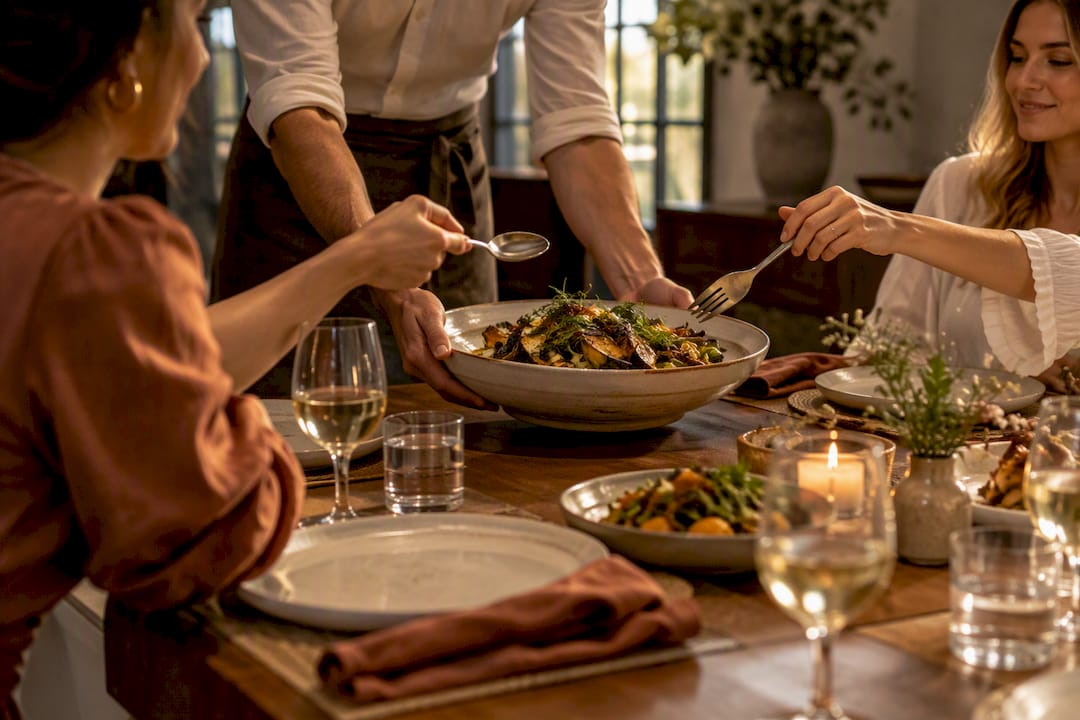
That effect is real, but it is not universal. The nuance matters: shared-plate cooperation depends heavily on cultural comfort, and many Western guests default to a preference for individual plates, especially with strangers at the table. Deploying family-style service on a room of people who have never met can backfire into quiet discomfort rather than warmth.
Use this decision rule: if most guests are meeting for the first time, start with pre-plated courses to establish comfort, then introduce a shared dessert or cheese course once rapport has built. If a meaningful portion of the table already knows each other, family-style service from the first course accelerates the cooperative effect you want. Either way, always build in a private opt-out, clear menu labeling, a plated fallback, or a pre-event dietary and format check, so no guest feels cornered by a service style they did not choose.
Operational trade-offs deserve equal attention. Allergies and dietary restrictions are harder to manage across shared platters. Creator optics matter too: a shared-plate table photographs as warm and unguarded, while plated courses photograph as polished and formal. Choose based on the story the brand wants told.
Confirm dietary restrictions and allergies in writing before finalizing the menu
Offer a shared-plate opt-in rather than assuming universal comfort
Match service complexity to staffing capacity, family-style demands more attentive floor coverage
Brief creators in advance on the format so they know what to expect on camera
Pro Tip: If you’re unsure which format fits, run a hybrid: serve the first two courses plated for comfort, then bring the main course family-style once the table has warmed up. It gives you the cooperative upside without the early-evening awkwardness.
What Conversation Prompts Actually Build Trust at a Dinner?
Prescribed interaction, structured exercises or pairings that engineer specific conversations rather than leaving guests to mingle randomly, has measurable effects. Modeling research on collaboration formation found that prescribed interactions at events significantly raise the odds of future collaboration compared with unstructured mixing, and some models suggest the increase can be an order of magnitude when the interaction is deliberately engineered into the program.
Deep, imaginative prompts also outperform small talk. Prompts that ask guests to reflect, imagine, or share something specific build trust faster than the standard “what do you do” networking exchange, and additional research on event design backs the same pattern: playful, imaginative exercises create novel connections that generic mixing rarely produces.
Here is a tested sequence, matched to the arc of the meal:
Arrival, drink in hand: a light icebreaker, “name one trip you’re planning,” keeps hands and minds occupied without forcing depth too early.
First course: a “make-up-a-memory” prompt, guests invent a fictional shared memory together, which sounds silly but reliably breaks social formality fast.
Early main course: a rapid gratitude round, each guest names one person or moment they are grateful for professionally this year.
Mid-meal, the deep prompt: pair guests for a two-minute exchange on a genuine professional challenge they are facing. This is the highest-value moment of the evening.
Mid-meal toast: the host delivers brief remarks here, not at the opening. Practitioner data from 40 private dining events shows mid-meal remarks land better and hold attention longer than opening toasts.
Dessert: a reciprocal-help pairing, each guest names one specific way another person at the table could help them, and vice versa.
Dessert reflection: a closing round where each guest names one takeaway from the evening in a single sentence.
Departure: a personal, one-on-one goodbye from the host to every guest, no group farewells.
Introduce each prompt lightly, almost as an aside, rather than announcing it as an “activity.” The goal is structure that feels spontaneous, and a host who treats the prompts as genuine curiosity rather than a script will get far more honest answers.
How Do Seating and Timing Shape the Room?
Seating is not decoration. It is the mechanism that either enables or blocks every prompt above. A well-built seating plan engineers conversation by pairing complementary expertise, deep-relationship creators next to brand decision-makers, activation creators next to each other for energy, and never seating two people with an existing rivalry across from one another. Fixed seating works best for dinners under 12 guests. For larger, mixed-deliverable evenings, a single rotation between courses (never more than one) keeps energy fresh without disorienting the room.
Timing rules, drawn from practitioner accounts of dozens of private dining events, sound almost too simple to matter, yet they consistently separate a memorable evening from an awkward one. The host must arrive before the first guest, every single time. Every guest should have a drink in hand within 30 seconds of walking in the door. Buffets are avoided entirely at this tier of event, they fragment the room and kill the cooperative effect a shared table creates. Toasts and remarks land mid-meal, not at the open.
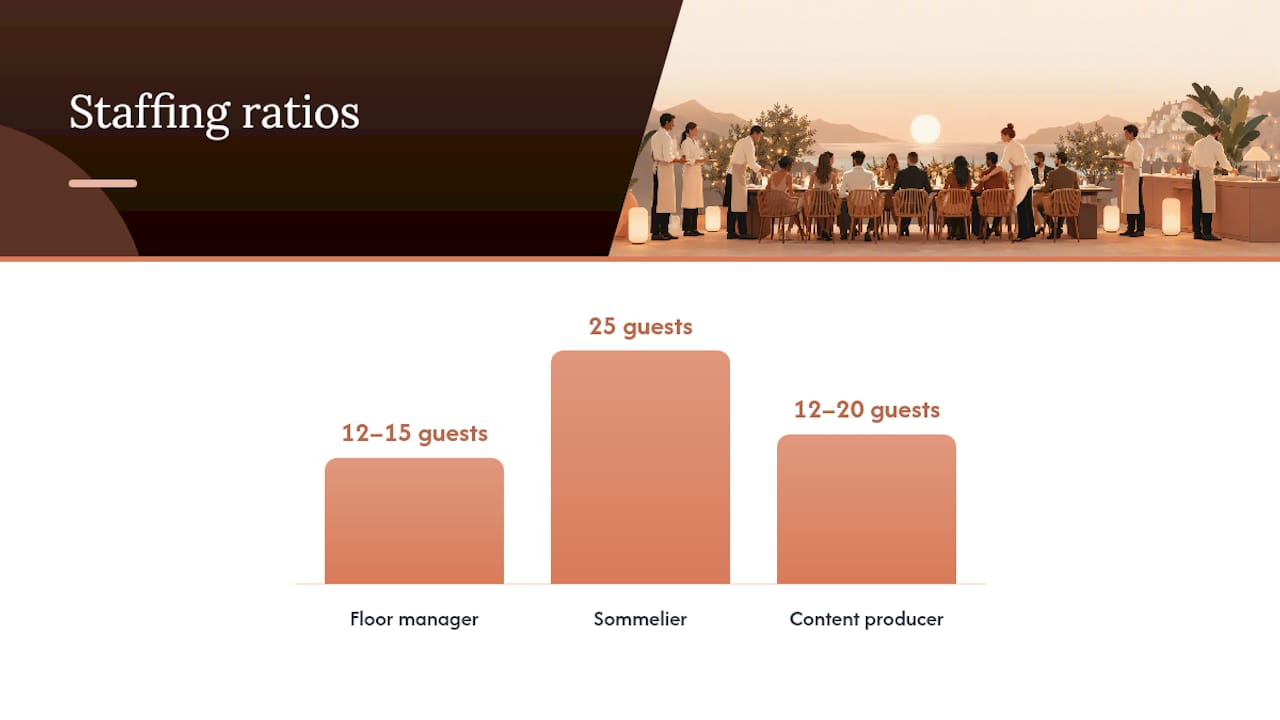
Staffing ratios matter just as much as the choreography. For private and ultra-high-net-worth dinners, plan on one floor manager per 12 to 15 guests, one sommelier per 25 guests for a full wine program, and one dedicated content producer for every 12 to 20 guests when capturing footage is part of the brief.
Confirm every allergy and dietary restriction 72 hours out, then again the morning of
Build a discreet privacy protocol for high-profile guests, no name cards visible from adjacent tables, no unsanctioned photography
Assign a single point of contact for security or personal assistants accompanying VIP guests
Walk the room 30 minutes before doors open to check lighting, sightlines, and acoustics for conversation
Pro Tip: Assign one staff member solely to “read the room.” Their only job is to flag a guest who seems disengaged or uncomfortable so a floor manager can quietly adjust, more wine, a seat change, a private word, before it becomes visible to anyone else at the table.
How Do You Measure Whether the Dinner Actually Worked?
A dinner that produces beautiful photos and no follow-up business is a missed opportunity. Measurement starts with a content brief written before the event, not scrambled together the morning after.
The brief should specify hero moments to capture (the toast, the deep-prompt pairing, arrival shots), a light B-roll list for ambience and food styling, guest anonymity preferences for anyone who does not want to be tagged, and a clear list of who gets featured in the final edit versus who appears only in background footage.
KPI | What it captures | Why it matters |
Content pieces produced | Total usable photo/video assets | Determines amplification runway |
Story and post views | Reach of creator-published content | Signals audience resonance |
Engagement lift | Comment/save rate vs. creator’s baseline | Shows content quality, not just volume |
Follow-up meetings booked | Calls or meetings scheduled post-event | Direct measure of relationship conversion |
Referral rate | New introductions made by attendees | Long-term network value |
Post-event activation runs on a tight clock. Within 48 hours, send each guest a curated content packet and an individualized follow-up ask, never a mass email. Within 7 to 14 days, propose one specific next step or collaboration per guest. Beyond that window, warmth fades and the evening becomes a nice memory instead of a business outcome. Paid amplification, boosting a creator’s organic post or repurposing UGC into brand channels, should happen inside that same two-week window while the content still feels current. A structured 90-day conversion plan helps translate a single evening’s content into a full campaign asset library rather than a one-time flurry of stories.
Bonnie Rae’s Hospitality-First Production Rules
Every element above only works if the production behind it is flawless. Bonnie Rae’s teams run every influencer dinner against the same operational checklist, refined across events for professional athletes, executives, and cultural icons who have no tolerance for a fumbled evening.
Host and full staff on-site and ready at least 30 minutes before the first guest arrives
Drink in hand for every guest within 30 seconds of arrival, no exceptions
No buffet service under any circumstance at this tier of event
Toast and host remarks scheduled mid-meal, never as an opening speech
Seating chart finalized 48 hours out, reviewed once more the morning of the event
Dedicated content producer briefed on hero moments before doors open
Privacy and security protocol confirmed in writing for any high-profile attendee
Element | Bonnie Rae standard |
Host arrival | Before first guest, always |
Drink service | Within 30 seconds of arrival |
Meal service style | No buffets; plated or shared with opt-out |
Toast timing | Mid-meal, not opening |
Staffing ratio | 1 floor manager per 12 to 15 guests |
What Are the Legal and Ethical Rules for Influencer Dinners?
Any influencer dinner that involves a brand paying for the experience, gifting product, or compensating a creator in any way triggers disclosure obligations under the FTC’s Endorsement Guides. Creators must clearly disclose the material connection, hashtags like #ad or #sponsored placed where a viewer will actually see them, not buried in a caption’s final line.
Brands and event producers share responsibility here. If Bonnie Rae or any host organization arranges the dinner on behalf of a brand, that brand should have a written disclosure policy communicated to every attending creator before the event, not left to individual interpretation after the fact. Verbal-only agreements create ambiguity that regulators do not forgive.
Ethical practice goes beyond legal minimums. Guests should know in advance whether an evening is purely relationship-building or explicitly tied to a content deliverable. Ambushing a creator with a content ask mid-dinner erodes the trust the entire format is designed to build. Respecting a guest’s choice to decline photography or tagging, and honoring that choice in the final edit, protects both the relationship and the brand’s reputation with the broader creator community. Transparency at every stage is what separates a hospitality-first strategy from a transactional one dressed up as intimacy.
Why Curated Dinners Beat Scale for Relationship-Driven Outcomes
The instinct to invite more people to a brand dinner is almost always the wrong instinct. Scale dilutes exactly the mechanism that makes these evenings valuable, the prescribed interaction, the shared plate, the mid-meal moment where a guest says something true. A room of 60 produces content. A room of 10, built with intention, produces relationships that compound.
Bonnie Rae’s approach treats each dinner as one chapter in a longer guest journey rather than a standalone event. A single evening rarely changes a brand relationship. A repeatable series—a quarterly brand dinner, an annual alumni gathering for past collaborators—does. Guests who attend a well-run second or third dinner arrive already trusting the room, which means the deep prompts land faster and the collaborations that follow are bigger.
Luxury hospitality itself signals something creators register instantly: that the brand values their time enough to get every detail right. That perceived care, more than any swag bag, is what makes a creator say yes to the next ask.
— Bonnie Rae
Bonnie Rae: Managed Production for Influencer Dinners
Bonnie Rae is the direct alternative to piecing together an influencer dinner from a rented venue, a freelance caterer, and a hope that the seating chart works out. Every element covered in this guide, guest segmentation, format selection, prescribed prompts, seating engineering, staffing, content capture, is built into a single managed engagement rather than left to a marketing team juggling five vendors under deadline.
A full-service engagement includes event production, private events and catering, professional sports concierge dining, brand installations, staffing, and a bar and sommelier program, all coordinated through one point of contact. That means the guest list strategy, the mid-meal toast timing, and the content producer briefed on hero moments come from the same team rather than three separate contracts that never quite align on the day. For brands working with professional athletes or high-profile executives, Bonnie Rae’s team also brings dedicated concierge dining and nutrition expertise that a standard caterer simply does not offer.
If your next influencer dinner needs to land on the first try, start a conversation with Bonnie Rae about production for your next event.
Sources
This guide draws on peer-reviewed and practitioner research into how shared meals shape trust and collaboration:
FAQ
What Is an Influencer Dinner?
An influencer dinner is a curated, invitation-only meal designed to build trust and working relationships between a brand and a small group of content creators, rather than a large-scale networking event. The format leans on hospitality, thoughtful seating, and structured conversation to create the kind of connection that a conference or product launch rarely achieves.
What Is an Influencer Strategy?
An influencer strategy is a deliberate plan for identifying, engaging, and building long-term relationships with creators whose audience and content style align with a brand’s goals. In the context of dinners, the strategy centers on guest segmentation, prescribed interaction, and measurable post-event follow-up rather than one-off outreach.
How Do You Become a Successful Food or Lifestyle Influencer?
Consistency, a clear point of view, and genuine relationships with brands matter more than raw follower count. Attending curated dinners and small-format events, rather than mass press trips, tends to build the kind of trust that leads to repeat collaborations.
What Are Some Tips for Hosting a Successful Dinner Party?
Keep the guest list small and intentional, choose a dining format that fits how well guests already know each other, and time your toast for the middle of the meal rather than the opening. Small production details, like making sure every guest has a drink in hand within 30 seconds of arrival, matter more than guests realize.
Does Bonnie Rae Handle Influencer Dinners for Brands?
Yes, Bonnie Rae produces full-service influencer and brand dinners, including guest list curation, venue selection, staffing, and content capture. Pricing is available on request through Bonnie Rae’s site.
Recommended
Comments