
For Luxury Hosts: Event Staff Dress Code Role by Role From Bonnie Rae
Adopt a role-by-role dress standard that specifies colors, footwear, identification, and who supplies each item, then write it into the booking before staff are ever confirmed. This single move eliminates the two most common failures on event day: mismatched uniforms and gaps in who’s responsible for replacing them. Confirm two details before deployment: the approved color palette and whether branded pieces come from your venue, your agency, or your production partner.
TL;DR:
Staff uniforms should be role-specific, with clear color palettes, identification methods, and footwear requirements tailored to each event type and function.
Dress code standards must specify who supplies and launders each uniform item, with responsibilities clearly documented in the staffing contract to prevent disputes.
PPE for build and strike crews, such as hi-vis vests, gloves, and hard hats, must be provided and paid for by the employer, following OSHA and DOL guidelines.
Proper sizing, fitting, and timely restocking of uniforms are critical, with sampling and pre-shift checks helping prevent last-minute failures.
Luxury event staff standards demand tailored, discreet attire, impeccable grooming, and attention to detail, as these elements directly influence guest perception and satisfaction.
Table of Contents
Event Staff Dress Code Standards by Role and Event Type
A dress code only works when it’s written for the job, not the event category. A black-tie gala and a trade show floor demand different silhouettes, but the roles inside them, server, bartender, registration, usher, security, production, need the same clarity regardless of setting.
For a formal gala, servers wear black tailored suits or floor-length aprons over white shirts, bartenders add a vest or bow tie to signal seniority behind the bar, and ushers wear a subtle lapel pin distinct from guest attire. Security stays in plainclothes dark suits, never visible tactical gear, unless the venue’s risk profile requires otherwise.
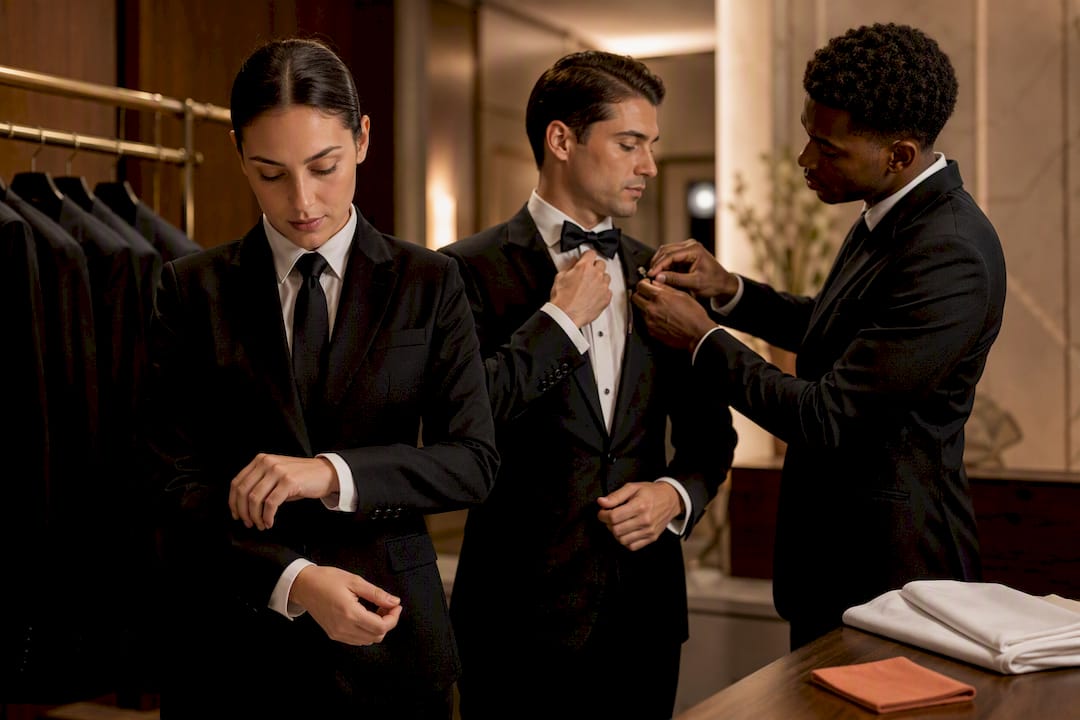
For a corporate dinner, business formal applies across service roles: charcoal or navy suiting, closed-toe leather shoes, and name badges rather than lanyards, which read too casual for the room.
For a business casual conference, registration and ushers wear branded polos or blouses with khakis or tailored trousers, while production crew keep dark, unbranded basics that won’t compete with stage lighting.
At a trade show, branded soft-shell jackets or vests over uniform shirts help guests spot staff instantly across a crowded hall.
For an outdoor festival, moisture-wicking fabric, brimmed hats, and closed-toe non-slip shoes matter more than formality, and security needs high-visibility elements after dark.
Across every format, a few rules hold constant:
Closed-toe, non-slip footwear is non-negotiable for anyone on their feet near food, drink, or crowd flow.
Jewelry stays minimal, no dangling earrings or loose bracelets near open flame, glassware, or machinery.
Staff should always read as slightly more formal than the most casual guest in the room, never the reverse.
Outer layers (jackets, aprons, vests) should carry the one visible brand or role cue guests use to identify who’s on duty.
What Every Written Dress Code Must Specify
An unambiguous dress code answers five questions before a single staff member gets dressed: what color, what identification, what’s on their feet, how they’re groomed, and who pays when something needs replacing.
Color palette. State it precisely, “black, charcoal, or navy only, no patterns above the knee,” rather than “business attire,” which every crew member interprets differently.
Identification. Choose one method per event, embroidered logo, contrast jacket, or credential lanyard, and apply it consistently so guests can identify staff at a glance without confusing them with VIPs.
Footwear and PPE. Require closed-toe, slip-resistant shoes for anyone handling food or beverage service. For roles touching build-out or heavy equipment, OSHA’s foot protection standard sets the baseline for when steel-toe or reinforced footwear becomes mandatory rather than optional.
Grooming and accommodations. Set fragrance-free expectations near dining areas and specify how religious garb or grooming requests get handled. The EEOC’s guidance on religious garb and grooming makes clear that accommodation is required unless it creates undue hardship or a genuine safety risk, so build a simple approval path into your staffing brief rather than leaving it to be improvised on site.
Supply and laundering. Name, in writing, who provides each item and who launders it between shifts.
Pro Tip: Put the color palette and supply responsibility in the same clause of your staffing contract. Separating them is where most disputes over “who forgot the jackets” actually start.
Safety Standards for Build, Strike, and Site Hazards
Front-of-house attire and build/strike attire are not the same uniform, and treating them that way creates real liability. The moment staff move from greeting guests to hauling rigging, hazard exposure changes, and clothing requirements have to change with it.
Build and strike crews need hi-vis vests near vehicle traffic or loading docks, gloves for rigging and cable work, and hard hats in overhead-work zones, none of which belong on a server’s shift. OSHA’s PPE standards apply directly to these tasks, and the Event Safety Alliance publishes operational guidance built specifically for live event production hazards.
Who pays for that equipment matters legally, not just operationally. DOL guidance on worker classification is explicit that employers cannot shift required protective equipment costs onto misclassified workers, which is exactly why your booking contract needs to state who supplies PPE before crews arrive.
A short pre-load checklist prevents most of this from becoming a problem:
Walk the site and flag hazards (traffic, overhead rigging, uneven terrain) before crew call time.
Match required PPE to each hazard, not a blanket policy for the whole crew.
Confirm who owns, fits, and inspects the equipment before the first truck arrives.
Managing Uniforms So the Dress Code Actually Works
A dress code is only as good as the logistics behind it. Written standards fail on event day for one reason more than any other: nobody sized, laundered, or restocked the uniforms in time.
Order sample garments before committing to a full run, and confirm fit against your actual roster rather than generic sizing charts, since branded uniforms only support recognition when the fit and fabric match the event’s tone.
Three supply models cover most bookings:
Client-provided premium pieces. The host supplies branded or bespoke items; highest polish, but requires lead time for fitting.
Agency-supplied standard uniforms. Your staffing partner owns inventory, sizing, and laundering; fastest to deploy, consistent quality.
Worker-provided base layers with agency accessories. Staff supply neutral basics (black pants, white shirt), and the agency adds branded elements; most cost-efficient, but harder to keep visually uniform.
Whichever model you choose, name it in the booking so laundering and repair responsibility isn’t assumed. Team leads should run a two-minute pre-shift check on every staff member, ID visible, fit correct, footwear compliant, before the floor opens.
Pro Tip: Build a same-day escalation path for accommodation requests or missing items. A staffer improvising with the wrong shoes is a bigger risk than a five-minute delay while a lead sources a replacement.
How Luxury Events Raise the Bar on Staff Presentation
Ultra-high-net-worth clients, professional athletes, and executives notice details that most guests miss, and the dress code has to account for that scrutiny. Five-star hospitality standards emphasize tailored fit over off-the-rack sizing, discreet rather than logo-heavy branding, and grooming so precise it never draws attention to itself, exactly the posture Bonnie Rae builds into every staffing assignment.
Photography matters here too. At a private estate dinner or a red-carpet activation, staff appear in the same frame as the guests, so wrinkled fabric or mismatched footwear ends up in someone’s photo feed. Fragrance is managed just as tightly as fabric, since a heavy scent near a tasting menu or wine service disrupts the experience maintained uniforms are proven to move guest satisfaction scores in exactly these settings.
A few sample elements we specify for luxury bookings:
Front desk and registration staff in tailored blazers with a single, subtle brand cue.
Servers and sommeliers in fitted black with white gloves reserved for formal courses only.
Butler service staff in fully bespoke uniforms fitted per individual, not per size chart.
Valet teams in weatherproof outerwear that still reads formal from ten feet away.
These standards echo what we track across the industry in our piece on luxury event trends, where presentation expectations keep tightening year over year.
Why We Build Dress Standards Into Every Booking, Not After
We’ve watched a flawless menu and a beautifully styled room get undercut by one bartender in the wrong shoes, guests notice inconsistency faster than they notice excellence. The events that run seamlessly are the ones where role standards and supply responsibilities were locked into the contract before staff were ever confirmed, not negotiated on-site. Write it down early, and the rest of the night takes care of itself.
— Bonnie Rae
Let Bonnie Rae Handle Your Staffing and Uniform Logistics
Bonnie Rae is the alternative to piecing together staffing, uniforms, and briefing across separate vendors. Instead of chasing down an agency for bodies, a rental company for jackets, and a laundering service for turnaround, one contract covers Staffing, sourcing, fitting, laundering, and pre-shift enforcement for every role on your floor.
Our teams draw from highly trained hospitality talent, so the person tailoring your servers’ uniforms and the person briefing them on service standards work from the same playbook. Beyond staffing, our Full Event Production, Valet, Butler Service, and Bar & Sommelier Program all operate under the same tailored, photo-ready standard, whether you’re hosting a private estate dinner, a professional athlete’s team dinner through our Professional Sports Concierge service, or a fashion brand activation through our Brand Installations team. Reach out through Bonnierae to start a proposal, and expect a conversation about your guest list, venue, and tone before anyone talks uniforms.
Authoritative Standards Worth Bookmarking
OSHA’s foot protection standard governs PPE requirements for build and strike crews.
DOL guidance on worker classification clarifies who must supply required protective equipment.
EEOC guidance on religious garb and grooming sets accommodation expectations.
Event Safety Alliance standards cover broader event operations and risk management.
Guest-service presentation guidance informs grooming and front-of-house expectations.
Sources
FAQ
What is the appropriate dress code for event staff?
The appropriate standard is role-specific: servers, bartenders, security, and production crews each need different colors, footwear, and accessories based on their function and the event’s formality. A written policy should specify color palette, identification method, footwear, and who supplies each item, rather than a vague label like “business attire.”
What are common dress codes for events overall?
Most events fall into formal (black-tie or business formal), business casual, and casual outdoor categories, and staff attire should sit one notch more polished than the most casual guest present. Luxury private events and corporate galas typically require tailored formal wear, while festivals and outdoor activations favor durable, weather-appropriate fabric.
What is formal attire for a work event?
Formal work-event attire for staff generally means tailored black or charcoal suiting, closed-toe leather shoes, and minimal jewelry, with any branding kept discreet rather than logo-heavy. For roles like bartenders or ushers, a small distinguishing element, a vest or lapel pin, helps guests tell staff apart from attendees without breaking the formal tone.
Does the 3-3-3 rule apply to event staff uniforms?
The 3-3-3 rule is a personal wardrobe-minimalism concept, not an event staffing standard, so it doesn’t govern professional dress codes. Event staff attire is better guided by role-specific function, safety needs, and brand consistency than by personal-closet frameworks.
Who is responsible for supplying and laundering event staff uniforms?
Responsibility should be assigned explicitly in the staffing contract, whether the client, the staffing agency, or a full-service production partner like Bonnie Rae owns sourcing, fitting, and laundering. Leaving this undefined is one of the most common causes of last-minute uniform failures on event day.
Recommended
Comments