
$350–$700 Per Guest: U.S. Corporate Gala Budget That Protects Luxury

Budget between $350 and $700 per guest for a genuinely luxury corporate gala in the United States, with venue, catering, and production absorbing most of that spend before a single centerpiece gets ordered. Those three categories alone typically eat 60% or more of the total. The rule that keeps that number from ballooning: approve one baseline budget, lock a contingency reserve that requires sign-off to use, typically within a commonly recommended range, and assign a named owner to every line item before contracts go out.
TL;DR:
Venue and infrastructure costs can consume 25 to 40% of a luxury gala’s total budget before considering decor or catering.
Building a detailed line-item budget with quotes for each category helps prevent overspending and surprises on event day.
Production and AV expenses can reach 25 to 40% for fully live-streamed or multi-camera events, requiring careful upfront planning.
Contingency funds should be locked and require approval for release, with monthly and weekly budget reviews to control drift.
A single vendor or contract managing venue, catering, and production streamlines scope management and reduces unforeseen costs.
Table of Contents
What Should A Corporate Gala Budget Include?
A per-guest range only means something once you attach it to a headcount, so here’s what that looks like at three common gala sizes. These are directional numbers meant to help you sanity-check a proposal, not a substitute for building your own workbook.
100 guests: $45,000 low end, $60,000 expected, $85,000 high end (roughly $450 to $850 per head, weighted toward intimate venues and a plated dinner).
200 guests: $80,000 low, $115,000 expected, $160,000 high (economies of scale kick in on catering and staffing, but AV and rigging costs stay largely fixed).
300 guests: $115,000 low, $170,000 expected, $240,000 high (venues at this size often carry their own production infrastructure, which shifts more spend into labor).
A workable allocation at the “expected” tier looks like this: venue at 25 to 30%, catering at 25 to 30%, production and AV at 10 to 20%, staffing at 8 to 12%, decor and florals at 8 to 10%, and contingency held at 10 to 15% on top of everything else, never buried inside another line.
That split moves fast when the venue itself is the statement piece. A raw industrial loft or a historic estate with no in-house infrastructure pushes production spend toward the higher end of that 10 to 20% band, sometimes past it, because you’re building an entire technical environment from nothing. Venue and infrastructure costs can consume 25 to 40% of a luxury gala’s total budget before a single flower or place setting gets purchased. That’s the number most first-time gala planners underestimate, and it’s why the venue selection conversation should happen alongside the budget conversation, not before it.
Building The Line-Item Budget Category By Category
A percentage allocation tells you where money goes in aggregate. A line-item budget tells you what to actually negotiate, and it’s where most overruns start. Build it out by category before you request a single quote.
Venue: rental fee, security deposit, required house staff, insurance rider, load-in/load-out hours, parking or valet.
Catering: per-person food cost, bar package, service staff, rentals bundled into the catering contract, tax and service charge (often 22 to 25% on top of the subtotal).
Production and AV: sound, lighting, staging, LED or projection, video capture, technical crew labor, rigging.
Entertainment: artist or band fee, greenroom requirements, travel and lodging riders, backline rentals.
Staffing: event manager, floor captains, coat check, registration, security, valet.
Rentals: tables, chairs, linens, tableware, lounge furniture, tenting if outdoors.
Insurance and permits: general liability, liquor liability, fire marshal permits, special event permits.
Transportation: guest shuttles, VIP car service, load-in trucking for production gear.
Marketing: invitations, digital promotion, signage, save-the-dates.
Catering, staffing, and transportation scale directly with headcount. Venue rental, most production labor, and permits stay largely fixed whether you host 100 guests or 300, which is exactly why per-person math breaks down at smaller events. Request three vendor quotes for every major category and log the winning vendor, the exact scope, and the internal owner responsible for that line in your workbook before you sign anything.
The Venue Fees That Blow Up A Locked Budget
Venue contracts hide their real cost in the fine print, and the surprises tend to cluster around infrastructure the space assumes you’ll need but doesn’t include in the headline rental fee. House labor requirements, power drop fees, rigging point approvals, dedicated internet bandwidth, cleaning and trash removal, prop and gear storage, additional permits, and damage waivers routinely add 15 to 25% on top of the quoted rental rate.
Ask for a full technical rider before signing: what power is included, what costs extra per drop.
Request the venue’s required labor minimums (union electricians, riggers, house AV techs) in writing.
Confirm whether internet is shared building Wi-Fi or a dedicated line, since live-streamed galas need the latter.
Get the damage waiver percentage and security deposit terms spelled out, not verbally promised.
Clarify load-in and load-out hour limits, since overtime after a contracted window often carries a premium rate.
Pro Tip: Ask every finalist venue for their “gotcha list,” the fees clients most often miss. A venue that answers that question honestly and quickly is usually the one that runs a tighter operation on event day.
Negotiate rigging and power access into the base rental rate whenever possible rather than accepting them as add-ons. Venues will often bundle these if you ask before signing, but rarely offer to once the contract is final.
What A Realistic Production And AV Budget Requires
Production and AV commonly run 10 to 20% of a corporate event’s total budget, climbing to 25 to 40% for production-heavy shows involving livestreaming, LED walls, or multi-camera capture. If your gala includes a keynote speaker, an awards presentation, or any broadcast component, plan for the higher end of that range from the start rather than discovering it during a change order.
The line items that catch planners off guard rarely show up on the first quote: crew overtime past a contracted call time, rehearsal hours for talent and AV cues, patch fees for connecting outside equipment to house systems, engineering drawings required for rigging approval, and dedicated internet circuits for anything being streamed.
Request a full technical rider and labor breakdown, not a lump-sum production quote.
Ask for an advance site survey so the vendor can flag power, rigging, or access issues before event week.
Build rehearsal time into the vendor’s scope explicitly, since it’s the most commonly underquoted line item.
Confirm who owns overtime risk if the program runs long.
A [detailed production spec built alongside the venue contract, not after it, is what keeps this category from becoming the line that eats your contingency first.
Setting Ticket Prices And Sponsorship Targets
Break-even math for a gala starts with total fixed and variable costs, divided by realistic attendance, then adjusted for expected sponsorship and auction revenue that offsets ticket pricing.
Add fixed costs (venue, base production, entertainment) to variable costs at your expected headcount to get total spend.
Subtract confirmed sponsorship revenue from that total to find the amount tickets and tables need to cover.
Divide the remainder by expected attendance to set a per-ticket price, then price tables at a premium over the per-seat rate to reward group commitment.
Model the same math at low and high attendance scenarios, since scenario modeling before pricing is what prevents a thin-attendance year from turning into a loss.
Sponsorship tiers should map directly to visibility and access: a presenting sponsor gets stage recognition and a reserved table, a supporting sponsor gets signage and program placement, and an in-kind sponsor offsets a specific line item like bar service or valet. Price tiers to reflect genuine value delivered, not round numbers that feel aspirational. For scale context, galas at the very top of the market, like the Met Gala, price tables into the hundreds of thousands, which is a useful illustration of how far ticketing models can stretch, not a benchmark for a typical corporate function.
How To Keep A Budget From Drifting Once Planning Starts
A contingency reserve only works if nobody can spend it without asking first. Treat that 10 to 15% as a locked line, released only through a documented change order that names the triggering issue, the alternatives considered, and who approved the release. Without that friction, contingency quietly becomes a second discretionary budget, and it disappears by the time you actually need it for a real emergency.
The workbook that supports this needs specific columns, not a single running total: assumptions, approved baseline, current forecast, committed spend, invoiced amounts, paid amounts, variance, and an owner for each line. That structure is what separates a spreadsheet from an actual budgeting system, because it shows you exactly where forecast has drifted from baseline before it becomes a surprise invoice.
Review the full budget monthly during early planning, weekly inside the final six weeks, and daily during show week.
Require written approval before any contingency dollar moves.
Reconcile every invoice against committed cost within two weeks of the event, not two months.
Notes From Bonnie Rae On Staffing, Priorities, And Tradeoffs
The line items that protect a luxury guest experience rarely show up on the guest-facing side of the event.
Certified rigging labor, adequate rehearsal hours, and a bartender ratio built for the actual pour speed of a full bar, not a conference coffee break, are what keep a gala feeling effortless. Guests never see the technical rider. They just notice when the room runs late or the bar line gets long.
Bonnie Rae builds staffing ratios around service perception, not headcount minimums. A one-to-fifty bartender ratio might satisfy a basic staffing formula, but it produces a line the moment cocktail hour peaks. Production labor gets the same scrutiny: certified technicians and full rehearsal time cost more upfront, and they’re the reason a program starts on time.
Pro Tip: Scope changes should route through the same contingency approval process as any other cost. A late request to “just add one more truss” is still a change order.
Getting Catering And Bar Staffing Ratios Right
Catering is where luxury gala budgets either hold their line or quietly fall apart, because per-person pricing swings enormously based on service style, not just menu. Industry benchmarks for plated dinner catering costs in the U.S. vary within a moderate range depending on service style and menu, though that figure climbs well past $150 once you add premium bar packages, passed hors d’oeuvres during cocktail hour, and dessert stations beyond a standard course.
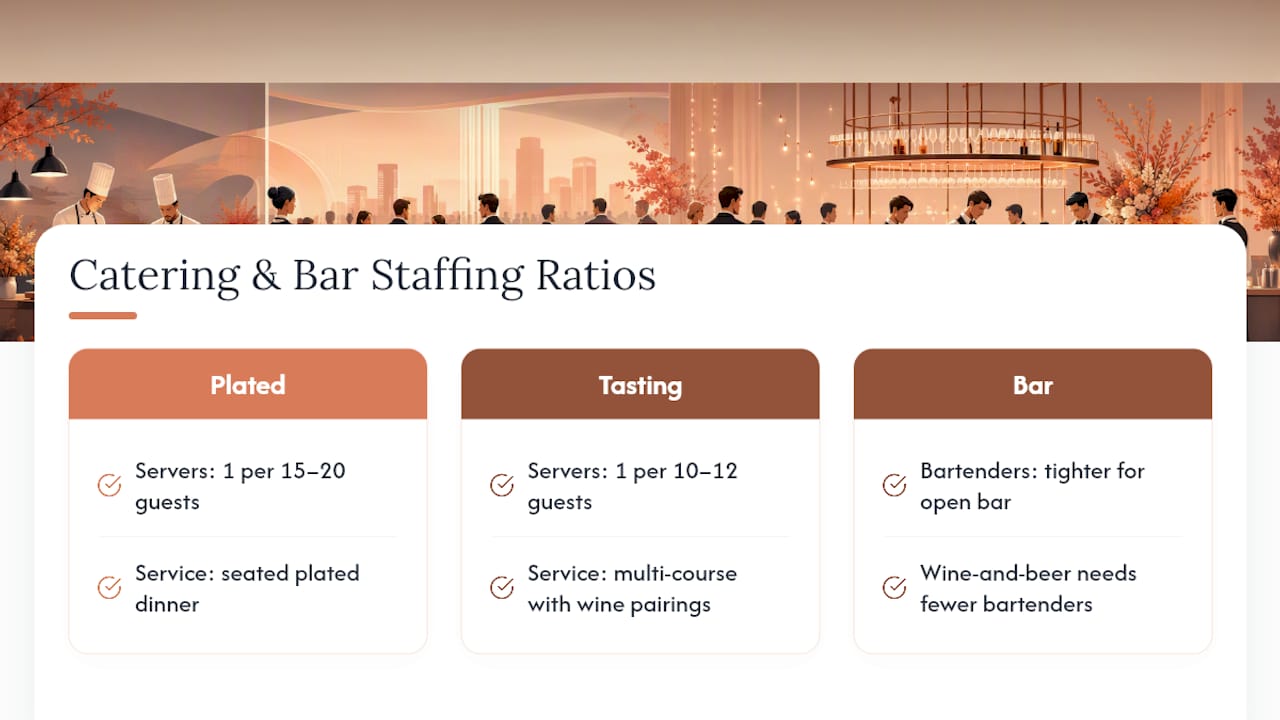
Staffing ratios matter as much as the menu itself. A server ratio of one staff member per 15 to 20 guests works for a seated plated dinner, but drops to one per 10 to 12 for a multi-course tasting menu with wine pairings. Bar staffing follows a separate logic entirely: a bartender-to-guest ratio built for a full open bar during a 90 minute cocktail hour needs to be tighter than one built for a wine-and-beer reception, since cocktail-heavy pours take longer per guest.

Get the catering quote broken into food, bar, staffing, and rentals as separate lines rather than one bundled number. That breakdown is what lets you compare vendors honestly and spot where one proposal is quietly underscoping labor to win the bid on price alone.
When The Money Actually Gets Spent
Gala costs don’t land evenly across the calendar, and planning your cash flow around that timing prevents a scramble in the final weeks. Pre-event spend, typically 60 to 70% of the total budget, covers venue deposits, catering deposits, entertainment holds, and the bulk of production and rental contracts, most of which require deposits 60 to 90 days out.
Day-of costs cluster around final headcount adjustments, day-of staffing overtime, and any last-minute rentals or floral top-offs, usually landing in the final one to two weeks before the event. This is also when contingency draws are most likely to happen, since it’s when unexpected needs surface, a broken piece of equipment, a weather contingency, an added staff shift.
Post-event costs are the ones planners forget to budget for entirely: final catering reconciliation once actual consumption is tallied, equipment damage assessments, gratuities settled after the fact, and any overtime charges billed after the invoice period closes.
Insurance And Liability Coverage For A Corporate Gala
Most venues require proof of general liability insurance before they’ll release the keys for load-in, and a corporate gala carries risk profiles a standard office event doesn’t. Budget for a general liability policy, typically sold as a one-day event policy when you don’t hold annual coverage, plus liquor liability if you’re serving alcohol, which many venues require as a separate rider even when general liability is already in place.
Costs vary by coverage limits and guest count, but one-day event policies for a few hundred guests commonly run into the low thousands of dollars, and liquor liability adds a separate premium on top. If you’re bringing in outside vendors, particularly entertainment or specialty production crews, confirm each carries their own certificate of insurance naming your organization and the venue as additional insured. A missing certificate two days before load-in is a solvable problem that becomes an unsolvable one on event morning.
Build the insurance line into your budget as a fixed cost early, since it’s one of the few categories that doesn’t scale meaningfully with guest count but absolutely gates your venue access if it’s missing.
Budgeting For Marketing And Promotion
Marketing rarely gets its own serious line item on a corporate gala budget, and that’s a mistake, because a gala with weak promotion undersells even flawless production. Plan for physical collateral, save-the-dates, printed invitations, and on-site signage, alongside digital promotion if the event has any public-facing sponsorship component that benefits from visibility.
That share climbs if the event includes any ticketed public component or if sponsors expect measurable digital promotion as part of their package, in which case digital ad spend and content production should be scoped as a distinct sub-line with its own owner.
Don’t let marketing collateral become an afterthought funded from whatever’s left in decor. Price it as its own line during initial budgeting, since printed materials and signage often carry rush fees that erase any savings from waiting.
Transportation And Lodging For Guests And VIPs
Guest transportation and VIP lodging are two of the most variable lines on a luxury gala budget, and they scale with the guest list’s composition, not just its size. A gala drawing local corporate attendees needs modest shuttle or valet budgeting. One flying in executives, board members, or celebrity talent needs a materially different plan.
Budget separately for guest shuttles between a hotel block and the venue, valet service at the venue itself, and dedicated car service for VIP arrivals who shouldn’t be waiting in a shuttle line. Lodging costs apply when you’re hosting out-of-town guests, speakers, or entertainment, and should include room blocks negotiated in advance rather than booked at rack rate closer to the event.
Coordinating corporate travel logistics for a guest list that includes flown-in executives or talent adds real complexity, since flight schedules, ground transportation, and lodging all need to sync with the event timeline rather than operate as separate bookings.
What Decor And Theming Actually Cost
Decor is the category most planners overestimate before they build a real budget and underestimate once rentals, labor, and strike costs get added in.
That share rises fast with immersive theming, custom fabrication, or floral installations at scale, since labor to install and strike elaborate decor often costs as much as the materials themselves. Get decor quotes broken into rental fee, floral and design labor, delivery, installation, and strike as separate lines, since strike costs in particular get missed when a proposal only quotes the “day-of look.”

Theme-driven galas also carry a hidden cost in coordination time. A cohesive theme across signage, tableware, lighting, and staging requires more design hours upfront than a classic black-tie aesthetic, and that design labor should show up as its own line rather than getting absorbed into a vague “styling fee.”
Budgeting For Guest Gifts And Giveaways
Gifts and giveaways sit at the bottom of most gala budgets in dollar terms but carry outsized weight in how guests remember the event. A thoughtful, well-curated gift often costs less than a mediocre one bought in bulk, and it’s worth allocating that line deliberately rather than defaulting to a generic branded item.
Custom or locally sourced items typically cost more per unit than mass-produced branded merchandise, but they align better with a genuinely luxury guest experience and are less likely to end up discarded.
Factor in packaging and delivery logistics as a separate line if gifts are being placed at each seat or shipped to VIP hotel rooms in advance, since white-glove delivery adds cost that a simple table hand-out doesn’t.
Perspective: Why Discipline Is What Makes Luxury Feel Effortless
The instinct is to assume luxury lives in the visible layer: the florals, the tablescape, the entertainment. It doesn’t. It lives in the rigging that never fails, the labor that shows up rehearsed, and the contingency reserve nobody touched because nothing went wrong. That invisible infrastructure is what guests actually feel, even when they can’t name it.
Treat your budget as a governance tool, not a spending cap. A locked baseline and a disciplined contingency policy don’t restrain the guest experience. They’re what protect it from the one unplanned failure that would otherwise be visible to everyone in the room.
— Bonnie Rae
Full-Service Production That Keeps Your Budget Locked
A DIY approach to a corporate gala means juggling separate contracts with a venue, a caterer, a production house, and a staffing agency, each with its own change-order process and its own opportunity to quietly inflate your forecast. Bonnie Rae runs venue scouting, catering, production, staffing, bar and sommelier programs, and hospitality design as one coordinated contract, which means scope changes get caught and priced before they become surprise invoices, not after.

That single point of accountability is what protects your contingency reserve in practice, not just on paper. When one team owns venue, catering, and production together, there’s no gap between vendors for costs to fall through, and no finger-pointing when a rigging fee shows up that nobody scoped. Review examples of executed luxury galas in the Bonnie Rae portfolio, or start a conversation about your event at Bonnierae to get a proposal built around your actual guest list and budget, not a generic package.
Recommended
Comments