
3 Priorities Luxury Planners Must Lock for Red Carpet Event Logistics

Every flawless red carpet arrival rests on three operational priorities: precise timing, secure staging with permits locked in, and a trained team who knows their role cold. Miss any one of them and the media-ready moment collapses into gridlock or worse. Book vehicles and production rentals 4 to 8 weeks out, and use the checklists below to execute each priority. This playbook is built from producing arrivals for clients who cannot afford a second take.
TL;DR:
Booking transportation, production rentals, and staffing should be done four to eight weeks in advance to avoid rush premiums and ensure availability.
Proper permits, a designated holding area, carpet dimensions, backdrop size, and lighting setups must be confirmed in writing before event execution.
A meticulous transport plan with layered routes, encrypted manifests, and vetted drivers is critical for secure and smooth arrivals.
Staffing must include a dedicated red carpet captain, talent handlers, photographers, security, and support staff, with ratios adjusted to event scale.
Rehearsals should test contingency routes and equipment to prevent delays or failures on the day of the event.
Table of Contents
What Are the Key Numbers Behind Red Carpet Event Logistics?
Planners taking a first client brief need a fast reference point before quoting anything. Booking windows for premium transport, production rentals, and staffing holds typically run 4 to 8 weeks in advance, and vehicle rates climb sharply the closer you get to the date, according to detailed vendor guidance on awards-season transport.
Budget allocation for a red carpet setup tends to follow a consistent pattern: roughly 30 to 35% goes to carpet and backdrop rentals, 25% to photography and videography, 15% to lighting and technical gear, 15% to staffing and coordination, and about 10% held as contingency.
Before anything else gets scheduled, confirm these six elements exist on paper:
Holding area location and capacity
Carpet dimensions and surface material
Step-and-repeat backdrop placement and sizing
Press line layout and photographer positions
Staging vehicles and driver assignments
Permits filed and approved with local authorities
How Do You Manage Transportation for Red Carpet Arrivals?
Vehicle selection shapes the photo before a single flash goes off. Larger SUVs and vans accommodate entourages and gowns effectively, while sedans and low-profile luxury cars often photograph better for solo arrivals. The decision is not aesthetic alone. A limo’s longer wheelbase can complicate a tight staging lane, while an SUV gives security a faster exit if the crowd surges.
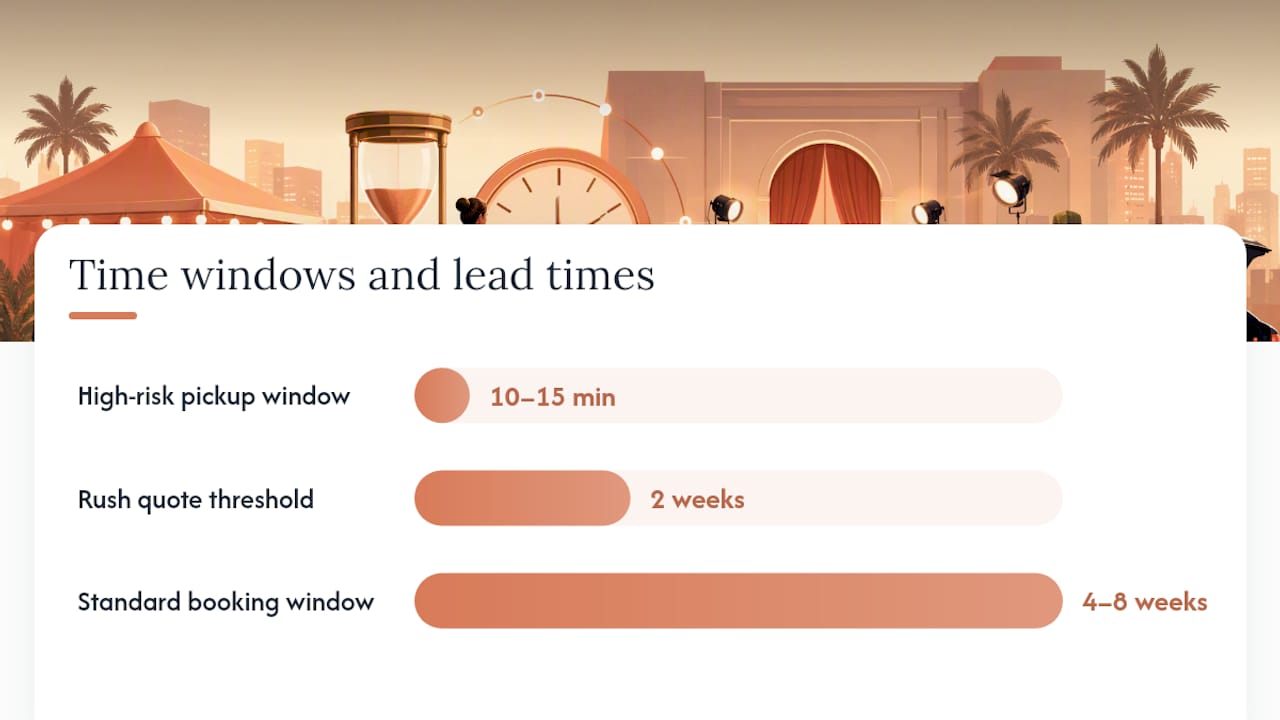
Building the transfer plan means thinking in time windows, not fixed clock times. The multi-stop concierge model recommended by transport specialists uses short 10 to 15 minute windows for high-risk pickups and wider windows where access is simpler, layered with primary, secondary, and tertiary routes in case the lead route closes.
Follow this sequence when building the manifest:
Confirm guest and vehicle count against the arrivals schedule.
Assign primary, alternate, and backup routes for every vehicle.
Issue encrypted manifests with single-use digital tokens rather than shared documents.
Vet every driver and require signed NDAs before the credential is issued.
Rehearse the staging area handoff at least once before doors open.
Rates for premium vehicles rise as the date approaches and 4 to 8 week booking windows are standard for gala-level events, per transport industry guidance. Treat any quote received inside two weeks of the event as a rush premium, not a baseline price.
Pro Tip: Never let a manifest travel by unencrypted text or shared spreadsheet. A single leaked arrival time can draw a crowd that overwhelms your staging lane before the first car arrives.
What Are the Specs for a Proper Red Carpet Setup?
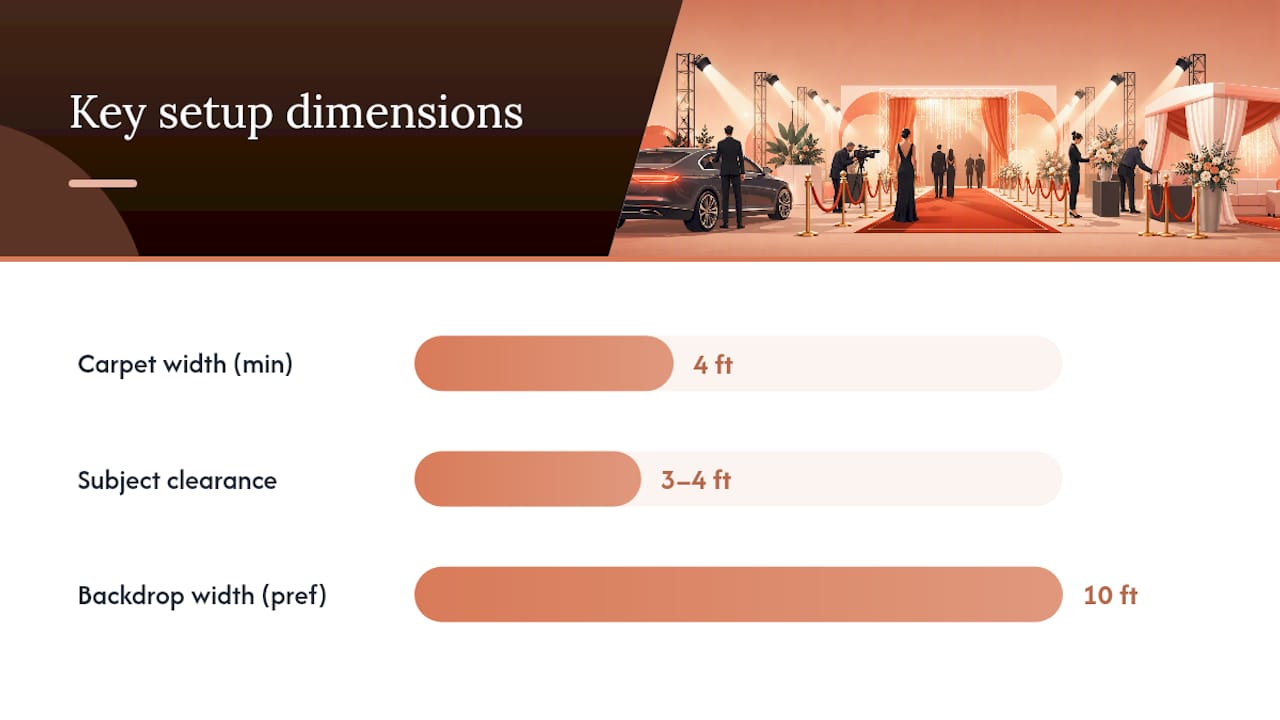
Carpet width should never be below a minimal width, with wider carpets recommended for two guests to walk and pose together comfortably, according to red carpet production specs. Length depends on throughput. A longer runway gives photographers room to shoot walking frames rather than static ones.
Step-and-repeat backdrops perform best at a size roughly around 10 feet wide by 8 feet tall, with smaller sizes acceptable as minimums. Logo spacing on the backdrop should be evenly spaced to prevent cropping in photographs, and subjects need roughly 3 to 4 feet of clearance from the backdrop for a clean camera angle.
Lighting makes or breaks the photography. A three-point setup, key light, fill light, and backlight, keeps skin tones even and shadows controlled. Mixing color temperatures between fixtures is the single most common lighting mistake on outdoor carpets; match every unit to daylight balance or a single warm tone.
Key setup elements to lock in advance:
Carpet width of at least 4 feet for two-person walking
Backdrop sized 8x8 minimum, 10x8 preferred
Logo spacing of 12 to 18 inches on the step-and-repeat
Three-point lighting rig matched to a single color temperature
Photographer positions marked and labeled by outlet
Who Needs to Be Staffed for a Red Carpet Arrival?
A red carpet captain runs the show. That person owns pacing, resolves disputes on the spot, and is the single point of contact for talent handlers and security during arrivals. Every other role reports through that captain.
Red carpet captain: Owns pacing and final call on any delay.
Talent handler: Escorts guests from vehicle to carpet to holding area.
Photographer manager: Assigns and enforces marked shooting positions.
Transport lead: Coordinates vehicle sequencing and driver communications.
Security lead: Manages crowd control and credential checks.
Holding-area attendant: Runs the private space for touch-ups and waiting.
Staffing ratios shift with event scale. Peak arrival windows often require multiple talent handlers to maintain efficient flow, adjusting staffing ratios based on guest count and event scale, with a rotation plan built in for shifts running past three hours so fatigue never touches the carpet. Build a pre-event brief that covers the celebrity tip sheet, the contact cascade, and a final name-check against the master guest list. National’s producers point to holding areas near the carpet as one of the most effective ways to reduce on-carpet congestion, since talent can get a final touch-up privately instead of lingering in front of cameras.
What Permits and Traffic Approvals Does a Red Carpet Event Require?
Getting the street to yourself, even for twenty minutes, takes paperwork most planners underestimate. Follow this order when applying:
File for temporary loading zone permits early, as they often require the longest municipal review time.
Apply for sidewalk closure permits after securing loading zone permits.
Request full street closures only if necessary for guest volume or security, understanding these require longer lead times.
Design your staging buffer to absorb the unexpected. A holding area set back from the carpet, paired with a secondary vehicle lane, keeps the flow moving even when one car runs late. Large-scale productions rely on staged fleets and command centers with tight coordination with municipal transit agencies to manage this exposure, as Hollywood Reporter’s account of major awards-show logistics makes clear. Run a discreet briefing with local police and DOT contacts at least a week out, never the morning of.
How Do You Time and Schedule Red Carpet Arrivals?
Spacing between vehicles should run 60 to 90 seconds for most high-visibility events, with 90 seconds standard practice at Met Gala-level productions where media coverage demands a clean, uninterrupted shot of every guest.
Build in a buffer of 15 to 40% on top of your base transfer time, scaled to traffic density and vehicle type.
Use time windows instead of fixed appointments for every pickup with real traffic exposure.
Rehearse the full timeline the day before the event.
A workable day-of skeleton looks like this: rehearsal the day before, full team brief 3 hours out, staging and equipment check 1 hour out, arrival window open, then a clean extraction plan once the last car clears.
How Do You Plan for Weather and Equipment Failures on a Red Carpet?
Rain does not cancel a red carpet, but it does force fast decisions. Tenting protects the carpet and equipment, though it changes sightlines and can flatten your lighting if the canopy blocks natural fill. Heaters and floor protection matter as much as the tent itself when temperatures drop.
Stage a spare vehicle and a wardrobe van near the holding area.
Carry spare batteries and redundant communications gear for every technical role.
Size generator capacity with real headroom, and route cables away from foot traffic. Generator planning guidance for luxury events covers the sizing math in detail.
Set quick hold points where talent can pause without blocking the carpet if a car is delayed.
For exterior setups, weatherproof lighting rigs and synced audio prevent the kind of technical failure that shows up in every photo. Outdoor lighting and audio-sync guidance is worth reviewing before the final walk-through.
Pro Tip: Test every generator and backup light rig the night before, fully loaded. A cold start on event day is when equipment failures actually happen, not during setup.
What Templates Keep a Red Carpet Arrival Running Smoothly?
Every arrival Bonnie Rae produces starts from the same operational skeleton, adapted to the guest list, venue, and security posture in front of us.
Use a vehicle manifest template that includes primary and alternate routing details
Staging map showing holding area, carpet, backdrop, and press line
Red carpet captain brief with name-check list and contact cascade
Photographer shot list with assigned positions by outlet
Template | What it solves |
Vehicle manifest | Prevents route leaks and last-minute vehicle confusion |
Staging map | Keeps holding area, carpet, and press line from colliding |
Captain brief | Gives one person final authority on pacing and disputes |
Photographer shot list | Reduces disputes over positioning that slow the carpet |
Adapt each template to your guest count and venue footprint before the first rehearsal, not after.
Lessons From Producing Celebrity Arrivals
The rehearsal is where most arrivals actually get saved, not on the night itself. A redundancy built into the transfer plan, a second route held in reserve, has more than once turned a closed street into a two-minute detour instead of a scrapped shot. If there is one habit worth adopting immediately, it is this: never rehearse the plan you hope happens. Rehearse the one where the primary route fails. This kind of scenario planning is worked through carefully before a single guest arrives.
— Bonnie Rae
Planning a Red Carpet Arrival That Cannot Afford a Misstep?
Red carpet logistics can be managed end to end, from transport manifests and permit filings to staffing, staging design, and the final extraction plan, so clients never have to coordinate vendors themselves.

An initial consult starts with your guest list, venue, and media exposure level, and moves into a proposal, a site visit, and a full production plan built around the timing, staging, and staffing priorities covered here. If your event includes hospitality staffing beyond the carpet itself, from butler service for VIP guests to valet operations at the arrival point, that gets built into the same plan. Visit the Bonnie Rae portfolio to see past productions, then reach out through Bonnie Rae to schedule a consult for your next arrival.
FAQ
How Do You Get Invited to a Red Carpet Event?
Invitations typically come through a publicist, talent agency, brand partnership, or the event’s producing organization, and are almost never available for public purchase.
What Are Examples of Event Logistics?
Event logistics covers transportation manifests, permit filings, staging design, staffing assignments, timing schedules, and contingency planning, all coordinated so an arrival runs without visible friction.
What Is a Red Carpet Event?
A red carpet event is a staged public arrival, typically for a premiere, gala, or awards show, where guests walk a designated carpet past photographers and media before entering the venue.
How Much Does It Cost to Go to a Red Carpet Event?
Attendance cost varies enormously by event and access level; production costs for the carpet itself follow a rough budget split of 30 to 35% for rentals, 25% for photography, 15% for lighting, 15% for staffing, and 10% for contingency.
Recommended
Comments