
Private Chef vs Catering: Which Fits Your Next Event?

For intimate, experience-driven dinners under roughly 30 guests, a private chef usually delivers more value per dollar; for larger events where logistics and consistency matter most, catering is the practical choice. Budgets overlap in the middle, and hybrid formats (a chef supported by service staff) solve most in-between cases. Use the checklist below to match your guest list and vision to the right model.
TL;DR:
Private chefs are ideal for small groups of 2 to 20 guests, offering fully customized menus and on-site cooking, usually at a higher per-person cost.
Caterers are better suited for larger events exceeding 40 guests, providing off-site prep, transport, and a full service team at a lower per-person price.
Small groups with complex dietary needs benefit from a private chef’s direct control, while larger events often rely on caterers’ scalability and equipment.
Booking lead times for private chefs range from one to four weeks, whereas caterers generally require two to twelve weeks, especially for complex menus.
Memorably, per-person costs decrease as guest numbers grow, with private chef prices typically between $90 and $200, and catering prices from $50 to $150.
Table of Contents
Private Chef vs Catering: A Quick Comparison
The two models solve different problems, and the differences show up long before the first course is plated.
Guest count: Private chefs work best for 2–20 guests, sometimes up to 30; catering scales efficiently past 40–50.
Price shape: Private chef pricing runs roughly $90–$200 per person for small groups; catering runs $50–$150 per person and drops further as headcount rises.
Customization: A private chef builds one bespoke menu around your table; caterers typically offer package menus with limited substitutions.
Staffing: Private chefs often work solo or with one assistant; caterers arrive with a full service team.
Cleanup: Both models typically include cleanup, but caterers often bring it as a line item rather than an assumption.
Lead time: Private chefs need less runway than full catering operations for large events.
The practical takeaway: smaller, personal, and flexible favors a chef; bigger, standardized, and predictable favors a caterer.
Private Chef vs. Caterer: What Each Actually Does

Private chef vs catering isn’t just a pricing question. It’s a question of who touches your food, where, and how much control you keep over the experience.
A private chef cooks on-site in your kitchen, and the role typically covers:
Menu design built around your preferences, allergies, and occasion
Grocery shopping and sourcing, often same-day for peak freshness
Live cooking, plating, and tableside presentation
Post-dinner cleanup, folded into most standard packages
A caterer prepares food off-site in a commercial kitchen, transports it, and staffs the event. Expect:
Menus drawn from set packages, with some room for tweaks
Transport, chafing equipment, and often a dedicated setup crew
Servers and bartenders available, usually billed separately
Rentals (linens, china, glassware) quoted as add-ons rather than included
Both models routinely add travel fees, gratuity, and specialty equipment rentals as separate line items. Ask for those upfront.
What Private Chef and Catering Costs Typically Look Like
Cost is where most hosts get surprised, mainly because per-person pricing behaves in reverse of what feels intuitive: smaller groups pay more per head, not less.
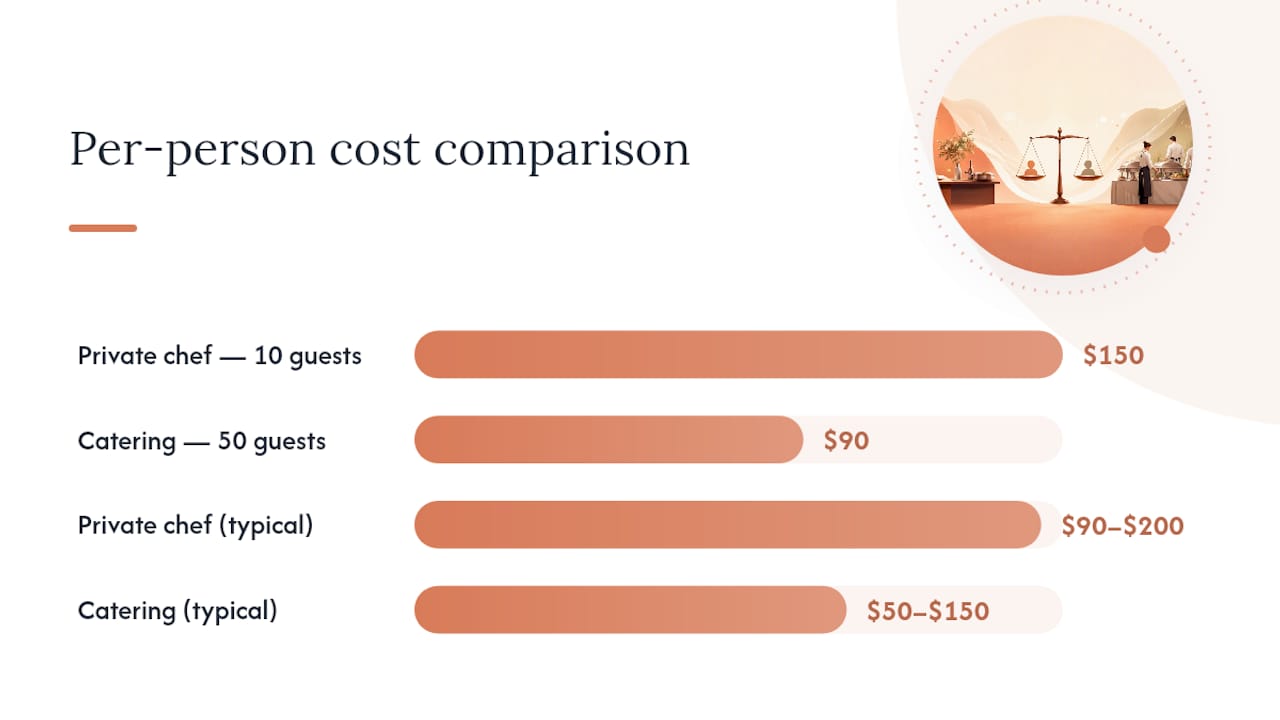
Private chef packages commonly land between $90 and $200 per person for intimate groups, since fixed costs (chef time, sourcing, planning) get spread across fewer plates. Full-service catering typically runs $50 to $150 per person, with the lower end reserved for larger, simpler menus.
Build your budget around these line items:
Chef or catering base fee
Groceries or food cost (often separate from labor)
Additional staff: servers, bartenders, kitchen assistants
Rentals: tables, linens, glassware, specialty equipment
Gratuity and travel fees
Worked example: A 10-guest dinner with a private chef at $150 per person runs about $1,500, plus groceries and gratuity. The same host booking catering for 50 guests at $90 per person lands near $4,500 total. That’s about $90 per head instead of $150, largely because fixed planning and labor costs stop scaling linearly once a caterer’s kitchen and crew are already committed to the event.
Which Guest Counts Suit Each Option?
Guest count is the fastest filter for this decision, and the ranges are fairly consistent across the industry:
2 to 20 guests: A private chef fits naturally, especially for plated, multi-course dinners meant to feel personal.
20 to 40 guests: This is hybrid territory. A chef paired with one or two service staff can still deliver a bespoke menu without overwhelming a solo cook.
40+ guests: Full catering becomes the practical choice, particularly for buffets, stations, or passed hors d’oeuvres at cocktail-style events.
Format matters as much as headcount. A seated, multi-course dinner leans toward a private chef even at the upper end of the range; a standing reception with rotating bites leans toward catering almost regardless of size.
Staffing, Equipment, and Venue Logistics to Confirm
Before booking either option, audit your kitchen: oven and burner capacity, counter space for plating, and refrigeration for a multi-course menu. Some private chefs travel with induction burners or extra equipment, but many rely entirely on what your kitchen already offers.
Caterers solve this differently. They often arrive with mobile kitchens, warming equipment, and their own refrigeration, which is precisely why they scale better for larger, more complex events.
Confirm whether cleanup is included or billed separately
Ask how many staff will be on-site, and in what roles
Clarify who supplies rentals: linens, chairs, glassware, service ware
Pro Tip: Always request a Certificate of Insurance naming you as additional insured before signing with either a private chef or a catering company. It’s a five-minute ask that protects you if anything goes wrong in your home or venue.
How Each Handles Dietary Restrictions and Custom Menus
A private chef’s biggest advantage shows up here: one cook, one menu, full control. Multiple simultaneous restrictions (gluten-free, kosher, nut allergies at the same table) are far easier to manage when a single chef designs every course around them.

Caterers can accommodate dietary needs too, but usually within the boundaries of their existing package structure. Cross-contamination in a shared commercial kitchen is a real question worth asking directly, not assuming away.
Before booking either option, brief them on:
Every guest’s restriction, not just the host’s
Whether substitutions are cooked separately or adjusted from a shared base
Cross-contamination protocols if anyone has a severe allergy
Booking Lead Times and Contract Terms to Require
Private chef services typically want one to four weeks’ notice for most dates, stretching to four to six weeks around holidays. Catering for larger events often needs two to twelve weeks, depending on guest count and menu complexity.
Booking further ahead almost never hurts. Booking too close to a peak date almost always limits your options.
Before signing anything, require:
A signed Certificate of Insurance naming you as additional insured
Clear cancellation and rescheduling terms
An itemized breakdown of inclusions and exclusions
Written staffing minimums for the event size you’re planning
Your Decision Checklist Before Requesting Proposals
Work through this in order, and you’ll avoid the two most common mistakes hosts make: booking on price alone, or falling in love with a concept before confirming it’s logistically possible.
Define the experience you actually want: intimate and personal, or polished and scaled.
Count your guests precisely, including plus-ones and last-minute additions.
Set a target per-person budget and compare it against realistic ranges for your guest count.
Audit your venue’s kitchen capacity, or confirm the caterer brings their own.
Request itemized quotes, not flat estimates, and require a Certificate of Insurance.
Compare true all-in costs (fees plus rentals plus gratuity), staffing levels, and menu flexibility side by side before you sign.
Why Experience and Certainty Both Matter at the Highest Level
The private chef vs catering question changes shape entirely once security details, athlete nutrition riders, or a sommelier program enter the picture. At that level, the decision is rarely about cost at all. It’s about which model gives you the outcome you actually need.
A private chef creates theater: a chef’s hands moving through a kitchen a guest can see, a tasting menu built around one athlete’s recovery macros, a wine pairing sequenced course by course. That kind of intimacy is nearly impossible to replicate at scale. But full-service production earns its place when certainty matters more than spectacle: 200 corporate guests, a tight run of show, service staff who have worked with your security team before.
What gets underestimated most often is coordination. Culinary planning, beverage sequencing, and staffing cadence have to move together, or the evening feels disjointed no matter how good the food is. That’s the layer most hosts don’t think to ask about until something goes sideways mid-service.
— Bonnie Rae
How Bonnie Rae Brings Both Models Together
Bonnie Rae gives you the intimacy of a private chef and the certainty of full production, without forcing you to choose one and sacrifice the other. Our team handles private-chef experiences, vetted hospitality staffing, sommelier programs, and the insurance and logistics management that most hosts don’t discover they need until mid-planning.

What sets us apart for high-net-worth and corporate clients is the vetting behind every recommendation: chefs, servers, and bartenders who have already worked events at this level, menus built around real dietary complexity, and execution designed to feel effortless from a guest’s seat at the table. We track the luxury hospitality trends shaping what today’s guests expect, so your event never feels dated the moment it starts.
If you’re planning a private dinner, a milestone celebration, or a corporate gathering that needs to run without a single visible seam, start a conversation with our team or browse our portfolio of past productions to see the range of experiences we’ve brought to life.
Sources
Recommended
Comments