
What a Private Chef Dinner Actually Costs in the U.S.

A private chef dinner for four to twelve guests typically totals $500 to $2,400, with the spread driven by one simple mechanic: a fixed chef fee gets divided across however many people sit at the table; for guidance on how guest numbers and tablescaping choices affect hospitality costs, see Luxury Hen Party tablescape ideas on a budget. For a party of eight to ten, national mid-range pricing lands around $110 to $160 per person, while an intimate dinner for two often runs higher per head, since the same labor and travel costs apply regardless of headcount.
Dinner for two: often $150 to $300+ per person, since the chef’s flat fee has nowhere to spread
Dinner for 8 to 10: roughly $110 to $160 per person, or $1,100 to $1,600 total
Premium or tasting-menu experiences: $300 to $500+ per person for chefs with notable credentials
Quick figure: A mid-size dinner party (four to twelve guests) commonly totals $500 to $2,400, split between labor ($300 to $1,200) and groceries ($100 to $600).
Key Takeaways
A private chef dinner in the U.S. typically costs $500 to $2,400 total for four to twelve guests, with per-person pricing falling as guest count rises because the chef’s fixed fee spreads across more plates.
Point | Details |
Know your baseline range | Budget $500 to $2,400 total for four to twelve guests, or $110 to $160 per person for a group of eight to ten. |
Ask for a line-item quote | Request separate figures for chef fee, groceries, staffing, rentals, and travel before comparing proposals. |
Watch for common exclusions | Confirm whether wine, gratuity, rentals, and sales tax are included or billed separately. |
Budget gratuity separately | Plan for 15 to 20 percent of the total, or a flat $200 to $500 for smaller high-end events. |
Consider full-service production for complex events | Bonnie Rae coordinates private chef experiences alongside staffing, florals, and sommelier programs as one accountable engagement for UHNW and celebrity hosts. |
Table of Contents
How Much Does a Private Chef Cost, Line by Line?
A quote for a private chef dinner isn’t one number. It’s a stack of separate costs, and knowing what belongs in each layer helps you compare proposals fairly instead of just picking the lower total.
The chef fee, sometimes called the labor or service fee, is the largest single line. Freelance event chefs in the U.S. typically charge $500 to $1,500 per day depending on experience, menu complexity, and whether the engagement includes shopping and prep time beyond the meal itself. Groceries usually run $100 to $600 for a mid-size dinner, though that figure climbs quickly with dry-aged beef, fresh truffle, or out-of-season seafood. Staffing for service, plating, and cleanup is billed separately from the chef fee when servers are involved, and rentals such as chafing dishes, specialty glassware, or extra place settings add their own line when your kitchen or dining setup can’t accommodate the menu. Finally, travel and parking costs matter more than most hosts expect, especially in dense urban markets where a chef may factor in tolls, mileage, or a validated parking fee.

Here’s how those categories typically shake out across two common scenarios:
A quote that looks lean often just has fewer categories listed, not lower actual costs. Before you sign anything, confirm whether the figure you’ve been given includes wine, gratuity, rental furniture, and applicable sales tax. Those four exclusions are the most common source of sticker shock once the final invoice arrives, and a reputable chef or event producer will itemize them upfront rather than folding them into a vague “package price.”
What Should You Expect to Pay by Guest Count?
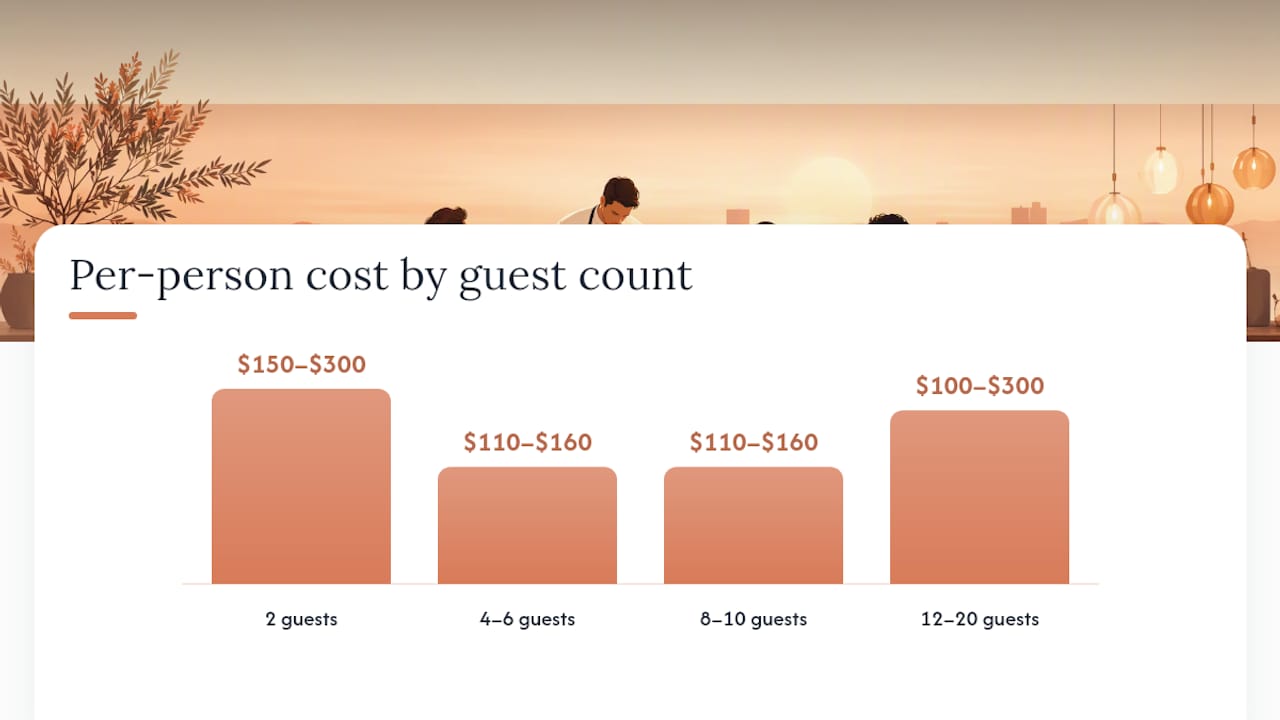
Pricing scales, but not the way most hosts assume. The per-person cost drops as the guest list grows, because the chef’s flat fee and travel time get distributed across more plates. A dinner for two rarely costs half of what a dinner for four costs; it often costs nearly the same in total, which pushes the per-person number up sharply.
Guest count | Per-person range | Typical total |
2 guests | $150–$300 | $300–$800 |
4–6 guests | $110–$160 | $600–$1,500 |
8–10 guests | $110–$160 | $1,100–$1,600 |
12–20 guests | $100–$300 | $500–$1,500 |
For groups of six to twelve, private-chef dinners commonly run $150 to $300 per person at the mid-tier, with premium or Michelin-caliber experiences reaching $500 to $1,500 or more per person once wine and dedicated service are added.
Where you live shapes these ranges considerably. Markets like New York, Los Angeles, and Miami trend toward the higher end of every bracket because of tighter competition for top culinary talent and higher ingredient costs, while secondary markets tend to sit closer to the midpoint of national averages.
Intimate dinners cost more per head because fixed costs (chef fee, travel, setup time) don’t shrink with fewer guests
Group dinners of 12 or more can introduce staffing tiers, which raises the ceiling even as the per-person average moderates
Holiday dates and weekend evenings often carry a premium regardless of city
What Factors Actually Move Your Final Price?
Two dinners with the same guest count can land $1,000 apart, and the gap almost always traces back to a handful of controllable decisions.
Menu complexity is the biggest lever you hold. A seasonal, locally sourced three-course menu costs meaningfully less than a five-course tasting menu built around wagyu, foie gras, or imported seafood. Chefs price using what amounts to a six-factor model: guest count, menu complexity, service format, staffing needs, location and logistics, and duration, and menu choice is where most of that variance originates.
Service format matters just as much. A chef-only arrangement, where the host and family handle plating and clearing, costs less than a full-service setup with dedicated servers and a sommelier managing wine pairings. Staffing ratios shift the price directly: one server per eight to ten guests is standard for a seated dinner, and adding a second server for a larger party is a real, line-itemized cost increase.
Logistics round out the picture. A chef working in a fully stocked, professional-grade kitchen charges less implicitly than one who has to bring induction burners, extra prep tables, or specialty equipment because your kitchen can’t support the menu. Holiday dates, last-minute bookings, and any request requiring a special permit (open flame, outdoor cooking stations) typically carry a surcharge.
Pro Tip: Ask your chef which three ingredients on the proposed menu are driving the highest cost. Swapping even one, say A5 wagyu for a dry-aged domestic cut, can shave hundreds off the total without touching the guest experience.
Per Person, Flat Fee, or Hybrid: How Are You Actually Being Billed?
Private chefs generally price their services one of three ways, and knowing which model you’re looking at changes how you should read the number.
Per-person pricing is most common for dinners with a set headcount and a fixed menu. It’s straightforward to compare across chefs but can understate the impact of a last-minute guest-count drop, since the fixed costs don’t scale down proportionally.
Flat or event fees cover the chef’s time and a defined scope regardless of small headcount changes. This model suits hosts who want budget certainty and expect the guest list to shift slightly before the event.
Hybrid pricing combines a base event fee with a per-person grocery or ingredient charge. It’s increasingly common for menus with expensive proteins, since it protects the chef from ingredient-cost volatility while keeping the labor portion predictable.
Grocery costs are usually handled one of two ways: either the chef fronts the shopping and bills you afterward with receipts, or you pre-fund a grocery budget before the event. Ask which applies, and get any overage terms in writing.
Beyond the base quote, budget separately for:
Wine pairings ($30 to $100 per person) or a dedicated sommelier ($500 to $1,500)
Additional servers beyond the standard ratio
Rental furniture, glassware, or specialty tableware
Last-minute ingredient surcharges if guest counts or dietary needs change close to the event date
What Should You Confirm Before Booking?
A polished proposal doesn’t guarantee a smooth event. Before you sign, work through this list with your chef or the event producer coordinating the evening:
Does the quote include groceries, or is that billed separately with receipts?
What’s the staffing plan, and does it include setup and cleanup, not just cooking?
What’s the cancellation policy, and is there a deposit or kill fee if plans change?
How are dietary restrictions and last-minute substitutions handled, and at what cost?
Does the chef carry liability insurance, and can they provide references from comparable events?
What kitchen equipment, counter space, and storage does the chef need on-site?
Is there adequate parking or a load-in area for equipment and rental deliveries?
What’s the payment schedule, and is gratuity included or additional?
On tipping specifically, most guides recommend 15 to 20 percent of the total for a strong experience, or a flat $200 to $500 for smaller, high-end events, with cash preferred for direct staff gratuities.
Pro Tip: Request the final guest count deadline in writing. Most chefs lock ingredient orders 48 to 72 hours out, and confirming that window upfront prevents a scramble, or a surcharge, if your list shifts at the last minute.
Where Full-Service Production Changes the Math
A private chef solves the meal. It doesn’t solve the evening. Once you add vendor coordination, a curated wine program, bespoke menu development tied to a brand activation, or nutritional planning for a professional athlete’s team, you’ve moved from booking a chef to producing an event, and the cost structure reflects that shift.
That premium buys specific things: vetted vendor relationships that don’t require the host’s own due diligence, a single point of accountability if something falls through, and a guest experience designed with the same intentionality as the menu itself. For ultra-high-net-worth hosts, pre-event consultations sometimes extend to dietary biomarker planning or a sommelier program built around a client’s existing cellar, work that’s typically folded into event logistics rather than the chef’s line item.
The extra investment in full-service coordination isn’t paying for more food. It’s paying for the certainty that every detail, from the sommelier’s pour to the athlete’s macros, arrives exactly as promised.
Bonnie Rae’s work in this space draws on the same trends shaping luxury hospitality in 2026, where guests increasingly expect an evening that feels authored, not assembled. The portfolio reflects how that coordination shows up in practice, from brand installations to athlete team dining.
The Line-Item Approach Beats the Ballpark Every Time
Most advice on this topic stops at a national average, and that’s where it falls short for the audience actually asking this question. A single number tells you almost nothing about whether your dinner should cost $800 or $3,000, because the honest answer depends on menu complexity, staffing depth, and how much coordination happens before the chef ever walks in the door.
The judgment worth taking from all of this: budget by line item, not by headline figure. Ask for the breakdown before you ask for the total. A chef or producer who itemizes groceries, labor, staffing, rentals, and travel separately is giving you a real quote. One who quotes a flat number with no breakdown is asking you to trust a black box.
For affluent hosts, the real decision usually isn’t “can I afford this?” It’s “am I paying for coordination and access, or just for a meal?” Those are different purchases, and knowing which one you’re making changes what a fair price actually looks like.
A Full-Service Alternative to Piecing It Together Yourself
Coordinating a private chef, a sommelier, rental furniture, and service staff as separate vendors means you’re the one absorbing the risk if any piece falls through. Bonnie Rae removes that risk by producing the entire evening as one coordinated engagement, built specifically for private, celebrity, and corporate clients who need every detail, from menu development to guest experience design, handled by a single accountable team.

That’s the fit for hosts coming from this article: you now know what a line-item quote should look like, and you know the questions worth asking before you sign. Bonnie Rae’s team applies that same level of specificity to full event production, including bespoke private chef experiences, staffing, florals, and sommelier programs, so nothing gets left to a single vendor’s availability on the day of your event. Visit Bonnie Rae to start a conversation about your next private dinner or event, or browse the portfolio for a sense of the scale and detail involved in past engagements.
Sources
Recommended
Comments