
Make 9 Pieces Feel Like 14: Passed Canape Quantities for Luxury Planners
- 15 hours ago
- 7 min read
For most events, plan on 4 to 6 passed canapés per person for a short pre-dinner reception, 8 to 10 for a one to two hour cocktail hour where canapés carry the meal, and 10 to 14 for a longer reception replacing dinner entirely. Adjust upward for alcohol-forward events and downward when a plated course follows.
TL;DR:
For events over two hours, plan on 10 to 14 canapés per guest, with substantial items making up about a third of the total for longer receptions.
Increase your total canapés by 15% to 25% for alcohol-heavy events, and reduce by 20% to 30% if a plated meal or stations follow.
Staffing ratios are crucial, with about one server per 25 to 30 guests, and tray rotations every 10 to 12 minutes to ensure smooth pacing.
Distribute total pieces across 3 to 6 menu items based on expected popularity, not equal division, to avoid over-ordering niche options.
Prioritize staffing, pacing, and menu sequencing over quantity alone to create a perceived sense of abundance, especially at luxury events.
Table of Contents
How Many Passed Canapé Quantities Do You Actually Need?
The math starts with a simple per-hour baseline: 4 to 6 pieces per person, per hour for passed hors d’oeuvres. From there, everything else is a modifier.
Here’s the fast reference:
Short pre-dinner reception (30 to 60 minutes): 4 to 6 pieces per guest
Cocktail hour as the main event (1 to 2 hours): 8 to 10 pieces per guest
Long reception replacing dinner (2 to 4 hours): 10 to 14 pieces per guest, sometimes up to 15
The one-line calculator planners actually use: pieces per person × total guests = total pieces needed. For 60 guests at a two-hour cocktail reception, that’s 60 × 9 = 540 total pieces.
Sourced Rule of Thumb: Passed appetizers run 4 to 6 pieces per person, per hour, while buffet-style stationary items scale closer to 6 to 8 pieces per person for that same hour. Passed service uses less food to create the same sense of abundance, which matters when you’re managing both a budget and a guest experience.
What Determines Your Canapé Count By Event Type?
Event duration and purpose drive nearly every decision in passed hors d’oeuvres planning. A practical per-person guide breaks this down by role, not just clock time, and that distinction changes everything about how a caterer should build your menu.
Pre-dinner welcome (30 to 60 minutes). Four to six pieces per guest is plenty here, because canapés are a bridge, not a meal. Guests are transitioning from arrival to their seats, and heavier service actually works against pacing. Two or three varieties, mostly cold or room-temperature bites, keep the moment light.
Cocktail reception as the main event (1 to 2 hours). Once canapés are the dinner, guests need 8 to 10 pieces each, with a genuine mix of cold, hot, and one or two substantial items, think a mini lamb chop or seared scallop, that read as more than a bite. Four to five varieties of rotation keeps the menu feeling curated rather than repetitive.
Long reception or cocktail-style wedding (2 to 4 hours). This format needs 10 to 14 pieces per guest, occasionally stretching to 15 for events running past the four-hour mark. Substantial items carry real weight here: sliders, small plates, or a warm risotto bite should make up a third of the total. Five to six varieties, including a sweet bite near the close, keep a long service from feeling monotonous.
Menu mix matters as much as quantity.
What Adjustments Should Change Your Piece Count?
Standard ranges are a starting point, not a finish line. A few variables consistently push totals up or down, and missing them is how hosts end up either overspending or running short at hour three.
Alcohol-heavy events: Open bars and cocktail-forward programs increase appetite and pacing. Bump your total by 15% to 25% depending on bar style and how quickly drinks are served.
Guest profile: Younger crowds, athletes, and guests coming straight from travel or training tend to eat more. Skew toward the higher end of any range for these groups.
Stations or a plated course: If you’re adding a raw bar, carving station, or seated course later, reduce passed pieces by 20% to 30% to avoid overwhelming guests before the main event.
Dietary requirements and buffer: Build in 5% to 10% extra pieces to cover last-minute dietary requests and the inevitable guest who circles back for seconds.
Pro Tip: Never subtract for dietary restrictions without adding equivalent replacement items. A guest skipped twice by the tray is a guest who remembers it long after the event ends.
How Does Service Style Affect How Much You Order?
Passed service, where staff circulate trays through the room, reads as considerably more polished than a stationed display, and it’s not just about aesthetics. Well-executed passed service creates a stronger sense of abundance with fewer total pieces than a self-serve table, because pacing and presence do the work that sheer quantity would otherwise have to do.
Staffing is what makes that possible. Luxury passed service runs on tighter ratios than standard catering:
Servers: Roughly 1 passer per 25 to 30 guests for polished, unhurried coverage. UHNW events often tighten this further for larger rooms or multi-level venues.
Bar staff: Coordinate passer counts with your bartender-to-guest ratio so drink service and food service hit the room in sync, not competing for the same guest attention.
Tray rotation: Rounds should cycle roughly every 10 to 12 minutes, keeping hot items warm and ensuring no corner of the room goes ten minutes without a pass.
When a room feels under-served, the fix usually isn’t more food. It’s an extra rotation or a floater server rebalancing coverage.
How Do You Split Total Pieces Across Menu Items?
Caterers rarely want a single grand total. They want counts by dish, and that means splitting your total across three to six varieties before you submit an order.
The approach that works: rank your items by expected popularity, then weight the split rather than dividing evenly.
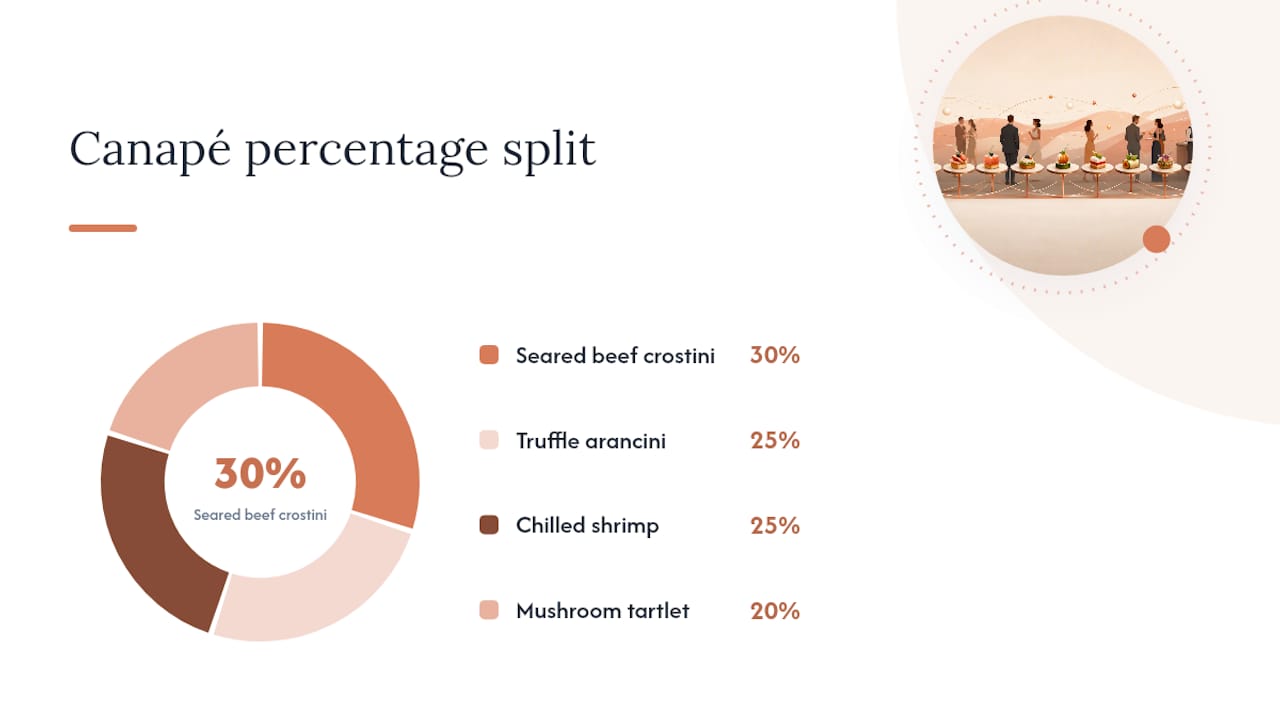
Here’s a worked example for 85 guests at 5 pieces per person, a total of 425 pieces across four items:
Seared beef tenderloin crostini: 30% (128 pieces)
Truffle arancini: 25% (106 pieces)
Chilled shrimp with citrus: 25% (106 pieces)
Wild mushroom tartlet: 20% (85 pieces)
For quick reference across common guest counts at a two-hour reception (9 pieces per person):
When a caterer asks for itemized counts, give them the total first, then the percentage split. That sequence protects you from over-ordering a niche item nobody requests twice.
What Do Luxury Events Get Right About Canapé Service?
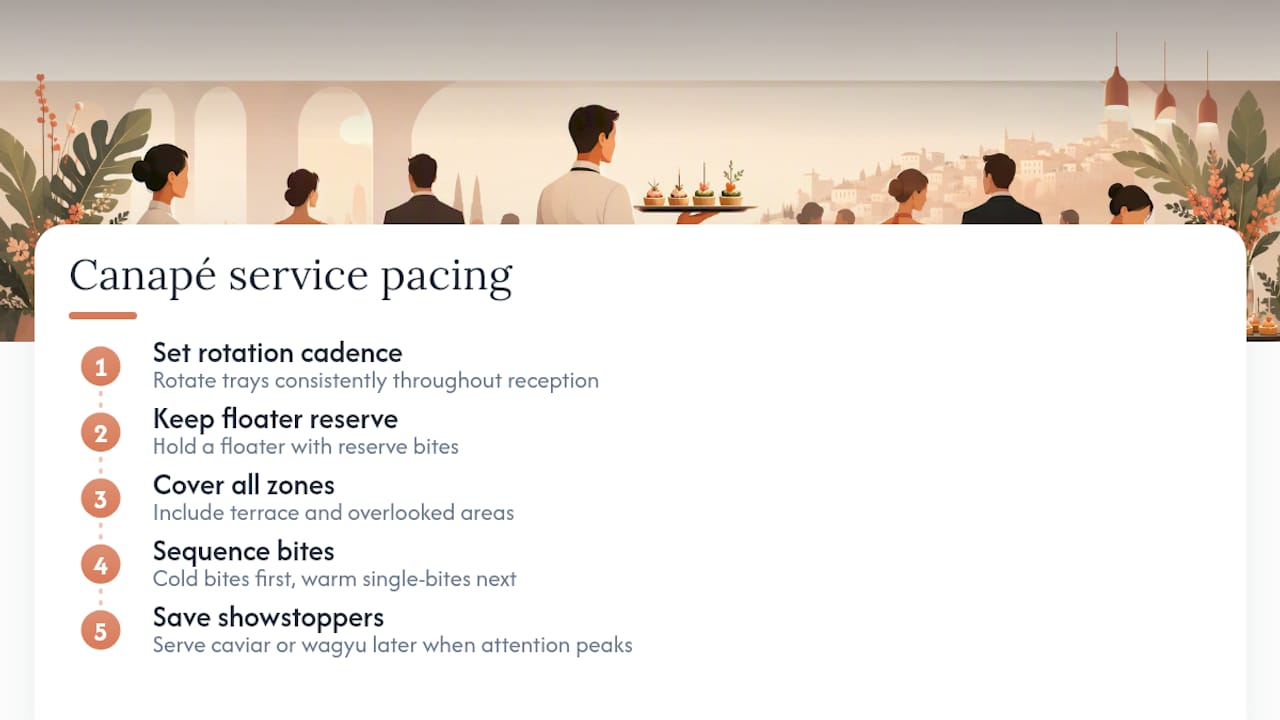
Experienced event producers know the count on the proposal is rarely what makes an event feel generous. Pacing does that. Rotating trays on a consistent cadence, keeping a floater in reserve, and covering every zone of a room, including the terrace nobody expects staff to reach, does more for guest perception than adding another 50 pieces to the order.
Sequencing matters just as much. Lead with cold, elegant bites early when guests are still settling in, then bring warm, single-bite luxury items as the room finds its rhythm. Save anything showstopping, a caviar bite, a wagyu skewer, for the point in the evening when attention is highest.
For events pairing passed canapés with a private chef station or live-action course, the goal shifts from feeding guests to pacing an experience, making family celebration menu planning steps especially helpful for venue hosts. The canapé count becomes a supporting note, not the whole composition.
Pro Tip: Reserve one or two ultra-premium bites for late in the reception, when the room has settled and guests notice quality over quantity.
Why Standard Portion Rules Miss What Luxury Events Actually Need
Most portion guides treat canapé counts as a math problem, and at a basic level, they’re right. But the standard ranges assume average staffing, average pacing, and average guest attention. None of those assumptions hold at a UHNW event, where every guest expects to feel personally attended to, not just fed.
The conventional advice undersells staffing’s role in perceived generosity. A poorly rotated 14-piece service reads as thinner than a well-paced 9-piece one, because guests remember gaps in coverage far more than they count bites. That’s the piece most portion charts leave out entirely.
If there’s one thing to prioritize first, it’s staffing ratio over piece count. Get your passers and bar staff coordinated, build in a buffer for dietary needs, and the per-person number becomes a formality rather than a gamble. Quantity solves an equation. Pacing solves an experience, and for this audience, the experience is the entire point.
— Bonnie Rae
Plan Your Canapé Program With Bonnie Rae
Getting the count right is only half the equation. The other half, staffing ratios, tray pacing, dietary buffers, and menu sequencing, is where most events either land flat or feel effortlessly generous. Some event production companies build full canapé programs for private and corporate clients, handling menu design, server staffing, pacing, and dietary accommodation as one coordinated plan rather than a series of separate vendor decisions.
Event proposals can be bespoke, built around your guest count, venue, and service style, with staffing ratios and dietary buffers priced in from the start rather than added as surprises later. If you’re planning an upcoming reception, request a proposal through Bonnie Rae and get a canapé program sized to your event, not a generic chart.
Sources
Recommended
Comments