
U.S. Luxury Event Production Costs: Bonnie Rae's Per Guest Benchmarks
Luxury event production in the United States typically runs from $5,000 to $30,000 for small corporate gatherings, $37,000 to $175,000 for mid-size programs, and $175,000 to $800,000 or more for large-scale galas and launches, according to Towerhouse Global. Those figures cover production only, not venue rental, catering, or travel. Creative ambition, timeline, and union requirements swing the range far more than guest count alone.
TL;DR:
Larger events with more ambitious design, staging, and technical elements significantly increase costs, especially for scaled-up scenic builds, LED walls, and senior technical leadership.
Creative scope, venue conditions, and union requirements often have a bigger impact on budget than guest count alone, with certain features like custom scenic design and extensive video content raising expenses.
Booking schedules at least four to six months in advance can save 20% to 30% by avoiding peak-season rush pricing and overtime premiums for overnight and last-minute builds.
Vendor choice and scope clarity are critical, as discounts for low bids often hide scope cuts or assumptions that could compromise guest experience or inflate costs later.
Regional market differences and venue-specific constraints can cause significant price variation, with major cities typically costing more than secondary markets due to higher union rates and competition.
Table of Contents
Luxury Event Production Cost by Event Scale
Executives approving budgets need a starting point before they read a single vendor proposal. The table below reflects production-only spending, meaning design, staging, lighting, audio, video, and technical labor, but excludes venue rental, catering, florals, taxes, and travel.
Event Scale | Guest Count (Typical) | Production-Only Range | Notes |
Small corporate event | Under 100 | $5,000–$30,000 | Simple staging, minimal AV, small crew |
Mid-size program | 100–150 | $37,000–$175,000 | Custom lighting, branded environments, multi-camera video |
Large-scale gala or activation | 150–350 | $175,000–$800,000+ | Full scenic builds, LED walls, senior technical leadership |
Launch or festival format | Varies widely | $800,000+ | Multi-day builds, complex rigging, large crews |
These ranges come from Towerhouse Global’s 2026 budgeting benchmarks and align with what Bonnie Rae sees across corporate and private engagements nationally. Production commonly represents 25% to 40% of a total event budget, a share Towerhouse Global confirms holds across scales. That means a $500,000 total event budget might allocate $125,000 to $200,000 to production alone, with the rest going to venue, catering, florals, and staffing.
Knowing when to move between bands matters as much as knowing the bands themselves. Guest count is the obvious trigger. A jump from 150 to 350 guests almost always pushes a program from mid-size into large-scale territory, since crew minimums, rigging points, and power distribution scale in steps, not smoothly. But creative ambition moves the needle just as hard. A 120-guest dinner with a custom scenic build, live orchestration, and a branded LED backdrop can cost more than a 400-guest conference with stock staging and a single screen. Executives who fixate on headcount while ignoring creative scope routinely get surprised by the invoice.
The practical takeaway: use these bands to sanity-check a proposal, not to set a final number. If a vendor quotes $40,000 for what sounds like a large-scale activation, ask what got cut.
What’s Included in a Luxury Event Production Budget?
Every luxury production budget breaks into the same core categories, but the ranges within each one vary enormously depending on creative complexity and venue conditions. Understanding where the money actually goes lets planners negotiate from a position of knowledge rather than guesswork.
Staging and scenic design typically splits into two tiers. Stock staging and rental scenic elements might run $3,000 to $15,000 for a mid-size event, while fully custom scenic builds, think branded environments, bespoke set pieces, or immersive installations, can run $25,000 to $150,000 or more. Custom is worth it when the scenic element becomes the story guests tell afterward; stock staging is fine when the room itself is already the statement.
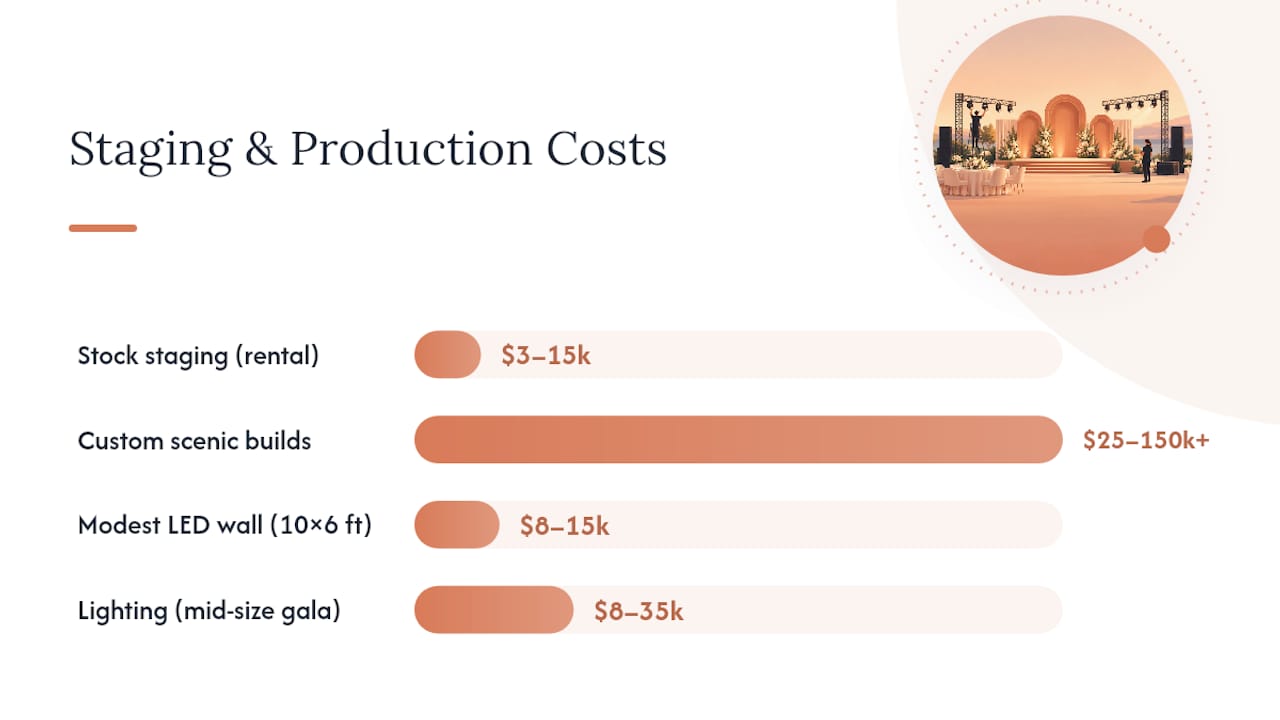
Lighting design carries three distinct cost lines: design fees (the creative concept), equipment rental, and programming labor (the technician who runs the show live). A mid-size gala might spend $8,000 to $35,000 across all three, with programming labor often underestimated by planners who assume the fixtures “just work” once installed.
Audio and sound needs front-of-house (FOH) mixing, monitor systems for any speakers or performers, and redundancy, backup amplification and microphones that never get used but must be present. Skipping redundancy is one of the most common corners cut, and it’s the one most likely to produce a visible failure in front of a room full of executives.
Video, IMAG, and LED walls scale in cost faster than almost any other line item. LED wall pricing runs per square foot of panel plus processing, rigging, and a dedicated video engineer. A modest 10 by 6 footwall might cost $8,000 to $15,000 for a single event; a room-wrapping immersive display can exceed $100,000.
Technical labor covers the humans who make everything function: senior technicians, certified riggers, audio engineers, and per-shift mechanics. Union requirements in many major markets mandate minimum crew counts and shift lengths regardless of show complexity, which is why identical productions can cost meaningfully different amounts in different cities.
Creative services and content, motion graphics, video content, custom animations, typically add 10% to 20% on top of the base production budget, depending on how much original content the program requires.
Experience-critical: lighting design, audio redundancy, senior technical leadership, scenic elements guests physically interact with
Safe to optimize: video content complexity, secondary screen counts, non-visible rigging aesthetics, backstage crew comfort items
Pro Tip: Ask your production partner to flag which line items are “guest-visible” versus “infrastructure.” Guests notice a flickering screen; they never notice whether the rigging truss is painted black or silver. Cut budget from the second category first.
How Much Should You Budget Per Guest for a Luxury Gala?
Bonnie Rae’s internal benchmarks for U.S. luxury galas and private dinners put floral spend alone at $350 to $700 per guest, and production typically adds a comparable or greater amount on top once staging, lighting, audio, and technical labor enter the picture. For a true luxury standard, executives should expect total per-guest costs, florals, production, catering, and staffing combined, to run well into four figures for a 200-guest program.
A sample corporate gala illustrates how this can break down in practice:
Florals and décor: $70,000–$140,000 (based on the $350–$700 per-guest benchmark)
Production (staging, lighting, audio, video, technical labor): $90,000–$160,000
Catering and bar program: $60,000–$120,000
Staffing (service, security, guest experience): $20,000–$45,000
Contingency and pass-throughs: $12,000–$25,000
That puts a 200-guest luxury gala’s total spend, excluding venue rental, somewhere between $252,000 and $490,000, or roughly $1,260 to $2,450 per guest. Raising per-guest spend beyond that typically buys one of three things: a more ambitious scenic environment, live entertainment or performance elements, or a materially upgraded bar and culinary program with named chef talent. Executives should ask which of those three the extra dollars are actually purchasing before approving an increase. For a deeper walkthrough of gala-specific splits, Bonnie Rae’s corporate gala budget guide breaks down each category further.
Why Does Timeline Change Your Production Cost?
Booking a production team four to six months ahead of a peak season date avoids the rush pricing that hits anyone booking inside the 60 to 90 day window before high season, when labor and equipment availability tighten and costs can inflate by 20% to 30%, according to Towerhouse Global. That single scheduling decision often has more budget impact than any line-item negotiation that follows it.
Several structural factors compound the timeline effect:
Rigging approvals require venue sign-off, structural engineering review, and certified rigger labor, none of which happen overnight, and all of which add cost beyond simple equipment rental.
Power planning for large LED walls, kitchens, and lighting rigs needs venue coordination weeks in advance; Bonnie Rae’s event generator power guide covers what to ask a venue before assuming standard power will suffice.
Union labor and load-in windows dictate crew size and shift length in many major markets, and overnight or early-morning builds trigger overtime premiums that can add thousands to a single load-in.
Multi-room or multi-day programs multiply crew, content, and logistics needs. A two-day, three-room activation doesn’t cost twice a one-day, one-room event; it often costs three to four times as much once crew turnover and content variations are factored in.
Primary cost drivers across the industry, venue infrastructure, power and rigging, union requirements, timeline, and creative complexity, consistently show that short-notice bookings and overnight builds strain both labor and logistics. Planners who lock dates early aren’t just securing a venue; they’re locking in pricing before the market moves against them.
How Do You Read a Luxury Production Proposal?
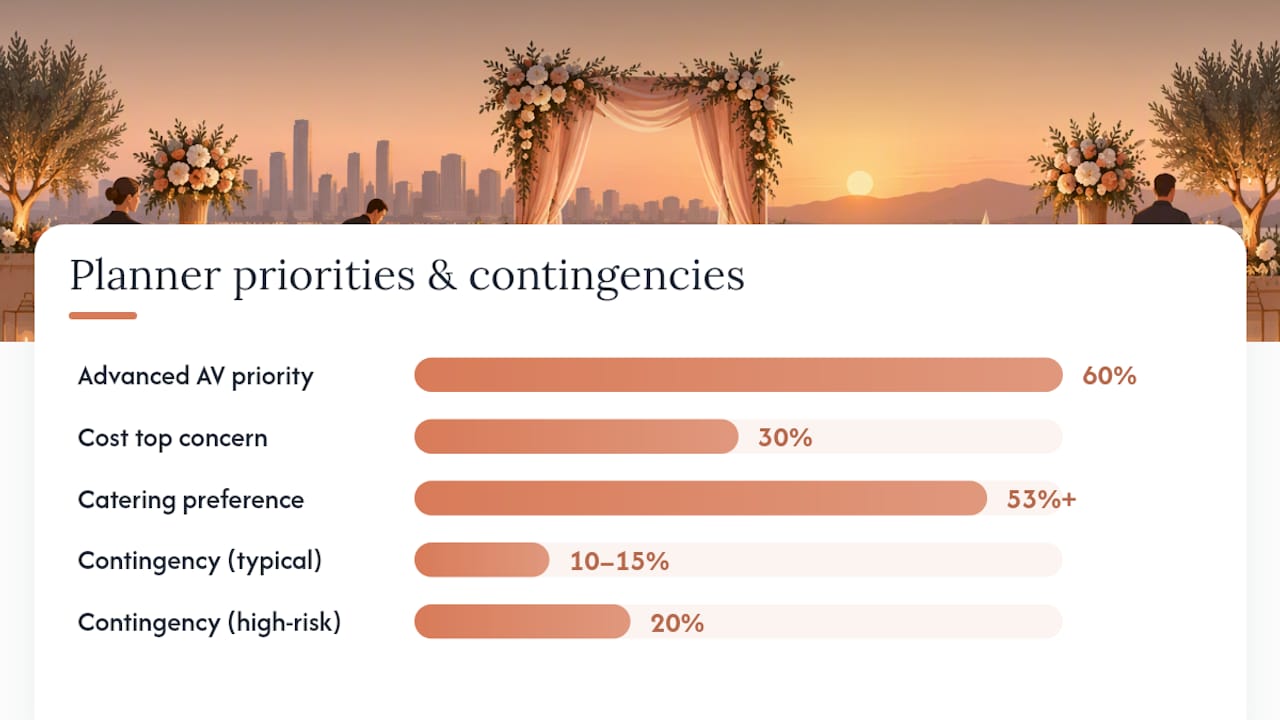
The strongest defense against budget overruns isn’t a bigger contingency fund. It’s a proposal that names every assumption before a contract gets signed. Cvent’s 2025 planner sourcing data found cost was a top concern for 30% of planners, which makes proposal literacy a genuine competitive skill for anyone approving six-figure budgets.
Before signing, confirm the proposal states:
Every assumption behind the number, including guest count, room dimensions, and creative scope as understood by the vendor.
Excluded pass-throughs, internet, security, storage, overtime, and union premiums frequently appear after the initial bid rather than inside it.
Crew-hour math, how many technicians, for how many hours, at what rate, and what happens if load-in runs long.
Power and rigging assumptions, whether the venue’s existing infrastructure is sufficient or additional generators and structural review are needed.
Payment terms and cancellation language, staged payments tied to milestones protect both sides better than a single deposit and balance.
A reasonable contingency for luxury productions runs 10% to 15% of the total production line, and that figure should climb toward 20% for any event involving rigging, outdoor elements, or a first-time venue. On negotiation, the highest-leverage moves are early holds on dates and inventory (locking pricing before peak season tightens), bundling rental categories with a single vendor, and phasing scope so lower-priority elements can be added back in only if budget allows.
Pro Tip: If a proposal doesn’t name a crew count or list rigging and power as separate line items, treat that as a red flag, not a bargain. Vague scopes are where budget overruns hide.
Knowland’s 2025 research backs this up directly: 60% of planners named advanced AV support a top priority, and more than 53% preferred catering proposals that emphasized functionality and hospitality over price alone. Clarity itself has become a signal of quality; vendors who can’t explain their own numbers are usually hiding risk, not savings.
Bonnie Rae’s Take on Setting a Realistic Luxury Budget
Internal benchmarks built across corporate galas, private dinners, and athlete hospitality programs nationwide include the $350 to $700 per-guest floral figure referenced earlier and comparable production splits for 200-guest events. Those numbers hold up because they’re tested against real proposals, not theoretical averages pulled from a generic pricing chart.
The sample gala split outlined above, floral, production, catering, staffing, and contingency landing between $252,000 and $490,000, reflects what leadership teams should expect to see when a proposal is built correctly. Before approving any luxury production budget, executives should confirm three things: the proposal names its assumptions, the contingency sits at 10% or higher, and the per-guest total accounts for every category, not just the ones that feel most visible. Bonnie Rae’s event production versus planning breakdown is a useful reference for separating what “production” actually covers before comparing quotes.
Do Luxury Event Costs Vary by U.S. Region?
Yes, and the swing is larger than most first-time luxury hosts expect. Major markets like New York, Los Angeles, and Miami carry higher union labor rates, tighter venue availability during peak social calendars, and more competition for top-tier crews, all of which push production costs toward the higher end of every range discussed above.
Secondary markets often deliver comparable creative results at a meaningfully lower production cost, largely because crew rates and venue exclusivity fees run lower outside the handful of cities where demand is constant. That doesn’t mean secondary markets are automatically cheaper across the board. Rigging-heavy venues, historic properties with strict preservation rules, or locations with limited local crew depth can erase the regional discount entirely once specialty labor has to be flown in.
Climate and season matter too. Outdoor luxury events in regions with unpredictable weather, the Northeast in early spring, the Gulf Coast during hurricane season, often carry a tenting and contingency premium that indoor, climate-controlled venues avoid. Warm-weather markets popular for winter galas, South Florida and the desert Southwest, see their own price compression during peak season for the same reason ski destinations spike in December.
The practical guidance: get at least one production quote calibrated to the actual host city before finalizing a budget built from national averages. A number that looks generous in a national benchmark can fall short the moment it meets Manhattan union rates or Aspen’s winter logistics premium.
Does Vendor Selection Really Change the Final Cost?
Vendor selection moves the final number more than almost any other decision an executive makes after the venue is booked. The same creative brief, handed to three different production partners, can return quotes that differ by 30% or more, not because one vendor is inflating prices, but because each one is pricing a different set of assumptions.
Bundling categories with a single full-service production partner, rather than hiring separate vendors for lighting, audio, video, and staging, typically reduces the number of pass-through markups a budget absorbs. Each specialty vendor in a fragmented approach adds its own markup, delivery fee, and coordination overhead; a single point of accountability collapses several of those markups into one negotiated rate.
Negotiation leverage comes from timing more than pressure. Vendors quote their best pricing when they have schedule flexibility, meaning early holds placed four to six months out routinely secure better rates than late requests competing for the same crew during a busy weekend. Staged payments tied to production milestones, deposit, pre-production lock, final balance, give planners more room to catch scope creep before it becomes an invoice.
The clearest red flag in vendor selection isn’t a high price. It’s a low price with no explanation for how it stays low. If a bid comes in well under the ranges discussed earlier in this guide, ask specifically what got removed, crew hours, redundancy, contingency staffing, before assuming it’s simply a better deal.
What Do Premium Extras Actually Cost?
Custom décor, experiential elements, and elevated catering coordination are where luxury events earn their name, and where budgets most often run over without a clear plan. Custom scenic and décor installations, discussed earlier in the staging section, sit at the high end of that range specifically because they’re built once and never reused, unlike rental inventory that vendors amortize across many events.
Experiential elements, interactive installations, branded activations, live culinary theater, carry a cost structure closer to content production than traditional decor. They require design time before the event, technical rehearsal, and often a dedicated operator during the event itself. Partners specializing in decor transformation, like Atlanta Balloon Designer’s corporate gala work, illustrate how a single visual centerpiece can anchor an entire room’s design language without requiring a full scenic rebuild.
High-end catering coordination adds cost in a less obvious place: the coordination layer between kitchen, service staff, and production timeline. A Michelin-caliber culinary program timed against a live program, speeches, entertainment, award moments, needs a production manager who understands both worlds. Misaligned timing between courses and program flow is one of the most common, and most preventable, failures at high-profile corporate galas. Budgeting a dedicated coordination line, rather than assuming catering and production will simply sync on their own, protects the one part of the evening guests remember most.
Protecting the Guest Experience Starts Before the Budget Does
The biggest mistake I see in luxury production budgeting isn’t overspending. It’s under-defining the experience before the numbers get built. When an executive sponsor signs off on a clear brief, what the evening should feel like, what moments matter most, every dollar afterward has a purpose to serve.
I’ve watched a single trade-off protect an entire program: cutting a secondary video wall to fund proper audio redundancy for a keynote speaker. Nobody remembered the missing screen. Everyone would have remembered a dead microphone.
Use the checklist and sample budgets in this guide as a starting brief for your own leadership conversation. Getting executive alignment early isn’t a formality, it’s the difference between a production budget that protects the guest experience and one that simply reacts to it.
— Bonnie Rae
Let Bonnie Rae Handle Your Luxury Event Production
Bonnie Rae is the single-partner alternative to piecing together lighting vendors, caterers, florists, and staffing agencies separately for a luxury event. Full event production, private events and catering, professional sports concierge dining, brand installations, staffing, and a dedicated bar and sommelier program all run through one point of contact, which means fewer vendor markups stacking on top of each other and fewer approval meetings competing for an executive’s calendar.
That single-partner structure matters most exactly where this guide spent the most time: rigging approvals, crew-hour math, and pass-through costs that hide inside fragmented proposals. When one team owns the entire production brief, from florals through technical labor, the assumptions in the budget stay consistent instead of getting lost between five separate contracts. The team brings Michelin-level culinary and hospitality talent to Fortune 500 programs, professional athletes, and high-profile private clients across the United States.
If you’re building a budget for an upcoming gala, launch, or private program, visit Bonnierae to start a budget consultation and see how a single-partner approach applies to your specific guest count and venue.
Primary Sources for Luxury Event Production Benchmarks
The cost ranges and industry data in this guide draw from the following primary sources:
Knowland: Meeting Planners Reveal New Opportunities
Conference Innovations: Budget Benchmarking Per Attendee
Sources
FAQ
How Much Does a Party for 50 Guests Cost?
An intimate 50-guest luxury event often costs more per guest than a larger program because venue minimums, crew minimums, and equipment rental fees don’t scale down proportionally. Expect production alone to fall within or above the $5,000 to $30,000 small-event range, with total spend, including catering and florals at the $350 to $700 per-guest benchmark, landing considerably higher.
How Much Do Event Designers Charge?
Event and production designers typically charge either a flat design fee or a percentage of total production spend, commonly landing within the broader 25% to 40% share that production represents of total event budgets. Bonnie Rae’s team provides pricing directly during a project consultation, since fees depend on scope and creative complexity.
How Much Does Event Production Actually Cost?
Production-only costs range from $5,000 to $30,000 for small events, $37,000 to $175,000 for mid-size programs, and $175,000 to $800,000 or more for large-scale galas, according to Towerhouse Global. These figures exclude venue, catering, and travel, which are typically budgeted separately.
What Are the Key Cost Drivers Behind Luxury Event Pricing?
The primary cost drivers are venue infrastructure, power and rigging requirements, union labor rules, timeline, and creative complexity, all of which compound when turnarounds are short. Booking four to six months ahead of peak season generally avoids the rush pricing that can add 20% to 30% to a late-booked production.
Recommended
Comments