
Make Gifts Remembered: Executive Gift Etiquette With Tiered Research
Executive gift etiquette comes down to one principle: give meaning, not spectacle. The right gift for a VIP or executive recipient is personalized, portable or genuinely useful, and discreet enough to protect both parties from unwanted attention. Judge every send against three filters, personalization, usefulness, and privacy, before price ever enters the conversation. Bonnie Rae built the checklists below from years of producing high-stakes hospitality moments, where the wrong gift caused more damage than no gift at all.
TL;DR:
Personalization should connect the gift to a specific shared moment or interest to create lasting memory rather than relying on brand or price.
Research time should be tiered: 30-45 minutes for broader circles, up to 2-4 hours for principal relationships, with direct outreach to gatekeepers for higher tiers.
Budgeting follows relationship importance: modest objects for wider circles, bespoke items or experiences for key relationships, with clear approval and alignment to organizational policies.
Timing and staging of gifts during multi-day events can enhance emotional impact, with personalized notes and discretion guiding delivery logistics.
Avoid gifts that imply obligation, such as branding or cash, especially during negotiations or personal crises, and always confirm gatekeeper approval and policies first.
Table of Contents
What Makes an Appropriate Executive Gift?
The best executive gifts pass a simple test: does the recipient remember the moment, not just the object? A gift that ties to a specific shared experience, what practitioners call memory-locking, outperforms anything chosen for its price tag. Craftsmanship and provenance matter more than logos, and quiet materials read as more considered than obvious branding.
Before you shortlist anything, sort candidates into these categories:
Experiential gifts — private access, a curated dinner, a reserved experience tied to the recipient’s known interests
Bespoke objects — monogrammed or custom pieces with no visible retail branding
Investment-grade items — objects with lasting or appreciating value, from rare vintages to fine craftsmanship
Hybrid packages — a physical keepsake paired with an experience or access
Travel and practical items — anything that solves a real logistical need, like a packing kit or a device the recipient already uses daily
Run three quick checks before finalizing anything: portability (will it clear security or airline screening?), dietary or allergy safety for consumables, and whether the recipient’s organization has an acceptance policy that limits gift value.
How Long Should Recipient Research Take?
Skipping research is the single most common reason a well-intentioned gift misses. Practitioners recommend tying research time directly to the recipient’s tier, since a tiered approach with defined research windows produces measurably better personalization than an open-ended search.
Tier 3 (30 to 45 minutes): Scan recent public statements, a LinkedIn profile, and any press mentions for hobbies or causes.
Tier 2 (60 to 90 minutes): Add a review of recent speeches or interviews, cross-check with gatekeeper notes from prior interactions, and note any dietary or travel patterns.
Tier 1 (2 to 4 hours): Layer in direct outreach to an assistant or house manager to confirm preferences, plus a review of past gifts the recipient has received or mentioned publicly.
Once research is done, write a one-paragraph narrative brief: who the recipient is, the specific moment or detail the gift references, and why that choice fits. That brief should inform every packaging and delivery decision that follows.
Pro Tip: Always confirm delivery logistics with the gatekeeper before you finalize the gift itself. A brilliant object sent to the wrong address, or one that violates a corporate acceptance policy, undoes hours of research in one bounced package.
What Budget Tier Fits Each Relationship?
Budget should follow relationship objective, not the other way around. A tiered gifting program with defined budget bands keeps spend disciplined while still allowing room for the occasional high-touch send that a pivotal relationship warrants. Bonnie Rae’s own gala budgeting work shows that per-guest bands of $350 to $700 can deliver genuine luxury without spectacle when the objective is clear.
Tier 3: A thoughtful, well-packaged object for broader executive circles or lighter-touch relationships.
Tier 2: A bespoke object or a modest experience for active client relationships or repeat guests.
Tier 1: A private experience, hybrid package, or investment-grade object reserved for principal relationships, renewal moments, or milestone occasions.
Escalate to an experience over an object once the relationship reaches a stage where access matters more than acquisition. Any Tier 1 send should carry a sign-off from the account lead before it ships. That approval step is not bureaucracy. It is what catches the gift that reads as generous internally but risky externally.
When Should You Send the Gift and How?
Timing changes how a gift lands. For multi-day events, staged room drops, one gift at arrival, another mid-event, a final one at departure, increase perceived care measurably over a single large gesture. A single delivery moment rarely creates the same emotional arc.
Arrival: A welcome piece tied to travel comfort or the destination itself.
Mid-event: Something smaller and situational, a note or item that references something that happened earlier in the stay.
Departure: The keepsake meant to travel home and be reused, since personalized, destination-connected items that guests actually take home and use again outperform anything purely decorative.
Packaging should stay minimal on branding and heavy on personalization: a handwritten card referencing the specific moment, not a generic thank you. For Tier 1 recipients, route delivery through a confirmed business address or intermediary, and secure written consent from the office before anything goes to a personal residence. Brief couriers on discretion protocols in advance, including who is authorized to hand off the package and what happens if the recipient is unavailable. Reference event valet planning logistics when the handover happens on-site during an active event.
Pro Tip: Never let a courier improvise the handover line. Script the exact phrase they use when presenting the gift, tied to the narrative brief, so the moment lands the way you designed it.

Should You Choose an Experience or an Object?
Experiential gifts win when the relationship has moved past acquisition and into access. A recipient who already owns everything worth owning responds to something they cannot simply buy: a private dinner, a reserved evening, a curated outing tied to a known passion. Object-based gifts still make sense for lighter-touch relationships or when logistics make an experience impractical.
Before booking any experience, run through this checklist:
Confirm host availability and any NDA requirements for private venues
Arrange transportation and confirm dietary restrictions in advance
Build in a privacy buffer, no public guest lists, no unannounced photography
Pair the experience with a small physical keepsake that references it afterward
A hybrid send often outperforms either option alone. A private tasting followed by a bottle from that exact evening, or a yacht-based hospitality experience paired with a custom travel case, gives the recipient something to relive the moment with long after the event ends.
How Do You Protect Privacy Before You Send Anything?
Confirm gatekeeper and public relations policies before a single item leaves the building. Never publicize a gift or the relationship behind it without written consent, no matter how flattering the moment feels.
Watch for these warning signs before you proceed:
Unsolicited delivery to a home address without gatekeeper confirmation
A gift large enough to imply an obligation or favor owed
Visible logos or price signaling that reads as status display rather than thoughtfulness
Any gift that could be misread as a business inducement under the recipient’s employer policy
Estate managers routinely caution that gifts creating a sense of obligation damage relationships faster than no gift at all. When in doubt, route the budget to a donation in the recipient’s name or a credit toward a future engagement instead, and document every approval in writing so there’s a clear record of consent and intent.
Templates Bonnie Rae Uses to Execute Without Missteps
A working narrative brief runs one paragraph: name the recipient, the specific detail or moment the gift references, the tier, and the intended outcome. The account lead signs off before anything moves for Tier 1 sends.
Delivery checklist, in order:
Confirm delivery address and gatekeeper approval
Verify acceptance policy and any dollar-value limits
Finalize packaging with minimal branding and a handwritten note
Lock the delivery window against the recipient’s known schedule
Brief the courier on handover protocol and discretion expectations
Follow up within a week to confirm receipt without prompting a public reaction
Sample note language for Tier 1: “Thinking of the conversation we had about [specific detail] and wanted you to have this.” For Tier 3: “A small note of thanks for [specific occasion].” Both stay short, reference something real, and avoid language that implies future obligation.
Keep every note handwritten, not printed
Reference one specific detail, never a generic compliment
Sign with a name the recipient will recognize, not a company title alone
What Legal and Policy Issues Should You Check First?
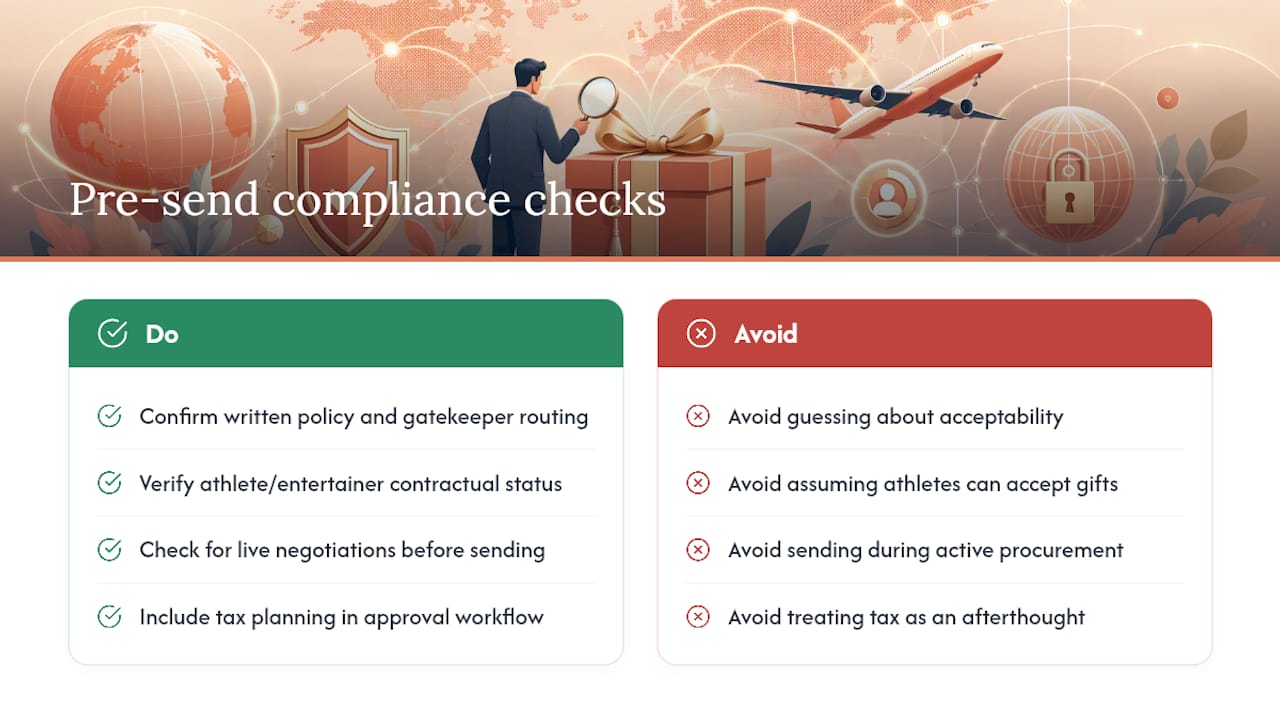
Corporate gift policies vary widely, and the gap between what feels generous and what a compliance team allows can be significant. Many public companies and financial firms cap acceptable gift values for executives and board members, sometimes as low as $100 to $200, and require disclosure above that threshold. Before finalizing any send above Tier 3, confirm whether the recipient’s organization has a written gifting policy, and route the question through the gatekeeper rather than guessing.
Athletes and entertainers often fall under different rules entirely. NCAA-adjacent relationships, endorsement contracts, and league conduct codes can restrict what a player or coach may accept, particularly from anyone connected to a sponsor or event partner. Confirm the recipient’s contractual status before assuming a gift is welcome.
Publicly traded companies also watch for gifts that could be construed as an inducement in a pending deal or negotiation. A beautifully executed gift sent during an active procurement decision can read as an attempt to influence outcome, regardless of intent. When representing a corporate client, ask whether any live negotiations exist before shipping anything of meaningful value.
Tax treatment matters too. In the United States, gifts given in a business context are generally deductible only up to $25 per recipient per year for federal tax purposes, a figure that surprises many event buyers accustomed to thinking in luxury budget bands. That deduction limit does not restrict what you can spend. It only affects what the organization can write off, so build tax planning into the approval workflow rather than treating it as an afterthought.
What Gifts Should You Never Send an Executive or VIP?
Some gifts damage relationships no matter how good the intention behind them. Anything overtly branded with a corporate logo signals a transaction, not a relationship, and reads as promotional rather than personal. Skip it entirely for principal-level recipients.
Cash or cash-equivalent gifts, gift cards included, almost always violate corporate acceptance policies and read as transactional even when policy allows them. Alcohol carries real risk too: sending wine or spirits without confirming the recipient drinks, or without checking a company’s specific restrictions on alcohol gifts to executives, is one of the most common missteps in the category.
Overly personal items, anything touching on appearance, health, or family without an explicit invitation to that territory, cross a line quickly. So does anything that requires the recipient to reciprocate or respond publicly, since that shifts the gesture from generous to obligating.
Timing mistakes compound the problem. Sending a gift during an active negotiation, right before a public announcement, or in the middle of a personal crisis the recipient hasn’t disclosed shows a research gap, not generosity. And perhaps the most overlooked pitfall: sending the same gift to an entire tier of recipients without any personalization at all. It reads as a mail merge, not a relationship, and undercuts the entire premise of executive gift etiquette.
A Practitioner’s Take on Memory-Locking Over Spectacle
Spectacle is easy to buy and easy to forget. What actually moves a relationship is narrative, an object or moment tied to something specific the recipient said or did, revisited months later. In one engagement, a modest, well-timed gesture tied to a detail from an earlier conversation did more to warm a stalled client relationship than any large gift could have. The recipient remembered the reference, not the price.
Research time and documented consent are what protect the relationship long after the gift itself is forgotten. Spend the minutes upfront. Skip the spectacle.
— Bonnie Rae
How Bonnie Rae Handles Gifting for UHNW and Corporate Clients
Executive gift etiquette gets harder to execute at scale, and that’s exactly where a full-service producer earns its place. Bonnie Rae manages the entire arc: recipient research, procurement of bespoke objects or experiences, discreet delivery coordination with gatekeepers and couriers, and post-send follow-up that keeps the relationship on track.

Keeping gifting in-house works fine for occasional, lower-tier sends where one assistant can manage the research and logistics alone. It stops working once you’re coordinating Tier 1 sends across multiple executives, athletes, or celebrity principals at once, each with different gatekeepers, timing windows, and privacy requirements. That’s the volume and complexity such a full-service event production company can handle, alongside broader hospitality production, staffing, and design work behind the events these gifts often support. If you’re planning a bespoke send or an entire hospitality program around a VIP relationship, visit Bonnie Rae’s home page to request a consultation and start the conversation.
Sources
FAQ
What Is the Golden Rule of Executive Gift Etiquette?
Prioritize meaning over price: choose gifts that are personalized, useful or portable, and discreet, and always route delivery through a confirmed gatekeeper.
How Much Should You Spend on a VIP Gift?
Budget by relationship tier rather than a flat number: bands aligning with tiers from a modest object for broader circles to bespoke or investment-grade gifts for key relationships and milestones.
Should You Send a Gift to an Executive’s Home Address?
Only with written consent from the recipient’s office or gatekeeper. For Tier 1 recipients, route the send through a confirmed business address or intermediary instead of a personal residence.
Is It Better to Give an Experience or an Object?
Experiences work best once a relationship has moved past acquisition into access, while objects suit lighter-touch or logistically constrained situations. A hybrid, a keepsake paired with a private experience, often delivers the strongest result.
How Do I Avoid Gifting Mistakes With Corporate Executives?
Confirm the recipient’s corporate gift policy and dollar-value limits before sending, avoid cash equivalents and heavily branded items, and never send during an active negotiation or without gatekeeper approval.
Recommended
Comments