
Start With 3 Numbers: Production Led Caviar Service for Luxury Hosts
- 1 day ago
- 10 min read
For most upscale events, a roaming, butler-led caviar service woven into full production delivers the most reliable luxury moment. Before contacting a provider, settle three numbers: your guest count, the moment in your timeline you want to anchor, and your budget band. Everything else follows from those three inputs.
TL;DR:
Roaming butler service creates more guest engagement and is ideal for small groups during cocktail hours, with a server managing around 15 to 20 guests.
Caviar bar setups require significant space and staffing, making them suitable for brand launches or VIP events, but less practical for tight spaces like yachts.
Budget calculations should be based on grams per guest, with luxury tastings needing significantly more product and staffing, especially for larger, high-end events.
Lead times of two to six weeks are essential to ensure proper cold-chain logistics, staffing, and regulatory compliance, especially for multi-city or destination events.
Presentation techniques such as mother-of-pearl spoons, continuous ice beds, and expert staff elevate the experience, with staff trained on delicate serving methods to preserve roe quality.
Table of Contents
What Are the Best Caviar Service Formats for Events?
The format you choose shapes the entire feel of the moment, not just how the caviar arrives. Each option carries its own staffing footprint, refrigeration demands, and visual payoff.
Roaming butler service (“caviar bumps”): a trained server moves through the crowd offering a single spoon directly to each guest. Minimal footprint, maximum intimacy, and it photographs beautifully. Requires one server per small guest cluster and constant ice replenishment.
Curated caviar bar: a dedicated station with multiple tins, garnishes, and a specialist explaining provenance. Strong visual anchor for a room, but needs real square footage and a supervisor on hand.
Tray-passed canapés: caviar-topped blinis or bites circulated on trays. Fast, efficient, and ideal for large crowds, though it sacrifices some of the theater of tableside service.
Seated tasting service: caviar plated and served at the table, often paired with a sommelier-led wine or vodka flight. The most formal option and the most labor-intensive.
Hand-served bumps and roaming butlers create measurably more guest engagement than a passive station, largely because the interaction itself becomes part of the experience. Photo-forward activations tend to favor roaming service or a bar; formal seated dinners favor tableside plating.
Which Format Fits Which Event?
Matching format to occasion is less about preference and more about what the room is trying to accomplish.
Wedding cocktail hour: roaming butlers work the crowd during the first 45 minutes, before guests settle into dinner. It sets a tone of abundance without competing with the meal.
Brand or product launch: a curated caviar bar anchored near the step-and-repeat gives press and guests a natural photo opportunity. Caviar functions as a focal point that elevates guest perception without requiring a large physical footprint.
VIP corporate hospitality: seated tasting service, paired with a short sommelier introduction, signals exclusivity to a smaller, high-value guest list.
Yacht or private dinner: tray-passed or bumps work best given tight deck space and limited staff mobility.
Position the moment at a program pivot, arrival, the cocktail-to-dinner transition, or a late-night reset, to get the most visibility per tin.
How Much Does Caviar Service Cost for an Event?
Budgeting starts with grams per guest, not dollars. Plan for a moderate amount per person when caviar is the featured tasting, and less for a lighter canapé pass. A VIP reception with a few dozen guests built around a full tasting experience needs a generous amount of product before you account for staff tastings or spillage.
A small VIP tasting for 25 to 40 guests, with one dedicated server and a modest tin selection, typically sits at the lower end of the luxury spectrum. A full evening activation for 150 or more guests, staffed with multiple butlers, a curated bar, and premium tin varieties, climbs substantially higher. Build in a cushion beyond the base gram calculation; a small surplus protects against running short when VIPs return for seconds.
Line items that routinely shift a quote:
Staff minimums (most vendors set a floor of hours regardless of guest count)
Travel and per diem for staff working outside a home market
Specialty or reserve tin selections versus standard varieties
Rental equipment: ice sculptures, chilled display vessels, custom risers
Rush delivery fees for bookings under two weeks out
What Should Be in a Caviar Service Booking Checklist?
Lead time protects quality more than any other single variable. Local events need at least two to three weeks; multi-city or destination bookings deserve four to six weeks so cold-chain logistics can be confirmed in advance.
Cold chain is non-negotiable. Caviar needs to stay within a narrow temperature band from delivery through service, ideally on a continuous ice bed rather than intermittent chilling. When product travels across cities, insist on a named cold-chain manager on the vendor’s team, not just a delivery confirmation email.
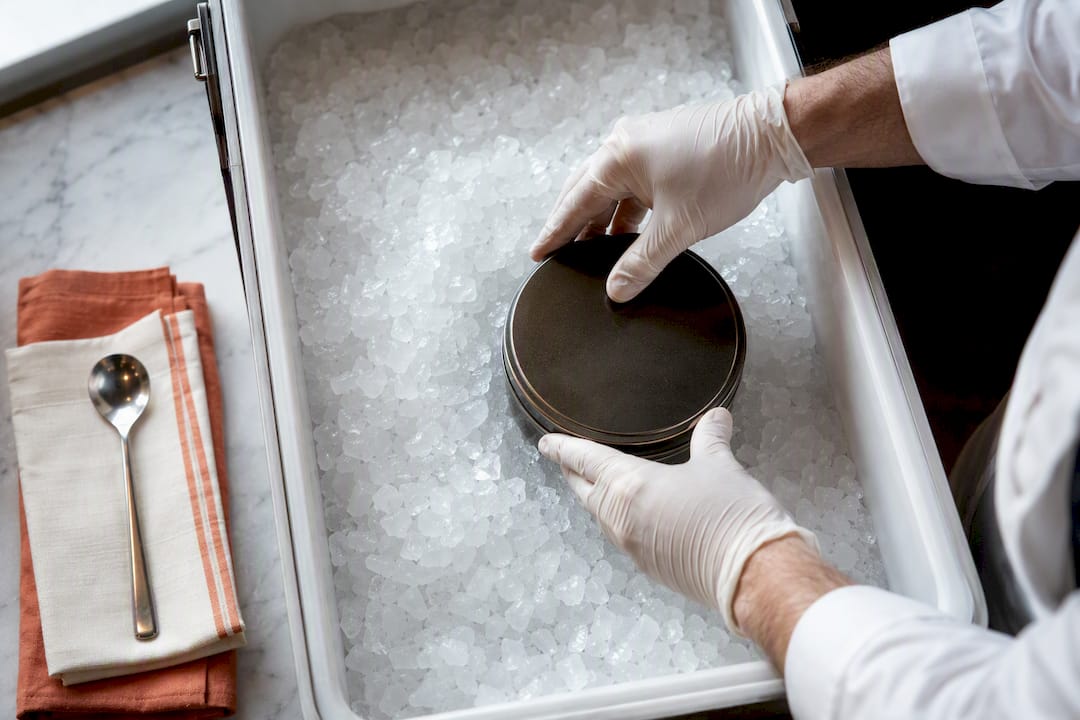
Staffing ratios matter as much as headcount. A single butler can comfortably manage roughly 15 to 20 guests moving through a cocktail hour; a curated bar needs at least one specialist plus a supervisor once the guest list passes 75. Attire should match the room, black tie service whites for formal dinners, sharper tailored looks for brand activations.
Pro Tip: Ask any prospective vendor for a written service choreography plan before you sign, not after. Rehearsed choreography and clear staffing minimums measurably reduce execution risk on high-profile nights when there is no room for a second take.
A tight RFP should include: guest count, venue and its refrigeration capabilities, desired service moment, dietary notes, and budget band. Detailed briefs that specify guest profile and venue capability get more accurate quotes back, faster.
How Should Caviar Be Presented at a Luxury Event?
Presentation is where technique either preserves the product or ruins it in front of your guests.
Mother-of-pearl or bone spoons only; metal reacts with roe and introduces a metallic taste.
Serve from a bed of crushed ice, replenished continuously, never a static ice block that melts unevenly.
Classic accompaniments: blinis, crème fraîche, minced egg, chives, finely diced shallot.
Pairing suggestions: dry Champagne or a chilled, unflavored vodka for tasting service; a crisp Chablis for seated dinners. Bonnie Rae’s guidance on wine pairing for tasting menus applies directly here.
Pro Tip: Train staff on the “gentle lift,” easing the spoon under the roe rather than scooping, so the eggs stay intact and the sheen survives to the guest’s mouth.
Staff demeanor is part of the presentation. A server who can speak briefly about origin and grade turns a bite of food into a moment of hospitality, which is really the whole point of booking caviar service in the first place.
Why Work With a Production Partner for Caviar Service?
A single specialty vendor can deliver excellent caviar. What they usually cannot do is fold that moment into the rest of your event, lighting, floral timing, staff uniforms, guest flow, without a production team coordinating every touchpoint. That integration is where a full-service event production company operates, drawing on the same production discipline behind full event builds for high-end and exclusive clientele.
A production partner handles vendor verification, service choreography rehearsal, and staff training before the first guest arrives, then treats caviar service as one design element among many rather than an isolated add-on. When a full-service event production company quotes a caviar moment, expect a proposal that specifies staffing ratios, gram allocations, cold-chain protocol, and how the service ties into the broader guest journey, not just a per-person food cost.
What Licensing Rules Apply to Serving Caviar at Events?
Caviar itself is not subject to alcohol-style licensing, but it sits inside food safety frameworks that vary by state and by whether the event is at a private residence, a rented venue, or a commercial space. Most jurisdictions require any catering entity handling and plating raw or minimally processed seafood, which sturgeon roe falls under, to operate under a valid food service permit and follow state-level cold storage and handling regulations.
Imported caviar carries an additional layer: sturgeon species are regulated under the Convention on International Trade in Endangered Species, and legitimate importers must document CITES compliance for each shipment. A reputable vendor will have this paperwork available on request. If your event crosses state lines, particularly for destination or multi-city bookings, confirm that the catering team holds the necessary permits in the state where service actually happens, not just where the company is based.
Private residences generally have more flexibility than licensed venues, but many venues require any outside caterer, including specialty food vendors, to carry liability insurance and pass a health department inspection before working on-site. Ask this question early rather than assuming your caviar vendor and your venue’s rules automatically align. A production partner working with venues regularly can often flag these requirements before they become a last-minute scramble.
Where Does Luxury Event Caviar Come From?
Origin matters both for flavor and for the story your service tells. The most sought-after varieties still trace back to specific sturgeon species, Beluga, Osetra, and Sevruga, though wild-caught Beluga from the Caspian is now almost entirely restricted under international trade protections. The overwhelming majority of caviar served at events today comes from farmed sturgeon, raised in aquaculture operations across the United States, France, Italy, and China.
Farming has actually improved both consistency and ethics. Wild sturgeon populations collapsed dramatically across the twentieth century from overfishing, which is precisely why international trade restrictions tightened. Farmed production removes pressure from wild stocks while giving producers control over diet, water temperature, and harvest timing, all of which affect grain size, color, and flavor.
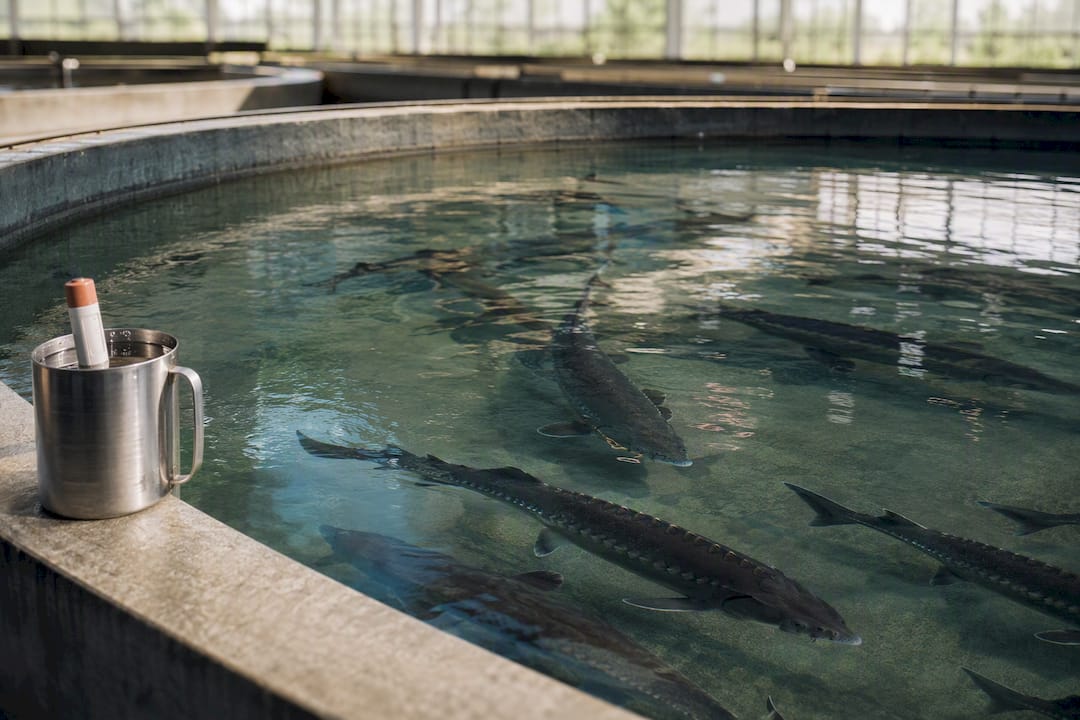
For hosts who want sourcing to be part of the narrative, ask vendors directly about farm origin, harvest method, and whether roe is hand-harvested versus machine-processed. Hand-harvesting, where roe is extracted with minimal stress to the fish and often without killing it in the process, commands a premium but also tends to produce a more consistent grain. This is a legitimate question to put in your RFP alongside gram counts and delivery windows, and any serious vendor should answer it without hesitation.
How Do You Handle Allergies and Dietary Restrictions With Caviar Service?
Caviar sits in the shellfish-adjacent gray zone that trips up a lot of hosts. Sturgeon roe is not a shellfish and does not trigger a shellfish allergy, but it is still a fish product, and guests with fin-fish allergies need it flagged clearly on any menu card or verbal announcement staff make while circulating.
Accompaniments cause more allergy issues than the caviar itself. Crème fraîche and traditional blini both contain dairy and gluten, so any RFP or event brief should note guests with those restrictions in advance. A well-run production team will offer a dairy-free garnish, often a citrus-forward compote or minced egg white, and a gluten-free base, like a delicate potato crisp or cucumber round, without treating it as a special request.
Pescatarian and non-pork dietary needs are worth confirming as well, since some accompaniment recipes use gelatin-based garnishes. Kosher and halal guests may ask about certification on the caviar itself; sturgeon roe processing varies by producer, so this is a fair question to route to your vendor rather than guess at.
The practical fix is simple: collect dietary notes with your RSVP process the same way you would for a seated dinner, then hand that list to your caterer at least a week out so substitutions can be sourced and plated correctly, not improvised tableside.
What Is the Typical Timeline for Booking Caviar Service?
Most caviar service bookings move through four recognizable milestones, and knowing them in advance keeps a busy planner from feeling rushed at any single step.
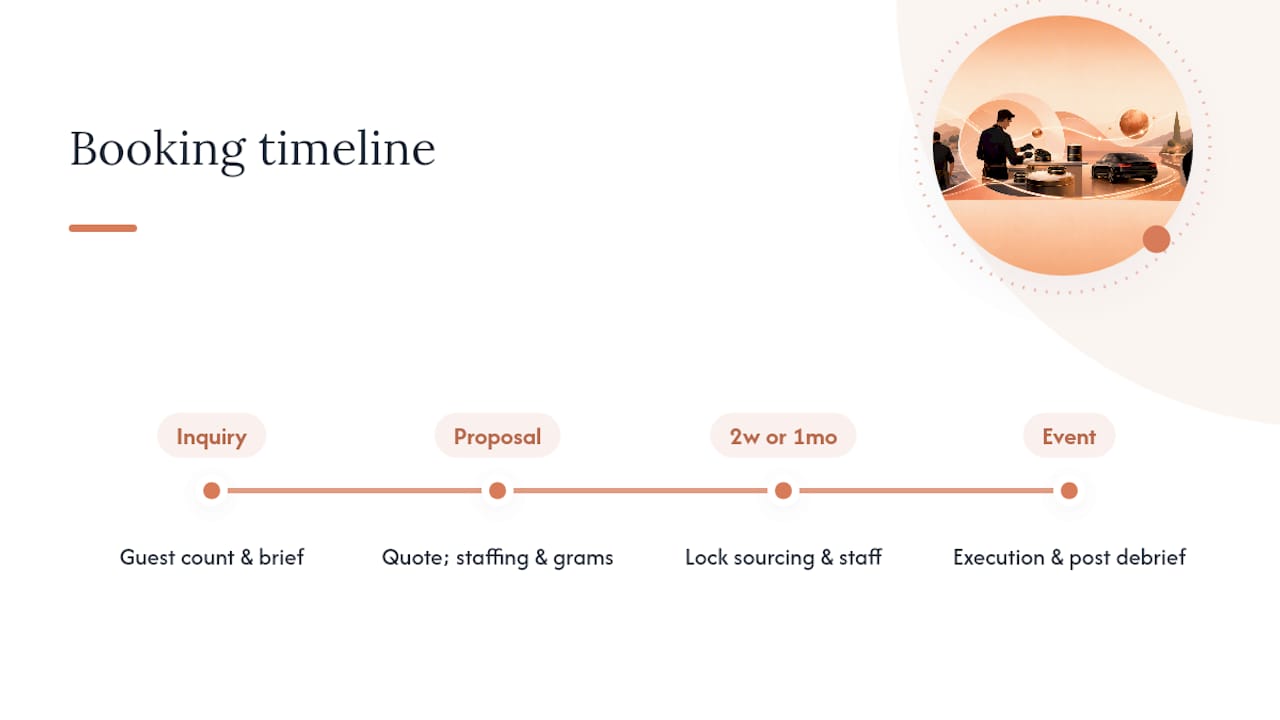
Inquiry and scoping happens first, usually one conversation covering guest count, venue, desired service moment, and budget band. This is where a detailed brief pays off, since vague inquiries produce vague quotes.
Proposal and confirmation follows within a few business days for most vendors, though full-service production partners handling caviar alongside other elements may take slightly longer to build an integrated quote. This stage is where staffing ratios, gram allocations, and cold-chain logistics get finalized in writing.
Pre-event logistics kicks in during the final two weeks before the event, when sourcing, delivery scheduling, and staff briefing all get locked. For multi-city or destination events, this window often stretches to a month to account for shipping and customs where relevant.
Execution and post-event follow-up is the event itself, plus a debrief that a genuinely good vendor will offer whether you ask for it or not. That follow-up conversation is worth having, since it is where you learn what actually landed with guests and what to adjust for next time.
Is Caviar Service Right for Your Event? Three Questions to Ask
Before you brief any vendor, sit with three questions. Who is actually in the room, tastemakers who expect refinement, or a broader crowd who needs an introduction to it? What is the moment supposed to accomplish, intimacy, spectacle, or a photo opportunity? And what is the real budget band, not the aspirational one?
If your guest list is small and discerning, go bigger per person, more grams, better tins, tableside service. If your list is large and the goal is visual impact, focus your spend into one striking activation rather than spreading thin service across the whole room. Either way, a tailored proposal built around your specific numbers beats any generic package.
— Bonnie Rae
Ready to Book Caviar Service for Your Next Event?
Bonnie Rae builds caviar service as one integrated piece of a larger production, not a rented add-on bolted onto someone else’s event plan. That means the same team handling your florals, staffing, and guest flow also choreographs your roaming butlers, curates your caviar bar, and trains staff on the gentle lift technique, so nothing about the moment feels disconnected from the rest of the night.
A proposal request works best when it includes your guest count, venue, the specific moment you want caviar to anchor, and a realistic budget band. From there, Bonnie Rae builds a service plan that accounts for staffing ratios, cold-chain logistics, and how the moment fits into your broader guest experience. Visit Bonnie Rae to start a proposal request for your next private, corporate, or celebrity event.
Sources
Explore staffing details in Butler Service for Events, catering format comparisons in Private Chef vs Catering, and venue strategy from Origins Ranch.
Recommended
Comments