
The Bartender to Guest Ratio That Actually Prevents Long Bar Lines
Aim for one bartender per 50 to 75 guests as your working baseline, tightening to roughly one bartender per 40 to 50 guests when the menu features a full cocktail program, and loosening toward one per 75 to 100 for a beer-and-wine reception. That’s the industry standard bartender to guest ratio, and it’s the number every catering contract, staffing agency, and event production team starts from before adjusting for the specifics of your event.
The right number for your event still depends on a handful of variables that move the baseline in either direction:
Menu complexity. A hand-shaken cocktail with fresh citrus takes far longer to build than a pour of Sauvignon Blanc.
Guest arrival pattern. A cocktail hour with everyone arriving in a 20-minute window needs more hands than a reception with staggered entry.
Bar layout. One centralized bar creates bottlenecks that two or three smaller stations avoid entirely.
Think of this baseline as the first draft of your staffing plan, not the final word. The calculation formula and per-guest-count breakdowns further down let you fine-tune it for your actual guest list.
Key Takeaways
Bartender staffing works best when the 1 to 50/75 baseline gets adjusted for menu complexity, arrival pattern, and layout, then backed by a calculated buffer for peak demand.
Point | Details |
Start with the baseline | Plan for 1 bartender per 50 to 75 guests, tightening to 1 per 40 to 50 for full cocktail menus. |
Calculate, then buffer | Use drinks per guest times guests divided by drinks per bartender hour, plus a 10 to 25% buffer. |
Split stations past 150 guests | One bar station becomes a bottleneck regardless of headcount once guest count climbs. |
Fix workflow, not just headcount | Pre-batched cocktails, extra POS terminals, and clear signage cut wait times without adding staff. |
Luxury events need more than ratios | Bonnie Rae builds beverage programs around beverage captains, mixologists, and wine servers tailored to guest profiles. |
Table of Contents
Bartender to Guest Ratio Chart for Common Event Sizes
Here’s a quick-reference chart for translating guest count into bartender headcount across the three most common bar formats: beer and wine, signature cocktails, and full mixology programs.
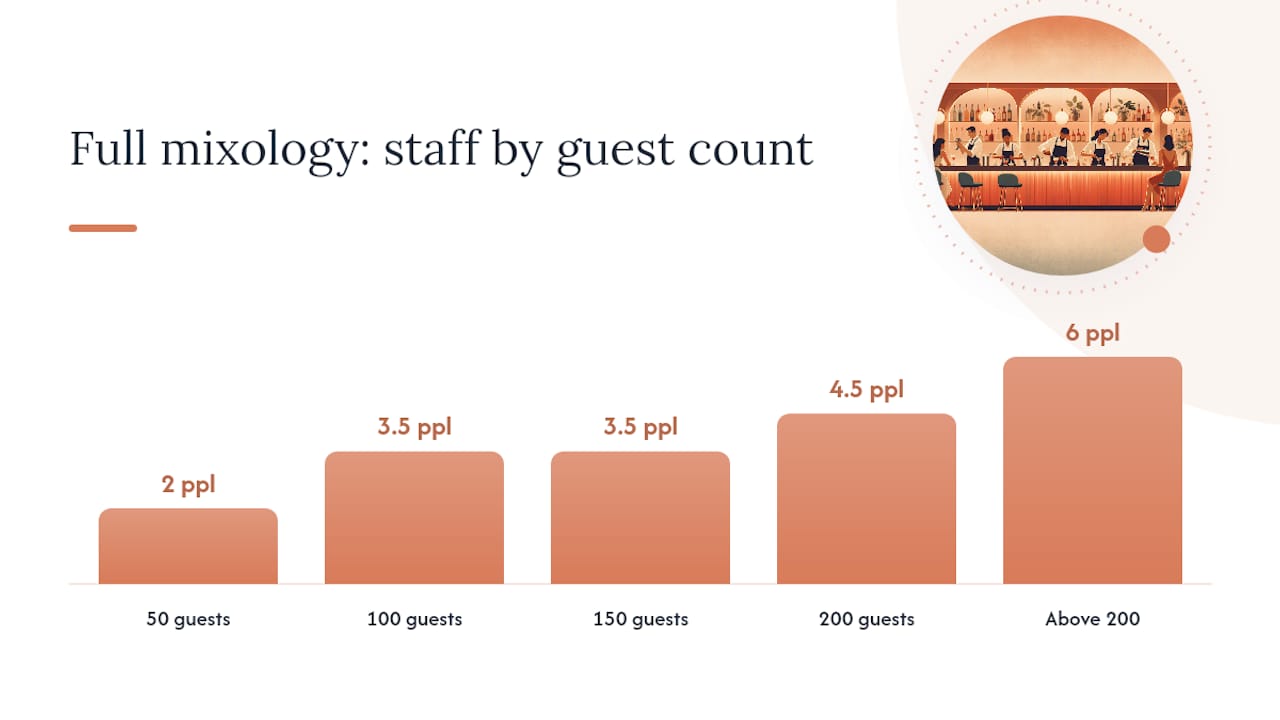
Guest Count | Beer & Wine | Signature Cocktails | Full Cocktail/Mixology |
50 | 1 bartender | 1 bartender | 1 bartender + 1 barback |
75 | 1 bartender | 1 to 2 bartenders | 2 bartenders |
100 | 1 to 2 bartenders | 2 bartenders | 2 to 3 bartenders + barback |
150 | 2 bartenders | 2 to 3 bartenders | 3 to 4 bartenders, 2 stations |
200 | 2 to 3 bartenders | 3 to 4 bartenders | 4 to 5 bartenders, mobile cart |
— | 3 to 4 bartenders | 5 bartenders | 6 bartenders, split stations |
Once you cross the 150-guest mark, a single bar station almost always becomes the bottleneck regardless of headcount, so splitting into two stations matters as much as adding bodies. Above 200 guests, a mobile cocktail cart or satellite station near a secondary gathering area keeps guests from funneling toward one point and forming the kind of line that stalls conversation and photo moments alike.
Staffing Plans for 100, 150, and 200 Guests
Guest count alone doesn’t tell the whole story. Here’s how the ratio translates into an actual working team, plus the drinks-per-hour logic behind each recommendation, grounded in the 2 to 3 minute average service time per drink that studies of bartender workflow have documented.
100 guests, beer and wine: One bartender handles this comfortably if the drink list stays to four or five options; two bartenders eliminate any wait during the first 30 minutes when almost everyone orders at once.
100 guests, signature cocktails: Two bartenders working a curated three-cocktail menu can pour roughly 45 drinks per hour each, enough to clear a cocktail-hour rush without a backup line.
100 guests, full bar: Two bartenders plus one barback restocking ice, garnishes, and glassware keeps pour speed high because neither bartender leaves the well to fetch supplies.
150 guests: Split into two stations at opposite ends of the room. Three to four bartenders total, with one barback per two bartenders, prevents the single-line problem that plagues mid-size events.
200 guests: Four to five bartenders across two or three stations, with a dedicated drink runner delivering to lounge areas, lets you serve a spread-out floor plan without making guests hunt for a bar.
The arithmetic behind these numbers assumes 40 to 60 drinks per bartender per hour for standard pours, dropping toward 30 to 40 when the menu leans heavily on muddled or layered cocktails.
What Changes Your Ideal Bartender Staffing Levels
The 1:50 to 1:75 baseline is a starting point, not a guarantee. Several factors push the real number up or down.
Menu complexity. A four-ingredient stirred cocktail with a citrus twist takes noticeably longer to build than a canned option or a simple gin and tonic, and that time compounds fast at volume.
Guest arrival curve. Events with a hard start time and a single entrance create a rush; staggered arrivals or multiple entry points spread demand more evenly.
Service style. A seated dinner with tableside wine service pulls glassware demand away from the bar, while a standing cocktail reception concentrates it there.
Bar layout. Cramped stations with poor reach-zone design slow every pour, regardless of headcount.
Guest demographics. Younger crowds and events with an open bar tend to generate higher per-guest drink counts than a corporate lunch or a milestone anniversary with an older guest list.
Payment technology. Contactless payment and pre-loaded drink tickets shave seconds off every transaction, and those seconds add up over a three-hour reception.
Pro Tip: *Map your guest arrival pattern before you finalize headcount.
How to Calculate Your Bartender to Guest Ratio
The formula is straightforward: multiply expected drinks per guest by total guests, then divide by drinks poured per bartender per hour.
Estimate drinks per guest. Budget 2 to 4 drinks per guest across a three-hour event, adjusting upward for an open bar with a younger crowd.
Set your pour rate. Use 40 to 60 drinks per bartender per hour for standard cocktails, or 60 to 80 for beer and wine.
Run the math. For 150 guests on a full bar averaging 3 drinks each over 3 hours, that’s 450 total drinks divided by 3 hours, or 150 drinks per hour. At 50 drinks per bartender per hour, you need 3 bartenders.
Add a buffer. Building in a 10 to 25% buffer above the bare minimum absorbs arrival spikes and prevents a line from forming during the first cocktail hour.
Scenario | Guests | Drinks/Guest | Bartenders Needed |
Full bar, 150 guests | 150 | 3 | 3 to 4 |
Beer and wine, 150 guests | 150 | 2 | 2 |
A beer-and-wine reception for the same 150 guests needs roughly half the staff, since pour speed for wine and draft beer runs nearly double that of a mixed cocktail.
When to Add Barbacks, Runners, and Wine Servers
Bartenders pour drinks fastest when they’re not also fetching ice, washing glassware, or delivering trays across the room. That’s where support roles earn their place.
Barback: Restocks ice, garnishes, and bottles; add one per 2 to 3 bartenders once you’re above 100 guests or running a full cocktail menu.
Drink runner: Delivers trays to lounge seating or a garden area, useful whenever your floor plan spreads guests beyond the bar’s sightline.
Wine server: Handles tableside pours during a plated dinner, freeing the bar to focus on cocktail hour and dessert service.
Beverage captain: Supervises pacing, coordinates runners, and watches for over-service, a role especially valuable when VIP guests are on the floor.
POS operator: A dedicated cashier or ticket-taker at a paid or ticketed bar keeps transaction time from slowing every pour.
Tactics That Cut Bar Wait Times Without Adding Staff
You can serve more guests with the same headcount by fixing the workflow around your bartenders, not just the number of them.
Pre-batch signature cocktails. Mixing base spirits and modifiers ahead of time turns a two-minute build into a fifteen-second pour, which is the single biggest lever most events overlook.
Open multiple service points. Two smaller stations or a mobile cocktail cart split demand and shorten every line simultaneously.
Speed up payment. Extra POS terminals, contactless taps, or pre-paid drink tickets remove the slowest part of many transactions.
Pre-pour for toasts and plated courses. Champagne poured and staged before a toast avoids a mid-speech rush at the bar.
Use signage to direct flow. Clear signs for a second bar or satellite station pull guests away from the most crowded point.
Pro Tip: Match your cocktail list to your bartenders’ actual speed, not the most impressive menu you can imagine. A five-cocktail list that takes each bartender 90 seconds per drink will always create a longer line than a tight three-cocktail menu built for a 30-second pour.
How Bonnie Rae Structures Beverage Programs for Ultra-High-End Events
Standard ratios cover the mechanics. Luxury events ask for more. Bonnie Rae builds beverage teams around a beverage captain who oversees pacing and guest experience, mixologists trained in bespoke recipe development for signature cocktails, and, for seated multi-course dinners, dedicated wine servers who handle tableside pours so the bar never competes with the kitchen’s timing.
At events where the guest list includes athletes, executives, or cultural figures accustomed to five-star hospitality, the beverage program isn’t measured by how fast a drink arrives. It’s measured by whether the drink feels like it was made specifically for that guest, at that moment, without them ever seeing the coordination behind it.
Guest profiling, custom drink development tied to a client’s personal taste, and pacing service to match a multi-course dinner’s rhythm all shape how Bonnie Rae staffs a bar, well beyond a generic per-guest formula.
A practitioner’s take on when to spend more on staff
Guest experience justifies extra staffing at VIP, celebrity, and brand-driven events where every pour reflects the host’s standards. For a casual gathering with a simple wine-and-beer menu, a leaner team is entirely reasonable. Either way, responsible, well-paced service matters more than speed alone.
Let Bonnie Rae Build Your Beverage Program From the Ground Up
Running the math on bartender ratios is useful right up until your event involves a celebrity guest list, a custom cocktail menu, and zero room for a line at the bar. That’s where a formula stops being enough. Bonnie Rae designs full beverage programs, mixologists, beverage captains, wine service, and staffing plan included, so you’re never the one calculating drinks-per-hour math the week of your event.
Every program is built around your guest list, your venue’s layout, and the pacing your event actually needs, not a generic staffing chart. Browse the portfolio to see how past beverage programs came together, then reach out through Bonnierae to start a conversation about your event’s staffing plan.
Sources
Recommended
Comments